
Nissan Leaf 2018-2025 (ZE1) Owner's Manual : ProPILOT Assist
WARNING
Failure to adhere strictly to the warnings and operational instructions regarding the proper use of the ProPILOT Assist system in your Nissan Leaf could result in loss of vehicle control, leading to serious injury or death.
- It is vital to understand that ProPILOT Assist is not a self-driving or autonomous system. It is a driver-support technology designed, within specific operational parameters, to assist the driver with certain steering, acceleration, and braking tasks.
- The ProPILOT Assist system is not a substitute for safe driving practices and is not engineered to compensate for distracted, careless, or inattentive driving habits. The system will not always maintain the vehicle's lane position, nor is it designed to prevent a total loss of vehicle control. You remain legally and operationally responsible for staying alert, driving safely, ensuring the vehicle remains within its intended lane, and maintaining full control of the Nissan Leaf at all times.
- ProPILOT Assist has distinct operational limitations. The system is not capable of functioning in all traffic, weather, or road conditions. It is your sole responsibility to continuously monitor your surroundings and remain prepared to take manual control of the vehicle instantly if the system’s performance becomes insufficient.
- The ProPILOT Assist system functions strictly as a driver-assist tool; it is neither a collision warning system nor an autonomous collision-avoidance device.
- ProPILOT Assist is intended exclusively for highway and freeway use and is not designed for the complexities of city traffic. Neglecting to manually apply the brakes or adjust steering when the situation demands it can result in a severe accident.
- Always comply with all posted traffic signs and speed limits; never set your cruise speed higher than the legally permitted maximum.
- Never remove your hands from the steering wheel while the system is engaged. You must keep your hands on the steering wheel at all times to ensure you are ready to steer or brake if necessary.
- Do not unfasten your seatbelt while ProPILOT Assist is active, as this action will trigger an immediate, automatic cancellation of the system.
- The ProPILOT Assist system is not capable of reacting to vehicles that are stationary or moving at very slow speeds.
- Drive with heightened focus whenever ProPILOT Assist is active. Before your first journey, you must read and fully comprehend the detailed instructions in your Owner's Manual. To prevent catastrophic injury or death, never rely on this system to manage speed during emergency situations or to act as an accident-prevention device. Only engage ProPILOT Assist when road and traffic conditions are appropriate for such systems.
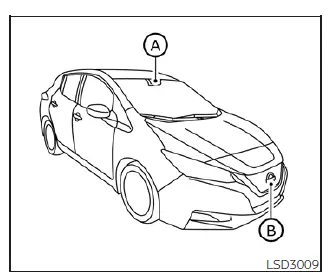
The ProPILOT Assist system is specifically engineered to enhance your driving experience by providing support when following a lead vehicle traveling in the same lane and direction.
The system integrates a sophisticated multi-sensing front camera unit (A), strategically mounted behind the windshield, alongside a precision radar sensor (B) positioned on the front of your Nissan Leaf. These components work in tandem to accurately measure the distance to the vehicle directly ahead and to constantly monitor lane markers. If the system detects a slower-moving vehicle, it will automatically modulate the throttle and brakes of your Nissan Leaf to maintain your pre-selected following distance. Simultaneously, when clear lane markings are detected, the system provides active steering assistance to help keep your vehicle centered within its travel lane.
- ProPILOT Assist system operation
- Operating ProPILOT Assist
- How to enable/disable the Steering Assist
- Intelligent Cruise Control (ICC) (for vehicles with ProPILOT Assist)
- ICC system limitations
- System Temporarily Unavailable
- Steering Assist
- Steering Assist display and indicators
- Steering Assist limitations
- Steering Assist temporary standby
- Radio frequency statement
- Conventional (fixed speed) cruise control mode
 Conventional (fixed speed) cruise control mode
The conventional (fixed speed) cruise control mode in your Nissan Leaf offers a traditional driving experience, allowing you to maintain a constant speed between 25 and 90 mph (40 to 144 km/h) without ...
 ProPILOT Assist system operation
Steering-wheel-mounted control (left): Dedicated to managing vehicle settings and menu navigation.
Vehicle information display: The primary interface for viewi ...
Other materials:
Engine knock
Description
CHART 16: ENGINE KNOCK
Diagnosis Procedure
1.CHECK ENGINE OIL
Check the grade of engine oil. Refer to LU-33, "Inspection".
Is the inspection result normal?
YES >> GO TO 2.
NO >> Replace engine oil. Refer to LU-34, "Refilling".
2.CHECK ENGINE ...
Transaxle assembly
Exploded View
CASE AND HOUSING
1. Differential side oil seal
2. Clutch housing
3. 2 way connector
4. Oil gutter
5. Air breather inner tube
6. Filler plug
7. Gasket
8. Transaxle case
9. O-ring
10. Rear housing
11. Position switch
12. Dowel pin
13. Magnet
14. Drain plug
15. ...
Reference Value
VALUES ON THE DIAGNOSIS TOOL
Remarks:
• Specification data are reference values.
• Specification data are output/input values
which are detected or supplied by the ECM at the connector.
* Specification data may not be directly related to their components
signals/values/operations.
I ...
