
Nissan Leaf 2018-2025 (ZE1) Owner's Manual : ICC system limitations
WARNING
The following points outline the operational boundaries of the Intelligent Cruise Control (ICC) system. Operating your Nissan Leaf without regard for these limitations can lead to a serious accident, resulting in injury or death:
- The ICC system is optimized for travel on straight, dry, and open roads with light-to-moderate traffic. It is strongly advised against using this system in dense city environments or highly congested areas.
- The ICC system cannot intelligently adapt its performance to changing road conditions. It is intended for use in stable, flowing traffic. Do not engage the system on roads characterized by sharp curves, or during adverse conditions such as ice, heavy rain, or thick fog.
- Because there are technical performance limits to the distance control function, never place your full trust in the ICC system. It cannot compensate for inattentive or careless driving, nor can it overcome poor visibility caused by bad weather. You must always maintain a safe following distance by manually adjusting your speed via the brake pedal based on traffic circumstances and environmental visibility.
- Be aware that when the ICC system brings your Nissan Leaf to a complete stop, it may automatically resume movement if the vehicle has been stationary for less than approximately 3 seconds. Always remain alert and prepared to manually apply the brakes if necessary.
- You must always monitor your vehicle's performance. The ICC system may occasionally fail to maintain the desired following distance or set speed due to unforeseen road or traffic dynamics; be ready to take over at any time.
- Certain environmental or road factors may prevent the radar sensor from accurately detecting the vehicle ahead. To ensure your safety, avoid using the ICC system in the following conditions:
- On roads with erratic, high-speed traffic or sharp, winding curves.
- On slick road surfaces, including patches of ice, snow, or slush.
- During compromised weather conditions, such as driving through heavy rain, snow, or fog.
- If snow, ice, or road grime has accumulated on the front bumper, as this can obstruct the distance sensor.
- On steep downhill grades, where the vehicle may unintentionally exceed the set speed and cause excessive brake wear or overheating from frequent, automatic braking.
- On roads with constant, dramatic elevation changes (repeated uphill and downhill sections).
- In traffic conditions that demand frequent, unpredictable acceleration and deceleration, which prevents the system from maintaining a consistent gap.
- When you suspect or encounter interference from other radar-emitting sources.
- Traffic or road objects can occasionally enter the sensor's detection zone unexpectedly, triggering the system to perform automatic braking. Always remain vigilant and refrain from using the ICC system in any environment identified as unsuitable within this section.
Please be aware that the Intelligent Cruise Control (ICC) system in your Nissan Leaf is not designed to detect or respond to the following types of objects:
- Stationary or slow-moving vehicles.
- Pedestrians, cyclists, or inanimate objects present in the roadway.
- Vehicles approaching from the opposite direction within the same lane.
- Motorcycles traveling in an offset position within your travel lane.
Furthermore, there are specific environmental and operational conditions where the radar sensor may struggle to identify a vehicle ahead, which can impact the reliability of the system:
- Reduced sensor visibility due to atmospheric conditions such as heavy rain, dense fog, snow, dust storms, or road spray kicked up by other vehicles.
- Navigating steep downhill slopes or roads with sharp, tight curves.
- Driving on extremely uneven or bumpy road surfaces, such as unpaved dirt roads.
- Obstructions on the radar sensor surface, including mud, ice, snow, or debris.
- Presence of vehicles with irregular profiles, such as flatbed trucks, car carriers, or trailers, which may not provide a clear radar signature.
- Electronic interference caused by external radar sources.
- Significant changes in vehicle pitch, such as when the Nissan Leaf is heavily loaded with excess baggage in the rear seating or cargo area.
The ICC system is programmed to perform internal diagnostics to monitor the radar sensor’s operational integrity within its intended functional limitations.
Because the radar sensor operates within a limited detection zone, a lead vehicle must be positioned directly within this field for the ICC to effectively maintain your following distance. A vehicle may shift outside of this detection zone based on its lateral position within the lane. For example, motorcycles may go undetected if they are traveling off-center. Similarly, a vehicle merging into your lane may not be recognized by the system until it has fully entered your lane of travel.
Should the system lose detection of a lead vehicle, it may alert you by flashing the system indicator and emitting an audible chime. In these scenarios, you must be prepared to assume manual control of your Nissan Leaf to maintain a safe, proper following distance.
The ProPILOT Assist-enabled ICC system also integrates a multi-sensing front camera to aid detection. However, there are scenarios where camera-based detection may be delayed or hindered:
- Poor visibility caused by inclement weather (rain, snow, fog) or road spray.
- Obstructions on the windshield directly in front of the camera, such as fogging, water droplets, ice, or dirt.
- Harsh light conditions, such as direct low-angle sunlight or the high beams of oncoming vehicles shining into the camera lens.
- Rapid transitions in ambient brightness, such as the sudden shift in light levels when entering or exiting tunnels, passing through shaded areas, or during frequent lightning flashes.
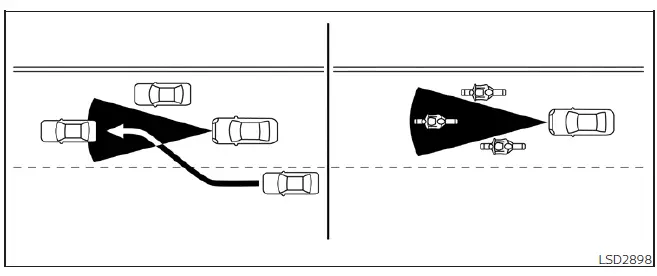
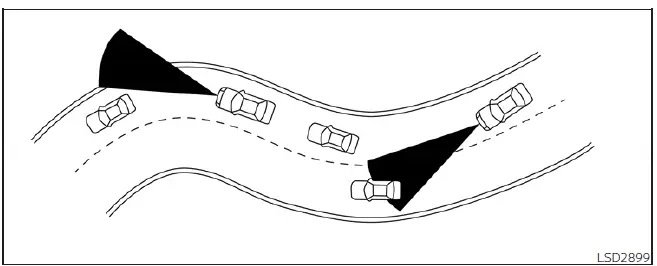
When driving on complex road layouts—such as narrow, winding, hilly, or curved paths, or areas undergoing construction—the radar sensor may mistakenly detect vehicles in adjacent lanes or experience temporary loss of detection for the vehicle ahead. This can result in the system performing unexpected deceleration or acceleration. Additionally, your own driving maneuvers, such as sharp steering inputs or your specific position within the lane, can affect how accurately the system identifies vehicles.
If the system provides an unexpected warning chime or flashes the indicator, do not hesitate; take immediate manual control of your Nissan Leaf to ensure you maintain a safe distance from the traffic ahead.
 Intelligent Cruise Control (ICC) (for vehicles with ProPILOT Assist)
WARNING
Failure to strictly adhere to these warnings and operational instructions regarding the Intelligent Cruise Control (ICC) system in your Nissan Leaf could result in a serious accident, per ...
 System Temporarily Unavailable
The ICC system may enter a state of temporary unavailability under the following conditions:
In these specific scenarios, the ICC system may not cancel automatically, yet it might fail ...
Other materials:
Meters and gauges
1. Tachometer
2. Engine coolant temperature gauge
3. Vehicle information display
— Odometer/twin trip odometer
— Trip computer
— Torque vectoring AWD (AWD model)
— Outside air temperature
4. Fuel gauge
5. Speedometer
6. Warning/indicator lights
7. Instrument brightness control kn ...
U1405 engine torque signal
DTC Logic
DTC DETECTION LOGIC
Diagnosis Procedure
1.PERFORM ECM SELF-DIAGNOSIS
Using CONSULT-III, check the “self diagnosis result� of “ENGINE� and repair
or replace any malfunctioning
parts.
>> • Refer to EC-108, "DTC Index". (MR16DDT)
• Refer to EC-522, &qu ...
Front grille
Exploded View
1. Bumper fascia assembly
2. Front side grille RH
3. Front center grille
4. Emblem
5. Front side grille LH
: Pawl
Removal and Installation
REMOVAL
CAUTION:
When remove front grilles (1) apply protective tape (A) on the
bumper fascia (2) to protect the painted surface fr ...
