
Nissan Juke Service and Repair Manual : Catalyst
2WD
2WD : Exploded View
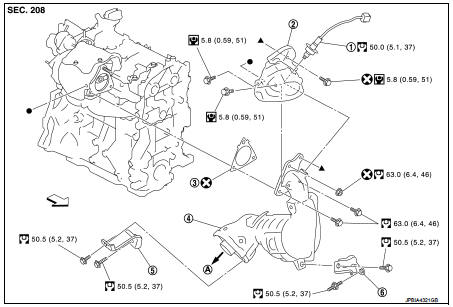
1. A/F sensor 1
2. Catalyst convertor shroud upper
3. Gasket
4. Catalyst
5. Catalyst convertor support bracket rear
6. Catalyst convertor bracket (RH)
A. To exhaust system
 : Engine front
 : N·m (kg-m, ft-lb)
 : N·m (kg-m, in-lb)
 : Always replace after every
disassembly.
2WD : Removal and Installation
REMOVAL
1. Remove engine cover. Refer to EM-25, "Exploded View".
2. Remove cowl top extension. Refer to EXT-20, "Exploded View".
3. Remove front tube. Refer to EX-5, "Exploded View".
4. Remove A/F sensor 1.
• Using heated oxygen sensor wrench [SST: KV10117100], remove A/F sensor 1.
CAUTION:
Handle A/F sensor 1 carefully and avoid impacts.
5. Remove catalyst convertor shroud upper.
6. Remove bolts and nut of catalyst convertor turbocharger side.
7. Remove support bracket (RH).
8. Remove drive shaft insulator. Refer to 9. Remove catalyst convertor.
INSTALLATION
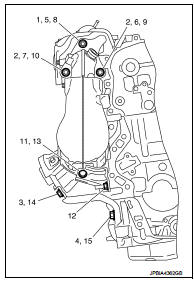
1. Install catalyst convertor with the following procedure.
• Tighten in numerical order as shown in the figure.
- Install catalyst convertor (base on stud position 1).
- Temporary assemble 2 (no priority).
- Temporary assemble 3, 4.
- Tightening 5, 6 and 7.
- Tightening again 8, 9 and 10.
- Temporary assemble 11.
- Tightening 12,13,14,and 15.
2. Install in the reverse order of removal after this step.
4WD
4WD : Exploded View
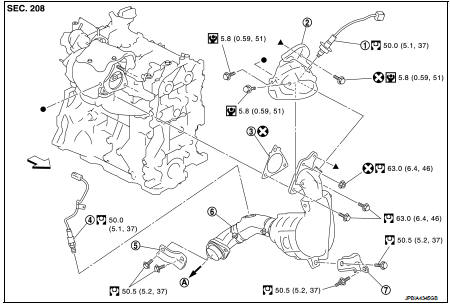
1. A/F sensor 1
2. Catalyst convertor shroud upper
3. Gasket
4. Heated oxygen sensor 2
5. Catalyst convertor upport bracket rear
6. Catalyst convertor
7. Catalyst convertor support bracket (RH)
A. To exhaust system
Engine front
: N·m (kg-m, ft-lb)
: N·m (kg-m, in-lb)
: Always replace after every
disassembly.
4WD : Removal and Installation
REMOVAL
1. Drain engine coolant. Refer to CO-11, "Draining".
2. Remove engine cover. Refer to EM-25, "Exploded View".
3. Remove cowl top extension. Refer to EXT-20, "Exploded View".
4. Remove front tube. Refer to EX-5, "Exploded View" 5. Remove A/F sensor 1.
6. Remove catalyst convertor shroud upper.
7. Remove bolts and nut of catalyst convertor turbocharger side.
8. Remove drive shaft insulator.
9. Remove support bracket (RH).
10. Move catalyst convertor.
11. Remove turbocharger. Refer to EM-36, "Exploded View".
12. Remove catalyst convertor.
INSTALLATION
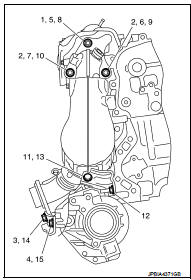
1. Install catalyst convertor with the following procedure.
• Tighten in numerical order as shown in the figure.
- Install catalyst convertor (base on stud position 1).
- Temporary assemble 2 (no priority).
- Temporary assemble 3, 4.
- Tightening 5, 6 and 7.
- Tightening again 8, 9 and 10.
- Temporary assemble 11.
- Tightening 12,13,14,and 15.
2. Install in the reverse order of removal after this step.
 Charge air cooler
Exploded View
1. Air inlet tube assembly
2. Air inlet tube bracket
3. Clamp
4. Air inlet hose
5. Gasket
6. Turbocharger
7. Mounting rubber
8. Charge air cooler
9. Air inlet tube assem ...
 Turbocharger
Exploded View
1. Heat insulator
2. Actuator hose
3. Clamp
4. Turbocharger inlet tube
5. Gasket
6. Gasket
7. Clamp
8. Oil outlet hose
9. Oil return pipe
10. Oil supply tube
11. O-ri ...
Other materials:
Doors
When the passenger doors are locked using one of the primary manual or electronic security methods, they are completely secured so that they cannot be opened from either the inside or outside door handles. The lock mechanisms must be deliberately placed in the unlocked position before anyone can ope ...
P0335 CKP sensor (POS)
DTC Logic
DTC DETECTION LOGIC
Diagnosis Procedure
1.CHECK GROUND CONNECTIONS
1. Turn ignition switch OFF.
2. Check ground connection E38. Refer to Ground inspection in GI-44, "Circuit
Inspection".
Is the inspection result normal?
YES >> GO TO 2.
NO >> Repair or ...
Windshield glass
Exploded View
1. Windshield glass molding
2. Dam rubber (upper)
3. Upper clip
4. Windshield glass
5. Dam rubber (lower)
6. Lower clip
7. Mirror base
8. Rain sensor bracket
9. Adhesive
10. Roof panel
11. Headlining assembly
12. Primer
13. Cowl top cover
14. Cowl top panel
1 ...
