
Nissan Juke Service and Repair Manual : P1585 G sensor
Description
• G sensor is installed to floor under instrument lower cover.
• G sensor detects longitudinal G and inclination that affects the vehicle and outputs to ECM using analog voltage.
ECM converts the analog voltage value to digital signal and transmits the signal to TCM via CAN communication.
• TCM detects longitudinal G and inclination of the vehicle using information of CAN communication.
DTC Logic
DTC DETECTION LOGIC

DTC CONFIRMATION PROCEDURE
CAUTION:
Always drive vehicle at a safe speed.
1.PRECONDITIONING
Immediately after performing any “DTC CONFIRMATION PROCEDURE�, always turn ignition switch OFF.
Then wait at least 10 seconds before performing the next test.
>> GO TO 2.
2.PERFORM DTC CONFIRMATION PROCEDURE
 With CONSULT-III
1. Start the engine.
2. Select “Data Monitor� in “TRANSMISSION�.
3. Select “VEHICLE SPEED�.
4. Using the “D� position, increase vehicle speed in constant acceleration within 5 seconds.
5. Select “Self Diagnostic Results� in “TRANSMISSION�.
Is “P1585� detected? YES >> Go to TM-236, "Diagnosis Procedure".
NO >> INSPECTION END
Diagnosis Procedure
1.CHECK G SENSOR SIGNAL
 With CONSULT-III
1. Park vehicle on level surface.
2. Turn ignition switch ON.
3. Select “Data Monitor� in “TRANSMISSION�.
4. Select “G SEN SLOPE�.
5. Check display of “G SEN SLOPE�.

Is the inspection result normal? YES >> GO TO 6.
NO >> GO TO 2.
2.CHECK G SENSOR POWER SOURCE
1. Turn ignition switch OFF.
2. Disconnect G sensor connector.
3. Turn ignition switch ON.
4. Check voltage between G sensor vehicle side harness connector terminal and ground.

Is the inspection result normal? YES >> GO TO 3.
NO >> GO TO 7.
3.CHECK HARNESS BETWEEN TCM AND G SENSOR (PART 1)
1. Turn ignition switch OFF.
2. Disconnect TCM connectors.
3. Check continuity between TCM vehicle side harness connector terminals and G sensor vehicle side harness connector terminals.

Is the inspection result normal? YES >> GO TO 4.
NO >> Repair or replace damaged parts.
4.CHECK HARNESS BETWEEN TCM AND G SENSOR (PART 2)
Check continuity between TCM vehicle side harness connector terminals and ground.

Is the inspection result normal? YES >> GO TO 5.
NO >> Repair or replace damaged parts.
5.CHECK G SENSOR
1. Remove G sensor. Refer to TM-282, "Removal and Installation".
2. Reconnect all the connectors.
3. Turn ignition switch ON.
4. Check voltage between TCM connector terminal and ground.
 : Direction of gravitational
force
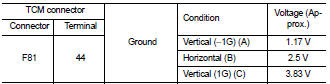
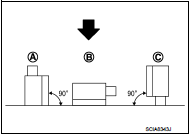
Is the inspection result normal? YES >> GO TO 6.
NO >> Replace G sensor. Refer to TM-282, "Removal and Installation".
6.PERFORM CALIBRATION
1. Install G sensor. Refer to TM-282, "Removal and Installation".
2. Select “Self Diagnostic Results� in “TRANSMISSION�.
3. Select “Erase�.
4. Perform “G SENSOR REMOVAL/INSTALLATION AND REPLACEMENT�. Refer to TM-182, "Description".
Is calibration complete normally? YES >> INSPECTION END
NO >> Check intermittent incident. Refer to GI-42, "Intermittent Incident".
7.CHECK HARNESS BETWEEN TCM AND G SENSOR (SENSOR POWER CIRCUIT) (PART 1)
1. Turn ignition switch OFF.
2. Disconnect TCM connectors.
3. Check continuity between TCM vehicle side harness connector terminal and G sensor vehicle side harness connector terminal.

Is the inspection result normal? YES >> GO TO 8.
NO >> Repair or replace damaged parts.
8.CHECK HARNESS BETWEEN TCM AND G SENSOR (SENSOR POWER CIRCUIT) (PART 2)
Check continuity between TCM vehicle side harness connector terminal and ground.

Is the inspection result normal? YES >> Check intermittent incident. Refer to GI-42, "Intermittent Incident".
NO >> Repair or replace damaged parts.
Special Repair Requirement
1.PERFORM G SENSOR CALIBRATION
Perform “G SENSOR REMOVAL/INSTALLATION AND REPLACEMENT�.
>> Refer to TM-182, "Description".
 P0868 transmission fluid pressure
Description
The secondary pressure solenoid valve regulates the secondary pressure to
suit the driving condition in
response to a signal sent from the TCM.
DTC Logic
DTC DETECTION LOGIC
DTC C ...
 P1701 TCM
Description
When the power supply to the TCM is cut OFF, for example because the battery
is removed, and the self-diagnosis
memory function stops, malfunction is detected.
NOTE:
Since “P1701 ...
Other materials:
Contents
• A QUICK REFERENCE INDEX, a black tab (e.g.
) is provided on the first page. You can quickly find the
first page of each section by matching it to the section's black tab.
• THE CONTENTS are listed on the first page of each section.
• THE TITLE is indicated on the upper portion of ea ...
P0641 sensor power supply
DTC Logic
DTC DETECTION LOGIC
Diagnosis Procedure
1.CHECK GROUND CONNECTION
1. Turn ignition switch OFF.
2. Check ground connection E38. Refer to Ground Inspection in GI-44, "Circuit
Inspection".
Is the inspection result normal?
YES >> GO TO 2.
NO >> Repair or r ...
Malfunction indicator
Component Function Check
1.CHECK MI FUNCTION
1. Turn ignition switch ON.
2. Make sure that MI lights up.
Is the inspection result normal?
YES >> INSPECTION END
NO >> Go to EC-789, "Diagnosis Procedure".
Diagnosis Procedure
1.CHECK DTC
Check that DTC U1001 is not disp ...
