
Nissan Leaf 2018-2025 (ZE1) Owner's Manual : I-FCW system limitations
WARNING
The following list details the specific operating limitations of the I-FCW system. Failure to operate your Nissan Leaf while mindful of these technical boundaries could lead to a failure in system alerts and result in serious injury or death.
- The I-FCW system is a sophisticated tool, but it cannot guarantee the detection of all vehicles under every possible traffic or environmental condition.
- The radar sensor is optimized for specific vehicle profiles and will not detect:
- Pedestrians, animals, or miscellaneous static obstacles present on the roadway.
- Oncoming traffic in the opposing lane.
- Vehicles crossing your path at intersections.
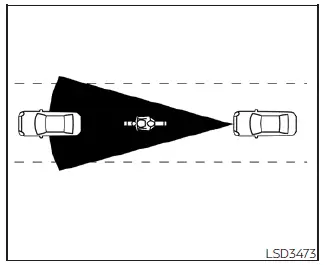
- The I-FCW system is not designed to recognize narrow targets, such as motorcycles or bicycles, and may not provide a warning if a vehicle of this type is ahead.
- Sensor performance may be compromised, preventing the detection of a vehicle ahead, under conditions such as:
- Adverse weather, including heavy snow or torrential rain.
- Physical obstructions such as mud, ice, or snow accumulation on the front radar sensor area.
- Signal interference originating from external high-powered radar sources.
- Road spray or dense mist kicked up by other vehicles traveling ahead of you.
- While driving through tunnels where signal reflection may vary.
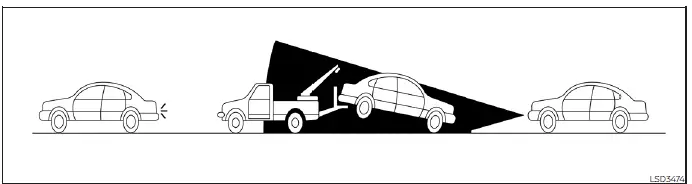
- If the vehicle ahead is being towed by another vehicle, which may confuse the radar signature.
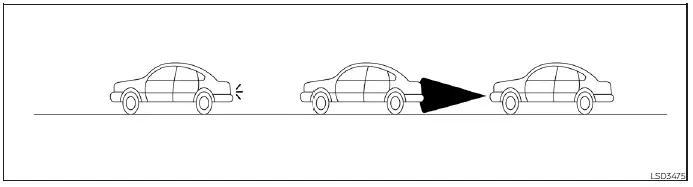
- If you are following the vehicle ahead at an extremely close distance, potentially obstructing the radar beam's effective path.
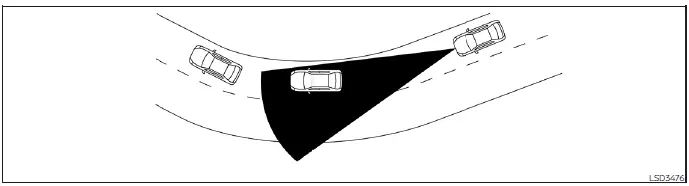
- When navigating steep downhill gradients or roads characterized by sharp, winding curves.
- The system performs automated diagnostic checks, but it remains unable to detect all types of obstructions (e.g., specific types of ice, thick stickers, or non-conductive debris). To ensure the system remains reliable, you must periodically inspect and manually clean the sensor area on the front of your Nissan Leaf.
- Please be aware that loud cabin environments—such as high-volume music, open windows with significant wind noise, or other distracting sounds—may mask the audible warning chime, causing you to miss the alert.
 I-FCW System operation
Vehicle ahead detection indicator
AEB with Pedestrian Detection system warning light
The I-FCW system is fully active when the ...
 System temporarily unavailable
Condition A
In specific scenarios where the radar sensor encounters electromagnetic interference from an external radar source, the system may find it impossible to accurate ...
Other materials:
Inside mirror
Exploded View
Manual anti-dazzling type
1. Windshield glass
2. Mirror base
3. Inside mirror assembly
: Do not reuse
Auto anti-dazzling type
1. Rain sensor bracket
2. Mirror base
3. Rain sensor
4. Inside mirror assembly
: Pawl
: Do not reuse
Removal and Installation
CAUTION:
Ne ...
NISSAN customer care program
NISSAN CARES ...
Both NISSAN and your NISSAN dealer are dedicated to serving all your automotive
needs. Your satisfaction with your vehicle and your NISSAN dealer are our primary
concerns. Your NISSAN dealer is always available to assist you with all your automobile
sales and service needs.
...
Input shaft and gear
Exploded View
1. Input shaft front bearing
2. Input shaft
3. 3rd input gear
4. Spacer
5. Snap ring
6. 3rd baulk ring
7. 3rd-4th coupling sleeve
8. 3rd-4th synchronizer hub
9. Insert key
10. 4th baulk ring
11. 4th input gear
12. 5th input gear
13. 5th baulk ring
14. 5th-6th c ...
