
Nissan Leaf 2018-2025 (ZE1) Owner's Manual : System temporarily unavailable
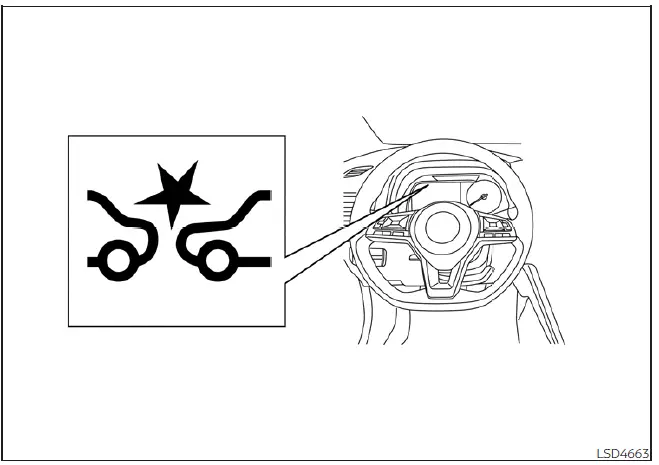
Condition A
In specific scenarios where the radar sensor encounters electromagnetic interference from an external radar source, the system may find it impossible to accurately track the vehicle ahead. To ensure reliability, the Intelligent Forward Collision Warning (I-FCW) system in your Nissan Leaf will automatically deactivate. During this state, the AEB with Pedestrian Detection system warning light (orange) will illuminate to alert you of the temporary suspension of service.
Action to take
Once you have moved away from the source of the interference and environmental conditions return to normal, the I-FCW system will automatically detect that it is clear to resume its monitoring functions.
Condition B
Severe inclement weather, such as heavy rain, dense fog, or thick snow, can physically block the front radar sensor. If the sensor's view is obscured, the I-FCW system will automatically cancel its operation. You will be notified by an audible chime, and the "Forward Driving Aids Temporarily Disabled Front Sensor Blocked See Owner's Manual" warning message will appear on the Nissan Leaf vehicle information display.
Action to take:
Once the weather clears and the sensor path is no longer obstructed, the warning message will vanish from the screen. Should the "Forward Driving Aids Temporarily Disabled Front Sensor Blocked See Owner's Manual" message persist despite clear weather, the system may require a professional inspection; we recommend contacting a NISSAN dealer for this service.
System malfunction
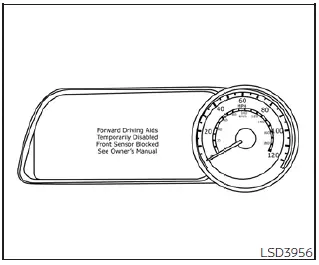
If the I-FCW system experiences an internal technical error, it will immediately enter a fail-safe mode and shut down. An audible chime will sound, the orange AEB with Pedestrian Detection system warning light will illuminate, and the "Malfunction: See Owner's Manual" notification will appear on your vehicle's display to indicate that the Nissan Leaf safety suite requires attention.
Action to take:
If the orange warning light appears, safely park the vehicle, fully power down the EV system, and then restart it. This sequence can often resolve transient software glitches. However, if the warning light remains active after a restart, the AEB with Pedestrian Detection system has likely identified a genuine fault. It is recommended that you visit a NISSAN certified LEAF dealer for a professional diagnostic and repair.
System maintenance
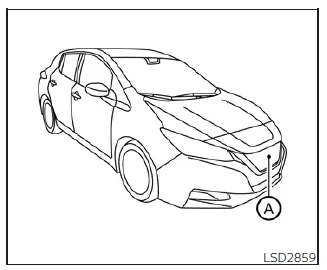
The radar sensor (A) is strategically positioned at the front of your Nissan Leaf. Maintaining this component is vital for the continued precision of your safety technology.
To ensure that the I-FCW system operates without interruption, please follow these maintenance protocols:
- Keep the designated sensor area, including the front bumper and emblem, free of dirt, mud, and road grime.
- Exercise care to avoid impacting, scratching, or damaging the surface surrounding the radar sensor.
- Do not apply stickers, decals, or install any aftermarket accessories on the front bumper near the sensor area. Foreign materials can distort radar signals and lead to system failures.
- Do not attach any metallic objects, such as brush guards or license plate frames that extend over the sensor area, as these can interfere with radar functionality and cause malfunctions.
- Do not perform any unauthorized alterations, removals, or repainting of the front bumper. If you are considering cosmetic customization or need bodywork performed on the front of your Nissan Leaf, please visit a NISSAN certified LEAF dealer to ensure the sensors remain correctly calibrated.
Radio frequency statement
For USA
This device complies with Part 15 of the FCC Rules. Operation of the safety systems within your Nissan Leaf is subject to the following two conditions:
1. This device may not cause harmful interference, and
2. This device must accept any interference received, including interference that may cause undesired operation of the vehicle's electronic systems.
FCC Warning
Please be aware that any changes or modifications to the equipment in your Nissan Leaf that are not expressly approved by the party responsible for regulatory compliance could void the user's authority to operate this equipment.
For Canada
This device complies with Part 15 of the FCC Rules and with Industry Canada licence-exempt RSS standard(s). Operation is subject to the following two conditions:
1. This device may not cause harmful interference, and
2. This device must accept any interference received, including interference that may cause undesired operation of the onboard systems.
Le présent appareil est conforme aux CNR d'Industrie Canada applicables aux appareils radio exempts de licence.
L'exploitation est autorisée aux deux conditions suivantes:
1. L'appareil ne doit pas produire de brouillage, et
2. L'utilisateur de l'appareil doit accepter tout brouillage radioélectrique subi, même si le brouillage est susceptible d'en compromettre le fonctionnement.
Radio frequency radiation exposure information:
This equipment complies with FCC and IC radiation exposure limits set forth for an uncontrolled environment.
To maintain compliance, this equipment should be installed and operated with a minimum distance of 30 cm maintained between the radiator and your body while inside or near the Nissan Leaf.
This transmitter must not be co-located or operating in conjunction with any other antenna or transmitter within the vehicle.
Cet équipement est conforme aux limites d'exposition aux rayonnements IC établies pour un environnement non contrôlé.
Cet équipement doit être installé et utilisé avec un minimum de 30 cm de distance entre la source de rayonnement et votre corps.
FCC Notice
Changes or modifications not expressly approved by the party responsible for compliance could void the user's authority to operate the equipment in your Nissan Leaf.
 I-FCW system limitations
WARNING
The following list details the specific operating limitations of the I-FCW system. Failure to operate your Nissan Leaf while mindful of these t ...
 Intelligent Driver Alertness (I-DA)
WARNING
The Intelligent Driver Alertness (I-DA) system is a supportive technology designed to monitor driving patterns; relying on this system to manage your fatigue or failing to adhere to the p ...
Other materials:
Combination switch input circuit
Diagnosis Procedure
1.CHECK INPUT 1 - 5 CIRCUIT FOR OPEN
1. Turn ignition switch OFF.
2. Disconnect BCM and combination switch connectors.
3. Check continuity between BCM harness connector and combination switch harness
connector.
Does continuity exist?
YES >> GO TO 2.
NO >> ...
Head restraints/Headrests
WARNING
Head restraint/headrest supplement the other vehicle safety systems. They
may provide additional protection against injury in certain rear end collisions.
Adjustable head restraints/headrests must be adjusted properly, as specified
in this section. Check the adjustment after someone el ...
ECU diagnosis information
ECM
Reference Value
TERMINAL LAYOUT
PHYSICAL VALUES
NOTE:
• ECM is located in the engine room left side near battery.
• When disconnecting ECM harness connector (1), loosen (B) it with
levers as far as they will go as shown in the figure.
2 : ECM
A : Fasten
• Pulse signal is measur ...
