Nissan Juke Service and Repair Manual : Writing unit parameter
Description
Perform writing unit parameter of electric controlled coupling after replacing 4WD control module, rear final drive assembly or electric controlled coupling. Refer to DLN-39, "Work Procedure".
Work Procedure
1.WRITE UNIT PARAMETER
With CONSULT-III
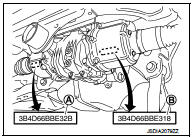
1. Confirm the unit parameter (A) of electric controlled coupling (LH) and (B) of electric controlled coupling (RH).
NOTE
:
• This illustration is sample.
• For the illustration, the unit parameters are following.
Right side: 3B4D66BBE318 Left side: 3B4D66BBE32B
2. Turn the ignition switch OFF to ON.
3. Select “UNIT CHARACTERISTICS WRITE� of CONSULT-III “WORK SUPPORT� for “ALL MODE AWD/4WD�.
4. Input unit parameters.
5. Select “Start�.
6. Check that “UNIT CHARACTERISTICS WRITE COMPLETED� is displayed.
>> WORK END
 Diagnosis and repair work flow
Work Flow
DETAILED FLOW
1.INTERVIEW FROM THE CUSTOMER
Clarify customer complaints before inspection. First of all, perform an
interview utilizing DLN-37, "Diagnostic
Work Sheet" and re ...

Other materials:
B1135 side air bag module LH
DTC Logic
DTC DETECTION LOGIC
DTC CONFIRMATION PROCEDURE
1.CHECK SELF-DIAG RESULT
With CONSULT-III
1. Turn ignition switch ON.
2. Perform “Self Diagnostic Result� mode of “AIR BAG� using CONSULT-III.
Without CONSULT-III
1. Turn ignition switch ON.
2. Check the air bag warning la ...
Radiator
Exploded View
1. Reservoir tank cap
2. Reservoir tank
3. Clamp
4. Reservoir tank hose
5. Mounting rubber (upper)
6. Reservoir tank hose
7. Radiator
8. Mounting rubber (lower)
9. Drain plug
10. O-ring
11. Cooling fan assembly
12. Radiator hose (upper)
13. Radiator hose (lower)
...
Cooling fan
Exploded View
1. Fan motor
2. Fan shroud
3. Cooling fan
A. Apply on fan motor shaft
: Apply genuine high strength
thread locking sealant or equivalent.
: N·m (kg-m, in-lb)
Removal and Installation
REMOVAL
1. Drain engine coolant from radiator. Refer to CO-37, "Draining".
...
