
Nissan Leaf 2018-2025 (ZE1) Owner's Manual : System temporarily unavailable
In certain operational scenarios, the Intelligent Blind Spot Intervention (I-BSI) system in your Nissan Leaf may automatically deactivate to ensure safety. In these instances, you will hear an audible chime, and a specific warning message will appear on the vehicle information display, signaling that the system is temporarily offline until the underlying conditions are rectified.
The I-BSI system will remain unavailable while the following conditions persist:
- "Not available Poor Road Conditions": This may trigger when the Vehicle Dynamic Control (VDC) system—excluding the Traction Control System (TCS) function—or the Anti-lock Braking System (ABS) is actively engaged to maintain vehicle stability.
- "Currently not available": This message occurs when the VDC system is manually turned off.
Action to take: Once the limiting conditions have cleared, you can manually reactivate the I-BSI system. Simply push the ProPILOT Assist switch (on models so equipped) or the dynamic driver assistance switch (on models without ProPILOT Assist) to restore functionality.
If the vehicle’s radar sensors detect a physical blockage, the I-BSI system will automatically disengage. A chime will sound, and the "Unavailable: Side Radar Obstruction" warning will be displayed on the information screen.
The system will remain inactive until the sensors are clear. For more guidance, please refer to the "System maintenance" section below.
Action to take: After the obstruction is removed, you can re-enable the system via the driver assistance switch. If the "Unavailable: Side Radar Obstruction" warning persists even after you have attempted to turn the system back on, pull over to a safe location, place the Nissan Leaf in the P (Park) position, and power down the EV system.
Inspect the rear bumper area to locate and remove any debris, mud, or snow obscuring the radar sensors, then restart the EV system to allow the sensors to re-initialize.
Additionally, if the vehicle has been parked in direct, intense sunlight in high-temperature environments (exceeding approximately 104ºF or 40ºC), the I-BSI system may automatically deactivate upon startup as a protective measure.
In this case, the "Unavailable: High Cabin Temperature" warning message will appear on your display.
Action to take: Once the vehicle's interior cabin temperature has been sufficiently reduced through ventilation or air conditioning, press the ProPILOT Assist or dynamic driver assistance switch to turn the I-BSI system back on.
System malfunction
Should the I-BSI system encounter an internal technical fault, it will automatically shut down. You will hear an audible chime, and the "Not available System Malfunction" message will appear alongside a glowing orange BSW indicator on your display.
Action to take: Stop your Nissan Leaf in a safe location, engage the P (Park) position, and cycle the EV system off and back on. If the "Not available System Malfunction" message and the orange BSW indicator remain, the system requires professional diagnostics. We strongly recommend visiting a NISSAN certified LEAF dealer to have the system inspected and repaired.
System maintenance
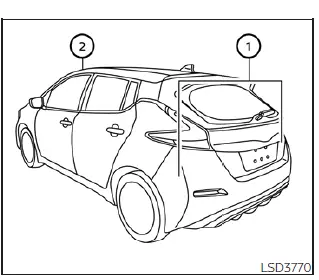
The I-BSI system relies on two radar sensors (1) mounted strategically near the rear bumper of your Nissan Leaf.
To maintain consistent system performance, it is vital to keep the area around these sensors free of dirt and road grime.
The radar sensors can be temporarily obstructed by environmental factors such as heavy water spray, dense mist, or thick fog.
Furthermore, physical obstructions like ice, frost, or accumulated mud can block the radar signals, leading to temporary system unavailability.
Regularly check for and remove any such objects from the vicinity of the radar sensors.
Do not apply stickers—including transparent films—or install aftermarket accessories, nor should you apply additional layers of paint near the radar sensors, as these can interfere with radar wave propagation.
Take care to avoid striking or damaging the bumper area surrounding the sensors.
It is highly recommended that you contact a NISSAN certified LEAF dealer if the area near the radar sensors sustains damage from a collision, as the sensors require precise alignment.
The lane camera unit (2) for the I-BSI system is mounted above the interior rearview mirror. To ensure the camera functions correctly and to prevent potential system malfunctions, please adhere to these guidelines:
- Always maintain a clean windshield in front of the camera unit.
- Do not apply stickers (even transparent ones) or install any accessories near the camera housing.
- Avoid placing reflective items, such as mirrors or white paper, on the instrument panel, as sun glare reflecting off these surfaces can impede the camera's ability to detect lane markings.
- Be careful not to strike or damage the camera area. Do not attempt to touch the camera lens or remove the mounting screws. If the camera unit is damaged in an accident, consult a NISSAN certified LEAF dealer for professional repair.
Radio frequency statement (Type A) (if so equipped)
For USA
This device complies with part 15 of the FCC Rules. Operation is subject to the following two conditions:
(1) This device may not cause harmful interference, and (2) this device must accept any interference received, including interference that may cause undesired operation.
FCC Warning
Changes or modifications not expressly approved by the party responsible for compliance could void the user's authority to operate the equipment.
For Canada
Applicable law: Canada 310
This device complies with Industry Canada licence-exempt RSS standard(s).
Operation is subject to the following two conditions: (1) This device may not cause interference, and (2) This device must accept any interference, including interference that may cause undesired operation of the device.
Frequency bands: 24.05-24.25GHz
Output power: less than 20 milliwatts
Radio frequency statement (Type B) (if so equipped)
For USA
This device complies with part 15 of the FCC Rules. Operation is subject to the following two conditions:
(1) This device may not cause harmful interference, and (2) this device must accept any interference received, including interference that may cause undesired operation.
FCC Warning
Changes or modifications not expressly approved by the party responsible for compliance could void the user's authority to operate the equipment.
For Canada
Applicable law: Canada 310
This device contains licence-exempt transmitter(s)/receiver(s) that comply with Innovation, Science and Economic Development Canada's licence-exempt RSS(s). Operation is subject to the following two conditions:
1. This device may not cause interference.
2. This device must accept any interference, including interference that may cause undesired operation of the device.
Radiofrequency radiation exposure information:
This equipment complies with radiation exposure limits set forth for an uncontrolled environment. This equipment should be installed and operated with minimum distance of 20 cm between the radiator and your body.
 I-BSI system limitations
WARNING
The following points outline critical operational limitations for the Intelligent Blind Spot Intervention (I-BSI) system. Failing to operate your Nissan Leaf in strict accordance with the ...
 Rear Cross Traffic Alert (RCTA)
WARNING
Failure to strictly adhere to the safety warnings and operational instructions regarding the Rear Cross Traffic Alert (RCTA) system can lead to severe vehicle damage, serious personal inj ...
Other materials:
Precaution Necessary for Steering Wheel Rotation after Battery Disconnect
NOTE:
• Before removing and installing any control units, first turn the ignition
switch to the LOCK position, then disconnect
both battery cables.
• After finishing work, confirm that all control unit connectors are connected
properly, then re-connect both
battery cables.
• Always us ...
Hazard warning flasher switch
Push the switch on to warn other drivers when you must stop or park under emergency
conditions.
All turn signal lights will flash.
WARNING
• If stopping for an emergency, be sure to move the vehicle well off
the road.
• Do not use the hazard warning flashers while moving on ...
Anti-hijack function does not operate
Diagnosis Procedure
1.CHECK “DOOR LOCK–UNLOCK SET� SETTING IN “WORK SUPPORT�
1. Select “DOOR LOCK� of “BCM� using CONSULT-III.
2. Select “DOOR LOCK-UNLOCK SET� in “WORK SUPPORT� mode.
3. Check “DOOR LOCK-UNLOCK SET� in “WORK SUPPORT�
Refer to DLK-41, "DOOR ...
