
Nissan Leaf 2018-2025 (ZE1) Owner's Manual : I-BSI system limitations
WARNING
The following points outline critical operational limitations for the Intelligent Blind Spot Intervention (I-BSI) system. Failing to operate your Nissan Leaf in strict accordance with these limitations could result in an inappropriate system response, potentially leading to serious injury or death.
- The I-BSI system is an assistive feature and cannot reliably detect all vehicles or hazards under every possible driving condition.
- The radar sensors may fail to detect or trigger I-BSI intervention when specific types of objects are present, including:
- Pedestrians, cyclists, or animals.
- Vehicles with non-standard silhouettes, such as motorcycles, extremely low-profile vehicles, or heavy-duty vehicles with excessive ground clearance.
- Vehicles that remain positioned in the detection zone while you are accelerating from a complete stop. For a deeper understanding of these specific scenarios, please refer to the "BSI driving situations" documentation.
- Oncoming traffic in adjacent or opposing lanes.
- A vehicle merging into an adjacent lane at a speed nearly identical to your Nissan Leaf, which may cause the radar to misinterpret the vehicle as stationary.
- A vehicle approaching from the rear at a very high rate of speed.
- A vehicle that your Nissan Leaf overtakes at a high speed.
- A vehicle that traverses the radar's detection zone too rapidly for the system to lock onto its signature.
- The radar sensor detection logic is calibrated for standard lane widths. When driving on wider multi-lane highways, the sensors may not reach vehicles in the adjacent lane. Conversely, when navigating particularly narrow roads, the sensors may detect vehicles traveling two lanes away, leading to unexpected system behavior.
- While the radar sensors are engineered to filter out stationary infrastructure, objects such as metal guardrails, concrete walls, roadside foliage, and parked vehicles may occasionally be detected. This is a normal operational characteristic of the system.
- The forward-facing camera system relies on clear visibility of lane markings; I-BSI functionality may be compromised or unavailable in the following scenarios:
- On roads with complex, overlapping, or multiple parallel lane markers; road sections where markings are severely faded, poorly painted, or non-standard; or markings obscured by standing water, mud, or snow.
- In areas where old, discontinued lane markers remain visible and confusing to the camera.
- On roads featuring extremely sharp curves that exceed the camera's tracking capability.
- On surfaces with high-contrast visual interference, such as deep shadows, patches of ice, reflective water, deep wheel ruts, or lingering seam lines from road repairs.
- On road segments where lanes merge or diverge significantly.
- When your Nissan Leaf is angled such that its direction of travel does not align with the perceived lane markers.
- When following another vehicle too closely, which physically obstructs the camera's ability to monitor the lane ahead.
- When the windshield area in front of the camera unit is obscured by rain, snow, dirt, or debris.
- When vehicle headlights are misaligned or dim due to lens clouding, reducing visibility for the camera system.
- When the camera is blinded by intense light sources, such as direct sunlight at sunrise or sunset shining into the front of the vehicle.
- When experiencing sudden, extreme changes in ambient lighting, such as immediately entering or exiting a tunnel or passing beneath a bridge.
- Avoid using the I-BSI system under the following conditions, as these environments can significantly degrade the system's accuracy and performance:
- During severe weather events (e.g., heavy downpours, thick fog, or blizzard conditions).
- When driving on surfaces with compromised traction, such as ice-covered or snow-packed roads.
- When traversing winding, uneven, or unstable terrain.
- When navigating through areas where lanes are narrowed or closed due to ongoing road construction.
- When traveling within temporary, makeshift, or redirected traffic lanes.
- When navigating roads where lane width is insufficient for standard vehicle operation.
- When your Nissan Leaf is operating with non-standard tire conditions, including excessive tread wear, improper air pressure, the use of a space-saver spare tire, or the installation of tire chains.
- When the vehicle has been modified with non-original, aftermarket brake components or suspension parts, as these can interfere with the system's ability to apply active steering or braking.
- When high-decibel ambient noise—such as loud audio system volume or driving with windows fully open—prevents you from clearly hearing the system's audible chime warnings.
I-BSI driving situations
Indicator on

Indicator off

Indicator flashing

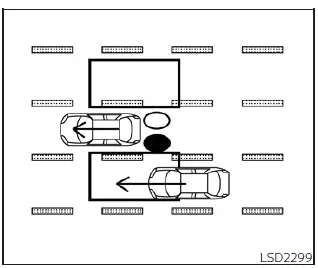
Illustration 1 - Approaching from behind
Another vehicle approaching from behind
Illustration 1: The side indicator light on your Nissan Leaf will illuminate to provide a passive warning whenever another vehicle enters your monitored blind spot detection zone from the rear in an adjacent lane.
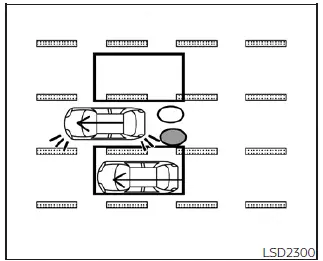
Illustration 2 - Approaching from behind
Illustration 2: Should you activate your turn signal while a vehicle is detected in that zone, the Nissan Leaf Intelligent Blind Spot Intervention (I-BSI) system will issue an immediate audible alert—two rapid chimes—and cause the side indicator light to begin flashing to warn you against proceeding with the lane change.
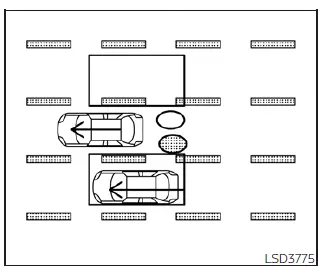
Illustration 3 - Approaching from behind
Illustration 3: If the I-BSI system is active and your Nissan Leaf begins to drift toward a lane marker while a vehicle is occupying the detection zone, the system will escalate to a triple-chime warning and flash the side indicator light. Simultaneously, the I-BSI system will apply corrective steering torque to assist in returning your vehicle to the center of the traveling lane.
NOTE:
- The radar sensors integrated into the Nissan Leaf may experience challenges in detecting vehicles that are approaching your position from the rear at an extremely high rate of speed.
- If you engage the turn signal before the target vehicle has entered the radar's detection zone, the side indicator light will flash upon subsequent detection, but the system will suppress the audible chime to prevent unnecessary noise during your maneuver.
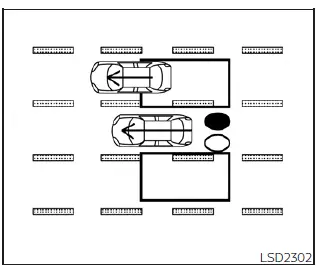
Illustration 4 - Overtaking another vehicle
Overtaking another vehicle
Illustration 4: When you overtake a slower vehicle, the side indicator light will illuminate in your Nissan Leaf as soon as that vehicle enters your detection zone, remaining lit as long as the vehicle persists in that zone for a duration of approximately 3 seconds.
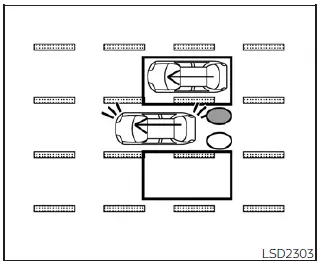
Illustration 5 - Overtaking another vehicle
Illustration 5: If you initiate a turn signal while you are in the process of overtaking and a vehicle is still within the detection zone, the Nissan Leaf will chime twice and flash the side indicator light to alert you to the potential conflict.
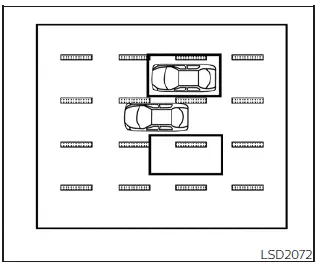
Illustration 6 - Overtaking another vehicle
Illustration 6: In a scenario where the I-BSI system is on and your Nissan Leaf approaches a lane marker while you are currently overtaking another vehicle in the detection zone, the system will trigger a three-tone chime and flash the side indicator. The I-BSI system will then activate its steering assistance to help guide your Nissan Leaf back into the center of your original lane.
NOTE:
- When you are passing a convoy of multiple vehicles, the Nissan Leaf radar sensors may fail to detect secondary vehicles if they are traveling in a tightly clustered group immediately following the first vehicle.
- The radar system may not reliably register significantly slower-moving vehicles if your Nissan Leaf passes them at a very high relative speed.
- If the turn signal is activated before the vehicle enters the detection zone, the side indicator will flash, but the audible chime will be suppressed when the vehicle is eventually detected.
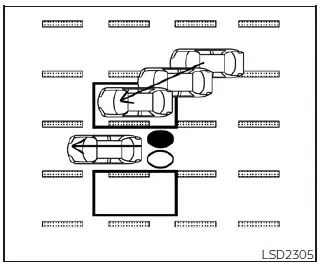
Illustration 7 - Entering from the side
Entering from the side
Illustration 7: The Intelligent Blind Spot Intervention (I-BSI) system on your Nissan Leaf is designed to be proactive; the side indicator light will illuminate immediately if a vehicle enters your designated detection zone from either the left or right side.
NOTE:
It is important to understand that the radar sensors may experience difficulty detecting a vehicle that is traveling at a speed almost perfectly synchronized with your Nissan Leaf as it enters the detection zone, as this minimizes the relative speed change the sensors rely on for identification.
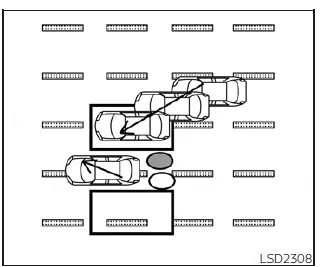
Illustration 8 - Entering from the side
Illustration 8: If you engage the turn signal while another vehicle is already present within the detection zone, the Nissan Leaf system will provide a double audible chime, and the side indicator light will begin to flash, reinforcing the visual warning to prevent an unsafe lane merge.
NOTE:
If you activate the turn signal before a vehicle has entered the detection zone, the system will flash the side indicator light once the vehicle is eventually detected, but no audible chime will be triggered to avoid unnecessary distraction.
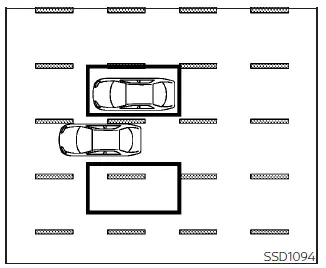
Illustration 9 - Entering from the side
Illustration 9: If the I-BSI system is enabled and your Nissan Leaf approaches a lane marker while a vehicle is occupying the detection zone, the system issues a triple-chime alert and flashes the side indicator. Simultaneously, the I-BSI system activates to apply corrective steering torque, assisting the driver in returning the Nissan Leaf to the center of the current travel lane.
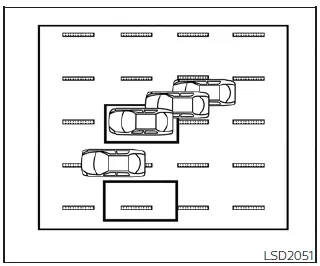
Illustration 10: - Entering from the side
Illustration 10: Please note that the I-BSI system will not execute active steering intervention if your Nissan Leaf is already positioned on or over a lane marker at the exact moment another vehicle enters the detection zone. In this specific scenario, only the Blind Spot Warning (BSW) system will remain operational.
NOTE:
- The radar sensors may not detect a vehicle that is traveling at approximately the same speed as your Nissan Leaf when it enters the detection zone.
- If the driver activates the turn signal before a vehicle enters the detection zone, the side indicator light will flash, but no chime will sound upon detection.
- To prioritize driver control, the I-BSI system will either suspend operation or refuse to activate, defaulting only to a warning chime, under the following conditions:
- When the brake pedal is depressed, indicating active manual braking.
- When you significantly accelerate while the I-BSI system is attempting to intervene.
- When you perform quick or aggressive steering inputs.
- When other critical warnings sound, such as Intelligent Cruise Control (ICC), Intelligent Forward Collision Warning (I-FCW), or Autonomous Emergency Braking (AEB) with Pedestrian Detection.
- When the hazard warning flashers are activated.
- When navigating curves at high speeds that exceed the system's operational parameters.
 I-BSI system operation
Side Indicator Light
Blind Spot Warning (BSW) indicator
Intelligent Blind Spot Intervention (I-BSI) indicator
Dynamic driver assistance switc ...
 System temporarily unavailable
In certain operational scenarios, the Intelligent Blind Spot Intervention (I-BSI) system in your Nissan Leaf may automatically deactivate to ensure safety. In these instances, you will hear an audible ...
Other materials:
Squeak and rattle trouble diagnoses
Work Flow
CUSTOMER INTERVIEW
Interview the customer if possible, to determine the conditions that exist
when the noise occurs. Use the Diagnostic
Worksheet during the interview to document the facts and conditions when the
noise occurs and any of
the customer's comments; refer to DLK-437, ...
Engine overheating
Description
CHART 17: ENGINE OVERHEATING
Diagnosis Procedure
1.CHECK COOLING SYSTEM
Check the cooling system. Refer to CO-60, "Troubleshooting Chart".
Is the inspection result normal?
YES >> GO TO 2.
NO >> Repair or replace.
2.CHECK ECM POWER SUPPLY AND GROUND CIR ...
Rocker cover
Exploded View
1. Blow-by hose
2. Rocker cover
3. Gasket
4. Camshaft position sensor
5. O-ring
A. To turbocharger air inlet pipe
: N·m (kg-m, in-lb)
: Always replace after every
disassembly.
Removal and Installation
REMOVAL
1. Remove air cleaner case. Refer to EM-280, "Explode ...
