
Nissan Leaf 2018-2025 (ZE1) Owner's Manual : Intelligent Blind Spot Intervention (I-BSI)
WARNING
Failure to strictly adhere to these safety warnings and operational instructions for the Intelligent Blind Spot Intervention (I-BSI) system could result in unpredictable vehicle behavior, potentially leading to serious personal injury or fatal accidents.
- The I-BSI system is a driver-assist feature and is not a substitute for standard, attentive driving procedures. It is not designed to prevent physical contact with other vehicles, road infrastructure, or obstacles. When executing a lane change in your Nissan Leaf, you must always verify the path is clear by utilizing the side and rearview mirrors, and physically checking your blind spots by turning your head in the direction of the intended maneuver. Never place total reliance on the I-BSI system to ensure safety.
- The radar and sonar detection technologies have inherent physical limitations.
Not every moving object, cyclist, or vehicle will be successfully detected in all scenarios. Operating the I-BSI system in specific road, terrain, lane-marking, traffic, or severe weather conditions may cause the system to function improperly or experience performance degradation.
Always remain fully in control of your vehicle and rely on your own active observation to prevent potential collisions.
The I-BSI system in your Nissan Leaf serves a dual purpose: it provides visual alerts to notify the driver of vehicles present in adjacent lanes and provides active steering assistance to help guide the vehicle back toward the center of your current lane if a potential lane-departure conflict is detected.
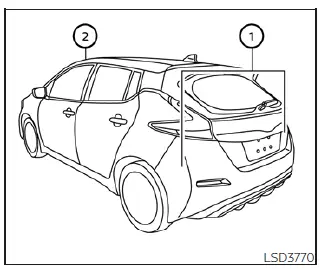
The I-BSI system utilizes high-precision radar sensors (1) mounted near the rear bumper to monitor for vehicles occupying the adjacent lanes. Complementing these sensors, the system integrates a sophisticated camera (2) positioned behind the windshield, which continuously monitors lane markings to track the positioning of your Nissan Leaf relative to its current travel lane.
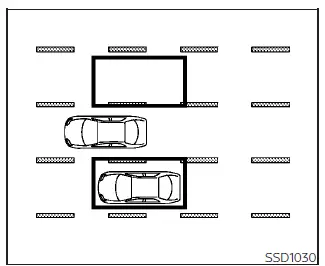
Detection zone
The system’s radar sensors are configured to detect vehicles occupying the space on either side of your vehicle within a defined monitoring envelope.
This detection zone spans from the trailing edge of the outside rearview mirror and extends approximately 10 feet (3.0 meters) rearward past the rear bumper, while also covering a width of approximately 10 feet (3.0 meters) out to the sides.
 System temporarily unavailable
When the system detects that the radar sensors are blocked, it will automatically deactivate to prevent inaccurate warnings. During this state, the BSW indicator (1) will blink i ...
 I-BSI system operation
Side Indicator Light
Blind Spot Warning (BSW) indicator
Intelligent Blind Spot Intervention (I-BSI) indicator
Dynamic driver assistance switc ...
Other materials:
PTC branch line circuit
Diagnosis Procedure
1.CHECK CONNECTOR
1. Turn the ignition switch OFF.
2. Disconnect the battery cable from the negative terminal.
3. Check the terminals and connectors of the PTC heater control unit for damage,
bend and loose connection
(unit side and connector side).
Is the inspection re ...
Starting difficult with cold engine
Description
CHART 3: STARTING DIFFICULT WITH COLD ENGINE
Diagnosis Procedure
1.CHECK ENGINE OIL LEVEL
Is the engine oil level correct?
Yes or No
Yes >> GO TO 2.
No >> Top up the oil.
2.CHECK ENGINE OIL
Check the grade of engine oil. Refer to LU-33, "Inspection".
...
Squeak and rattle trouble diagnoses
Work Flow
CUSTOMER INTERVIEW
Interview the customer if possible, to determine the conditions that exist
when the noise occurs. Use the Diagnostic
Worksheet during the interview to document the facts and conditions when the
noise occurs and any of
the customer's comments; refer to DLK-139, &q ...
