
Nissan Leaf 2018-2025 (ZE1) Owner's Manual : System temporarily unavailable
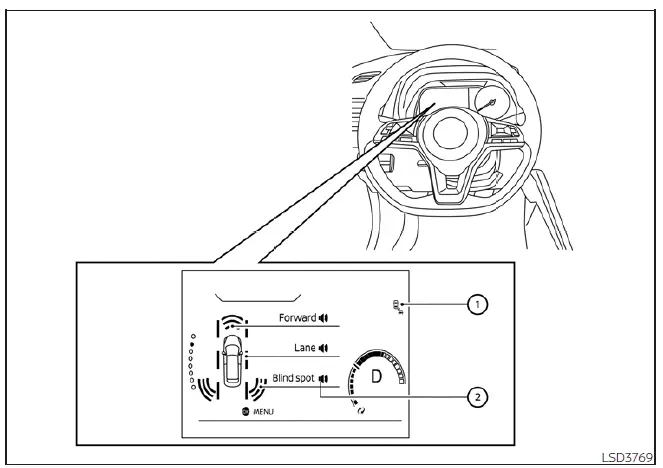
When the system detects that the radar sensors are blocked, it will automatically deactivate to prevent inaccurate warnings. During this state, the BSW indicator (1) will blink in yellow on your vehicle information display, and the indicator adjacent to "Blind spot" within the "Driving Aids" menu (2) will also flash yellow to alert you of the status change.
The Blind Spot Warning system will remain unavailable until the environmental or physical obstructions are cleared and the sensors regain a clear path.
Radar sensors may become temporarily obstructed by adverse ambient conditions, such as heavy water spray, mist, dense fog, or significant road debris. Additionally, physical accumulation of ice, thick frost, or caked-on dirt directly on the sensor surface will effectively block the radar signal.
NOTE:
Please be aware that if the BSW system is disabled due to these conditions, the Rear Cross Traffic Alert (RCTA) system will also cease to function, as both systems rely on the same sensor data.
Action to take:
Once the conditions causing the blockage are resolved, the system will perform a diagnostic check and resume normal operations automatically.
Malfunction
Should the BSW system experience a persistent internal malfunction, it will turn off automatically for your safety. A solid yellow BSW indicator will appear on your vehicle information display, and the corresponding indicator in the "Driving Aids" menu will also illuminate steadily in yellow.
NOTE:
As with a temporary blockage, if the BSW system suffers a malfunction, the RCTA system will also be disabled.
Action to take:
To attempt a system reset, bring your Nissan Leaf to a complete stop in a safe location, engage the P (Park) gear, turn off the EV system entirely, and then perform a fresh restart. If the warning indicators remain illuminated after the restart, there is likely a component fault. It is highly recommended that you visit a NISSAN certified LEAF dealer to have the system professionally diagnosed and serviced.
System maintenance
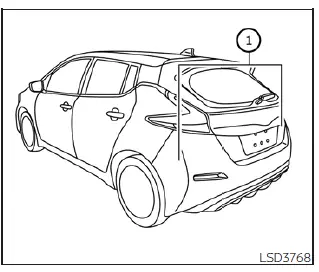
The two primary radar sensors (1) essential for the BSW and RCTA systems are mounted behind the rear bumper fascia. To ensure optimal performance of your Nissan Leaf, you must always keep the areas overlying these sensors clean and free of debris.
Be mindful that your radar sensors can be momentarily blinded by harsh environmental elements like heavy road spray, mist, or dense fog.
Persistent blockage is often the result of frozen slush, heavy frost, or accumulated road grime directly obstructing the radar signal path.
Regularly inspect the exterior of your rear bumper and gently remove any ice, snow, or mud buildup surrounding the sensor areas.
Do not apply stickers, adhesive decorative films (including transparent ones), or install aftermarket accessories near the radar sensors, as these materials can interfere with signal propagation. Furthermore, avoid applying extra paint layers to the bumper area housing the sensors.
Take care not to strike or physically damage the rear bumper area around the radar units. If you have been involved in a collision or notice impact damage in these zones, we strongly recommend visiting a NISSAN certified LEAF dealer to ensure the sensors are properly aligned and functional.
Radio frequency statement (Type A) (if so equipped)
For USA
This device complies with part 15 of the FCC Rules. Operation is subject to the following two conditions:
(1) This device may not cause harmful interference, and (2) this device must accept any interference received, including interference that may cause undesired operation.
FCC Warning
Changes or modifications not expressly approved by the party responsible for compliance could void the user's authority to operate the equipment.
For Canada
Applicable law: Canada 310
This device complies with Industry Canada licence-exempt RSS standard(s).
Operation is subject to the following two conditions: (1) This device may not cause interference, and (2) This device must accept any interference, including interference that may cause undesired operation of the device.
Frequency bands: 24.05-24.25GHz
Output power: less than 20 milliwatts
Radio frequency statement (Type B) (if so equipped)
For USA
This device complies with part 15 of the FCC Rules. Operation is subject to the following two conditions:
(1) This device may not cause harmful interference, and (2) this device must accept any interference received, including interference that may cause undesired operation.
FCC Warning
Changes or modifications not expressly approved by the party responsible for compliance could void the user's authority to operate the equipment.
For Canada
Applicable law: Canada 310
This device contains licence-exempt transmitter(s)/receiver(s) that comply with Innovation, Science and Economic Development Canada's licence-exempt RSS(s). Operation is subject to the following two conditions:
1. This device may not cause interference.
2. This device must accept any interference, including interference that may cause undesired operation of the device.
Radiofrequency radiation exposure information:
This equipment complies with radiation exposure limits set forth for an uncontrolled environment. This equipment should be installed and operated with minimum distance of 20 cm between the radiator and your body.
 BSW system limitations
WARNING
The following points detail the operational boundaries and inherent limitations of the Blind Spot Warning (BSW) system. Failure to operate your Nissan Leaf with a full understanding of th ...
 Intelligent Blind Spot Intervention (I-BSI)
WARNING
Failure to strictly adhere to these safety warnings and operational instructions for the Intelligent Blind Spot Intervention (I-BSI) system could result in unpredictable vehicle behavior, ...
Other materials:
4WD mode indicator lamp (4WD-V)
Component Function Check
1.4WD MODE INDICATOR LAMP OPERATION CHECK
1. Turn the ignition switch ON.
2. Change 4WD mode switch to “4WD-V�.
3. Check that 4WD mode indicator lamp (4WD-V) turns on.
Is the inspection result normal?
YES >> INSPECTION END
NO >> Proceed to diagnosis ...
Off position warning does not operate
Diagnosis Procedure
1.CHECK DTC WITH BCM AND COMBINATION METER
Check that DTC is not detected with BCM and combination meter.
Is the inspection result normal?
YES >> GO TO 2.
NO-1 >> Refer to BCS-67, "DTC Index". (BCM)
NO-2 >> Refer to MWI-36, "DTC Index&qu ...
Precaution Necessary for Steering Wheel Rotation after Battery Disconnect
NOTE:
• Before removing and installing any control units, first turn the ignition
switch to the LOCK position, then disconnect
both battery cables.
• After finishing work, confirm that all control unit connectors are connected
properly, then re-connect both
battery cables.
• Always us ...
