
Nissan Leaf 2018-2025 (ZE1) Owner's Manual : System malfunction
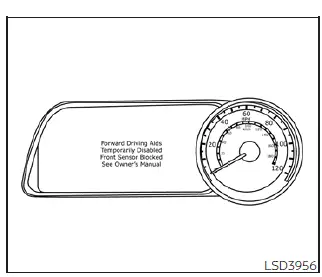
If the AEB with Pedestrian Detection system encounters a technical error or internal fault, it will automatically deactivate to ensure vehicle safety. When this occurs, you will hear an audible chime, the AEB with Pedestrian Detection system warning light will illuminate in orange on your dashboard, and the "Malfunction: See Owner's Manual" diagnostic message will be displayed in the Nissan Leaf information center.
Action to take
If the orange warning light appears while you are driving, please pull over and park your Nissan Leaf in a safe, secure location. Turn off the EV system completely, wait a few moments, and then restart the system to attempt a reset of the sensor suite.
If the warning light remains illuminated after the restart, the system has detected a persistent issue that requires professional attention. In such cases, it is essential to have the AEB with Pedestrian Detection system inspected by qualified technicians; we recommend visiting a NISSAN certified LEAF dealer for this service.
System maintenance
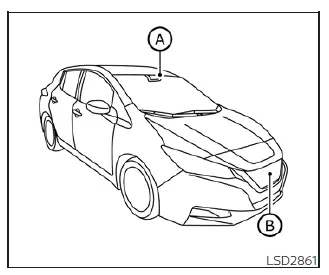
The safety and reliability of your Nissan Leaf depend on its advanced sensor array, which includes a precision radar sensor located on the front bumper (B) and a high-resolution camera mounted at the upper portion of the windshield (A).
To ensure that the AEB with Pedestrian Detection system continues to operate at peak efficiency and provides you with accurate safety monitoring, please adhere to the following maintenance guidelines:
- Maintain absolute cleanliness of the sensor areas on the front bumper, the front emblem, and the windshield glass. Grime, heavy road salt, or debris can impede sensor performance.
- Exercise extreme care to avoid striking or damaging the areas where the sensors are housed, specifically the front bumper and the windshield glass.
- Do not cover the sensor areas or attach any aftermarket stickers, decals, or accessories in the immediate vicinity of these components. Such modifications can block essential signals, leading to system failure or erratic operation.
- Avoid attaching any metallic objects, such as heavy-duty brush guards or unauthorized grille accessories, near the radar sensor, as these can interfere with radar wave propagation and cause systemic errors.
- Do not place reflective materials—including white paper, documents, or mirrors—on the upper instrument panel. Glare or sunlight reflected off these items can disrupt the camera unit's ability to detect road conditions and obstacles.
- Do not attempt to alter, remove, or repaint the front bumper. If you are planning any cosmetic customization, bodywork, or repairs to the front end of your Nissan Leaf, it is recommended that you consult with a NISSAN certified LEAF dealer to ensure the sensors are correctly calibrated and handled.
Radio frequency statement
For USA
This device complies with Part 15 of the FCC Rules. Operation is subject to the following two conditions:
1. This device must not cause harmful interference, and
2. This device must accept any interference received, including interference that may cause undesired operation of the safety systems within your Nissan Leaf.
FCC Warning
Please be advised that any changes or modifications to the equipment not expressly approved by the party responsible for regulatory compliance could void the user's authority to operate this technology in your Nissan Leaf.
For Canada
This device complies with Part 15 of the FCC Rules and with Industry Canada licence-exempt RSS standard(s). Operation of the safety systems in your Nissan Leaf is subject to the following two conditions:
1. This device may not cause interference, and
2. This device must accept any interference received, including interference that may cause undesired operation of the device.
Le présent appareil est conforme aux CNR d'Industrie Canada applicables aux appareils radio exempts de licence. L'exploitation est autorisée aux deux conditions suivantes:
1. L'appareil ne doit pas produire de brouillage, et
2. L'utilisateur de l'appareil doit accepter tout brouillage radioélectrique subi, même si le brouillage est susceptible d'en compromettre le fonctionnement.
Radio frequency radiation exposure information:
This equipment complies with FCC and IC radiation exposure limits set forth for an uncontrolled environment.
To ensure safety, this equipment should be installed and operated with a minimum distance of 30 cm maintained between the radiator and your body.
This transmitter must not be co-located or operated in conjunction with any other antenna or transmitter within the Nissan Leaf.
Cet équipement est conforme aux limites d'exposition aux rayonnements IC établies pour un environnement non contrôlé.
Cet équipement doit être installé et utilisé avec un minimum de 30 cm de distance entre la source de rayonnement et votre corps.
FCC Notice
Changes or modifications not expressly approved by the party responsible for compliance could void the user's authority to operate the equipment in your Nissan Leaf.
 System temporarily unavailable
Condition A
The AEB with Pedestrian Detection system in your Nissan Leaf may automatically deactivate, accompanied by a blinking warning light, when it encounters environmen ...
 Intelligent Forward Collision Warning (I-FCW)
WARNING
The Intelligent Forward Collision Warning (I-FCW) system is a supportive safety feature; failing to adhere to the provided operational instructions or relying solely on this technology co ...
Other materials:
P1723 speed sensor
Description
The secondary speed sensor detects the revolution of parking gear and
generates a pulse signal. The pulse
signal is sent to the TCM, which converts it into vehicle speed.
The prymary speed sensor detects the primary pulley revolution speed and sends a
signal to the TCM.
DTC Log ...
P0075 IVT control solenoid valve
DTC Logic
DTC DETECTION LOGIC
DTC CONFIRMATION PROCEDURE
1.PRECONDITIONING
If DTC Confirmation Procedure has been previously conducted, always perform
the following procedure
before conducting the next test.
1. Turn ignition switch OFF and wait at least 10 seconds.
2. Turn ignition swit ...
Back door lock
Exploded View
1. Back door lock assembly 2. TORX bolt 3. Back door striker
: Do not reuse
: N·m (kg-m, ft-lb)
: Body grease
Door lock
DOOR LOCK : Removal and Installation
REMOVAL
1. Remove the back door lower finisher. Refer to INT-35, "BACK DOOR LOWER
FINISHER : Removal and
Insta ...
