
Nissan Leaf 2018-2025 (ZE1) Owner's Manual : How to trickle charge (AC 110-120 volt) by L1 EVSE
WARNING
- If you utilize a pacemaker or an implantable cardiovascular defibrillator (ICD), ensure you maintain a minimum distance of 6 inches (15 cm) from the EVSE (Electric Vehicle Supply Equipment) at all times to prevent potential electromagnetic interference.
- Before initiating the charging operation for your Nissan Leaf, consult with the manufacturer of your medical device regarding any specific precautions, as the electromagnetic fields generated during charging could potentially affect the operation of your implanted medical device.
- To minimize the risk of electric shock or fire resulting from a short circuit, always connect your equipment to a GFI (Ground Fault Interrupter) circuit breaker and utilize a properly grounded, waterproof electrical socket.
- Immediately cease the use of the EVSE if you detect that the plug or electrical outlet has become hot to the touch, or if you identify any unusual burning odors during the session.
- Under no circumstances should you utilize extension cords or third-party plug adapters with your EVSE.
- Always disconnect and stow the EVSE when it is not actively being used to charge your Nissan Leaf.
- The Genuine NISSAN L1 EVSE is designed to draw a continuous 12 amps when charging your Li-ion battery via a standard AC 110-120 volt outlet. Before plugging in, have a licensed electrician inspect your circuit to verify that it can safely support this sustained 12-amp draw. Electrical circuits are significantly more prone to failure under the following conditions:
- Improper utilization of the EVSE may lead to severe fire, personal injury, or fatal consequences.
- Do not attempt to use the EVSE in structures where the electrical wiring is more than 40 years old.
- Avoid using the EVSE in buildings that rely on outdated, fuse-based circuit protection; you must only connect to electrical circuits protected by modern circuit breakers.
- Do not use the EVSE in conjunction with two-prong electrical outlets.
- Do not connect the EVSE to a circuit that is simultaneously powering other household appliances.
- Always disconnect by gripping the plug or the EVSE housing; never pull on the electrical cord itself.
- Ensure the cable remains free from tension; do not pull, twist, sharply bend, step on, or drag the cable across abrasive surfaces.
- Never attempt to attach or detach the Genuine NISSAN Adapter while it is energized and currently inserted into an electrical outlet.
- Do not use the Genuine NISSAN Adapter unless the plug is fully inserted into the outlet and verified to be in the locked position.
- Exercise caution when using the EVSE holder to prevent accidental scrapes or injuries from contact with its edges or hardware.
- Immediately discontinue use if you observe frayed insulation, exposed wiring, or any visible signs of structural degradation on the cable or cord.
- If shifting or moving the plug causes charging to interrupt, stop using the EVSE immediately.
- Do not use the EVSE if the control box, plug, or charge connector displays any signs of cracking, corrosion, structural opening, or mechanical damage.
- Avoid use if the plug exhibits a loose connection within the outlet, or if the outlet itself appears rusted or physically compromised.
- Prior to connection, verify the rated current on the EVSE and confirm the circuit capacity can safely handle the load to avoid catastrophic overheating or fire.
- If you harbor any doubts regarding the integrity or capacity of your electrical outlet or circuit, consult a qualified electrician before use.
- Internal components of the EVSE may generate sparks during operation; never operate the device in areas where gasoline, paint fumes, or other volatile flammable liquids are stored or handled.
- If you suspect a malfunction or the device has sustained any form of physical impact, stop using the EVSE and contact a NISSAN certified LEAF dealer for a professional replacement.
- The EVSE is a sealed, non-serviceable unit; do not attempt to open or repair it, as any unauthorized modification will immediately void your warranty.
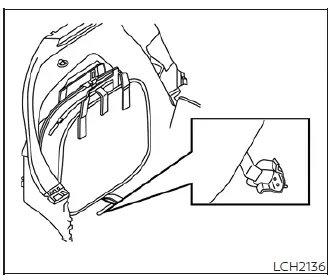
- Always pass the lower side belt of the EVSE case securely through the designated fastener on the luggage board to prevent it from becoming an unsecured projectile in the event of sudden braking or a vehicle collision.
CAUTION
- Only utilize a standard AC 110-120 volt, 15A dedicated electrical outlet for trickle charging. Do not attempt to charge via portable electric generators or non-standard power sources, as voltage instability may cause charging failures or irreversible damage to your Nissan Leaf or the EVSE hardware.
- NISSAN strongly advises using only Genuine NISSAN charging equipment to maintain optimal battery health and vehicle safety; the use of non-NISSAN equipment can interfere with correct charging protocols and potentially void vehicle component warranties.
Precautions on storage
- Avoid storing the EVSE in locations subject to prolonged, direct sunlight.
- Keep the EVSE away from environments exposed to high winds, moisture, or direct rain.
- Always secure the protective cap on the charge connector when not in use to safeguard the terminals from dust, debris, and environmental contaminants.
- Do not wrap the cable or cord tightly around the control box during storage, as this can cause internal strain.
- Ensure the cable and cord are stored in a relaxed, untwisted state to maintain the integrity of the internal wiring.
- The control box is designed to dissipate heat and may become warm during a charging session; this is a normal operational characteristic and not an indication of a malfunction.
To start trickle charging:
NOTE:
For your convenience, flexible charging options such as the Charging Timer, remote charge features (on models equipped with a navigation system), and immediate charge commands can all be utilized while in the trickle charge mode.
1. Secure the Nissan Leaf by pushing the P (Park) position switch and ensuring the parking brake is firmly applied.
2. To ensure a successful handshake between your charger and the vehicle, keep the power switch in the OFF position during the connection process. If the power switch is in the ON position, the system will inhibit the start of the charging cycle.
3. Gently open the exterior charge port lid. Refer to your vehicle’s "Charge port lid" documentation for further guidance if needed.
4. Retrieve your EVSE unit from its designated storage location within the rear luggage compartment.
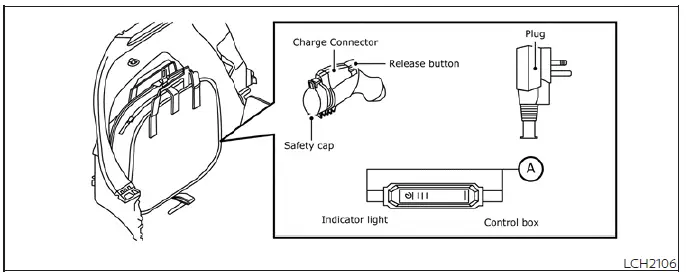
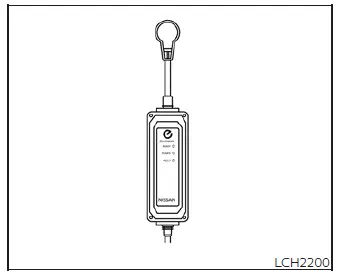
5. Insert the electrical plug into a dedicated AC 110-120 volt, 15A electrical outlet. A successful connection is indicated by the illumination of the green light on the EVSE control box, signaling that the unit is powered and ready.
NOTE:
The control box features integrated holes (labeled A) through which a cord can be passed to hang the unit securely while your Nissan Leaf is charging.
For optimal strain relief, always orient the EVSE so the plug is in an upright position, allowing the cable to extend directly downward from the outlet.
6. Open the internal charge port cap to reveal the charging inlet.
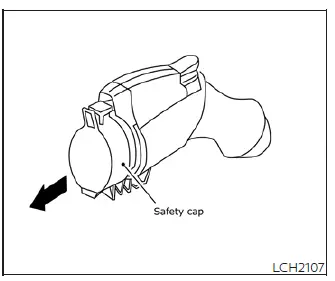
7. Carefully remove the protective safety cap from the charge connector.
8. Firmly connect the charge connector to the Nissan Leaf charge port. A single audible beep will sound, confirming that the vehicle has detected the connection.
9. Once the power transfer begins—or if the vehicle enters a standby state awaiting a scheduled charging timer—you will hear two consecutive beeps, and the charging status indicator light display will update to confirm the current mode.
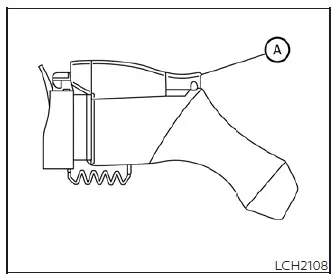
10. When performing outdoor charging, such as in your personal driveway, you may use a commercially available padlock through position A to secure the connector and prevent unauthorized removal or theft.
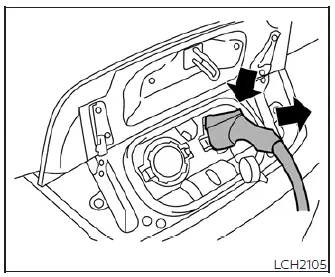
To stop trickle charge:
1. Before attempting to disconnect, confirm that the charge connector lock system is disengaged. See "Charge connector lock system" for details.
2. Press the release button on the connector, wait for the lock to disengage, and withdraw the charge connector from the port.
3. Securely close the internal charge port cap.
4. Replace the protective safety cap onto the EVSE connector head.
5. Carefully remove the electrical plug from the 110-120 volt, 15A wall outlet.
6. Properly coil the cable and store the EVSE in its protective carrying case.
NOTE: Follow these steps to ensure the EVSE is stored safely within its case:
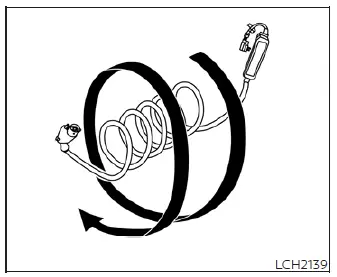
- Coil the charge cable into a loose loop, approximately 14 inches (36 cm) in diameter, to fit comfortably in the case.
Winding the cable in the specific direction shown below helps prevent excessive tension and preserves the long-term life of the cabling.
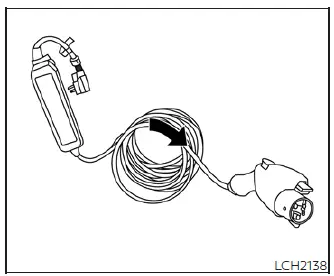
- Place the coiled EVSE unit into the carrying case.
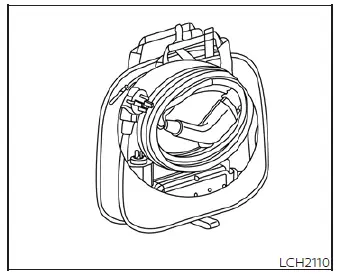
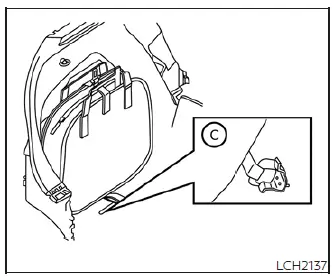
- Thread the lower side belt of the case through the fastener located on the bottom of the vehicle's luggage board (C).
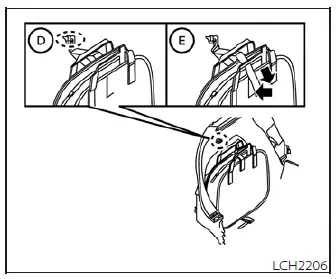
- Secure the case by attaching the hook (OD) to the trim ring.
- Tighten the belt (E) by pulling the end and fastening it securely with the hook-and-loop strip on the side of the case.
WARNING
You must pass the lower side belt of the EVSE case through the luggage board fastener securely. If the case is not properly restrained, it could shift during vehicle movement, potentially causing serious injury or worse in the event of a collision.
1. Ensure the internal cap is locked, then close the outer Nissan Leaf charge port lid until it latches.
NOTE:
Should you need to stop charging at any time, simply remove the charge connector; the Nissan Leaf charging system will detect the interruption and automatically cease all power flow.
 How to normal charge (AC 220-240 volt) by charging device
WARNING
If you utilize any medical electronic devices, such as an implantable cardiac pacemaker or an implantable cardiovascular defibrillator, please consult with the manufacturer of t ...
 How to trickle charge (AC 110-120 volt) by L1 & L2 EVSE
WARNING
If you use a pacemaker or an implantable cardiovascular defibrillator (ICD), you must maintain a distance of at least 6 inches (15 cm) from the EVSE (Electric Vehicle Supply Equ ...
Other materials:
Cylinder block
Exploded View
1. Cylinder block
2. Top ring
3. Second ring
4. Oil ring
5. Piston
6. Piston pin
7. Snap ring
8. Connecting rod
9. Connecting rod bearing (upper)
10. Connecting rod bearing (lower)
11. Crankshaft key
12. Connecting rod cap
13. Connecting rod cap bolt
14. Main ...
P183E yaw rate sensor
DTC Logic
DTC DETECTION LOGIC
DTC CONFIRMATION PROCEDURE
1.PRECONDITIONING
If “DTC CONFIRMATION PROCEDURE� has been previously conducted, always turn
ignition switch OFF and
wait at least 10 seconds before conducting the next test.
>> GO TO 2.
2.DTC REPRODUCTION PROCEDURE
W ...
P1650 starter motor relay 2
Description
ECM controls ON/OFF state of the starter relay, according to the engine and
vehicle condition. Models with no
Intelligent Key System transmit a control signal directly to IPDM E/R. On the
other hand, models with the Intelligent
Key System transmit a control signal to IPDM E/R by w ...
