
Nissan Leaf 2018-2025 (ZE1) Owner's Manual : How to trickle charge (AC 110-120 volt) by L1 & L2 EVSE
WARNING
- If you use a pacemaker or an implantable cardiovascular defibrillator (ICD), you must maintain a distance of at least 6 inches (15 cm) from the EVSE (Electric Vehicle Supply Equipment) to prevent potential interference with your medical device.
- Before initiating any charging process for your Nissan Leaf, consult with the manufacturer of your implantable cardiac device—such as a pacemaker or ICD—to fully understand the potential effects of the electromagnetic field generated during charging. Never overlook this step, as proper operation of your medical device is critical.
- To eliminate the risk of severe electric shock or fire caused by short circuits, ensure the charging equipment is connected exclusively to a GFI (Ground Fault Interrupter) circuit breaker and that the electrical socket is a properly rated, waterproof ground-type outlet.
- Stop using the EVSE immediately if you notice the plug or the outlet feels excessively hot to the touch, or if you perceive any unusual odors, which could indicate a developing electrical fault.
- Do not use extension cords under any circumstances; they are not rated for the continuous, high-current draw required for your Nissan Leaf.
- Only utilize a Genuine NISSAN Adapter designed for the EVSE; never attempt to use third-party plug adapters, as they may not meet the safety specifications required for your vehicle.
- Ensure the EVSE is unplugged from the wall outlet whenever it is not being used to charge your vehicle.
- The Genuine NISSAN L1 & L2 EVSE maintains a continuous 12-amp draw while charging the Li-ion battery on a standard AC 110-120 volt outlet. Never plug your equipment into a circuit without first confirming with a licensed electrician that the specific circuit can safely handle this sustained 12-amp load. Residential electrical systems are far more likely to experience dangerous failures under the following conditions:
- Incorrect operation of the EVSE poses a serious risk of fire, property damage, and potentially fatal injury.
- Avoid using the EVSE in residential structures that were built more than 40 years ago, as wiring degradation is more common.
- Never use the EVSE in environments where the electrical system relies on legacy fuse-based circuit protection; the Nissan Leaf must only be charged on circuits equipped with modern circuit breakers.
- Do not attempt to use the EVSE on older two-prong electrical outlets, which lack the necessary grounding for safe EV charging.
- Ensure that the charging circuit is dedicated; do not plug the EVSE into an outlet if other high-draw devices are active on the same circuit.
- When unplugging, always grasp the plug housing or the Genuine NISSAN Adapter body firmly, rather than yanking on the cable itself, to prevent internal wire breakage.
- Avoid mechanical stress on the cable; do not pull, sharply twist, bend, step on, or drag the charging cord across hard surfaces.
- Never connect or detach the Genuine NISSAN Adapter while it is live and inserted into the electrical outlet.
- Do not attempt to use the Genuine NISSAN Adapter if the plug is not fully seated and locked into the socket.
- Handle the EVSE holder with care during installation and use to avoid potential lacerations or injuries from sharp edges or mechanical parts.
- Cease all operations if the EVSE or Genuine NISSAN Adapter shows any signs of frayed cable insulation, exposed inner wiring, or any other visible damage.
- If moving the Genuine NISSAN Adapter, the plug, or the cord results in an intermittent charging cycle, stop the process immediately.
- Do not use the EVSE or Genuine NISSAN Adapter if any component—including the control box, plug, or charge connector—appears cracked, open, corroded, or structurally compromised.
- Avoid use if the connection between the plug or Genuine NISSAN Adapter and the electrical outlet feels loose, or if the outlet itself shows signs of rust or physical damage.
- Always review the rated current on the EVSE before connecting to ensure the wall outlet and the circuit breaker capacity are sufficient for the vehicle’s power needs, as an inadequate circuit will cause overheating and potential fire.
- If you possess any uncertainty regarding the safety or capacity of your wall outlet and electrical circuit, contact a qualified electrician for a professional assessment.
- Internal components of the device can generate sparks; never operate the unit in areas where gasoline, paints, or volatile flammable chemicals are used or stored.
- Should a malfunction occur or the EVSE/Genuine NISSAN Adapter sustain any physical damage, do not continue to use it. Visit your NISSAN certified LEAF dealer to obtain a proper, certified replacement.
- The EVSE and Genuine NISSAN Adapter are sealed units with no user-serviceable parts; attempting to perform internal repairs will not only be unsafe but will immediately void your vehicle warranty.
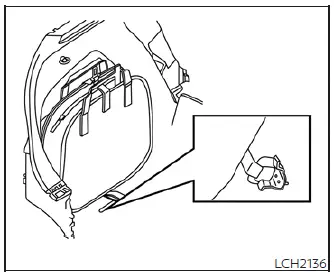
- Ensure you pass the lower side belt of the EVSE case securely through the designated fastener on the bottom of the luggage board to keep it fixed in place during transit.
- Ensure the lower side belt of the EVSE storage case is passed securely through the retention fastener located on the bottom of the vehicle's luggage board.
- If the storage case is not correctly anchored and suddenly becomes loose during transit, it may shift, potentially resulting in serious injury or death in the event of an accident.
CAUTION
- Only perform charging using a standard AC 110-120 volt, 15A dedicated electrical outlet. Avoid the use of portable electric generators, as inconsistent power output can cause the charging process to fail and may lead to damaging power surges that affect both your Nissan Leaf and the EVSE equipment.
- NISSAN strongly advises the exclusive use of Genuine NISSAN charging equipment to replenish the vehicle's battery. The utilization of non-NISSAN, third-party, or aftermarket hardware could compromise the charging efficiency of the Li-ion battery and risks causing permanent damage to the vehicle's onboard charging system.
Precautions on storage
- Do not store the EVSE and the Genuine NISSAN Adapter in any location that is subject to direct, prolonged sunlight.
- Avoid storing the EVSE and Genuine NISSAN Adapter in environments exposed to moisture, wind, or rain, which can degrade the components over time.
- Always ensure the EVSE is stored with the protective cap securely attached to the charge connector terminal to prevent the ingress of dirt, dust, and environmental contaminants.
- Do not wrap the cable or the power cord tightly around the control box during storage, as this can create undue stress on the internal connections.
- Always store the EVSE in a manner that avoids kinks or twists in the cable and cord, which helps maintain the structural integrity of the wiring.
- It is normal for the EVSE control box to become warm to the touch during a charging session due to thermal dissipation; this is a standard operational characteristic and does not indicate a malfunction.
To start trickle charging:
NOTE:
The Nissan Leaf supports various convenience features during trickle charge mode, including the Charging Timer, remote charge management (for models equipped with a navigation system), and standard immediate charging.
1. Ensure your vehicle is properly parked by engaging the P (Park) position switch and firmly applying the parking brake.
2. Before initiating the charging cycle for the Li-ion battery, ensure the vehicle's power switch is in the OFF position.
3. Please note that if the power switch is left in the ON position, the Nissan Leaf will prevent the Li-ion battery from initiating a charge for safety reasons.
4. Open the exterior charge port lid. For more information, please refer to the "Charge port lid" section of your owner's manual.
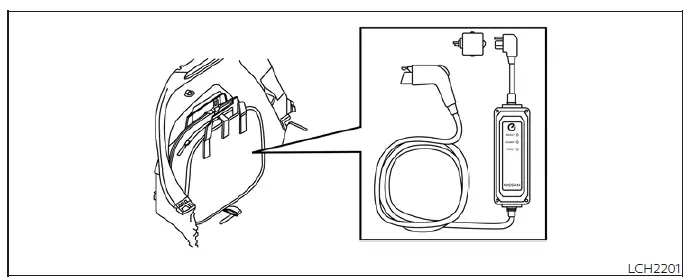
5. Retrieve your EVSE and the Genuine NISSAN Adapter from the rear hatch storage area.
6. Carefully connect the electrical plug into a dedicated AC 110-120 volt, 15A electrical outlet using the Genuine NISSAN Adapter. When the connection is successfully established, the green indicator light on the EVSE control box will illuminate, confirming the system is ready to deliver power.
NOTE:
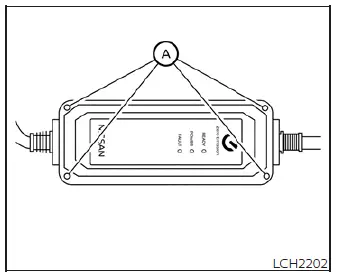
To keep the equipment tidy during a charge, you can pass a cord through the integrated holes (A) on the control box to hang it securely while your Nissan Leaf is charging.
For the best connection, always operate the EVSE with the plug in an upright position, ensuring the power cord hangs naturally downward from the outlet to prevent cable strain.
7. Open the internal charge port cap to access the vehicle inlet.
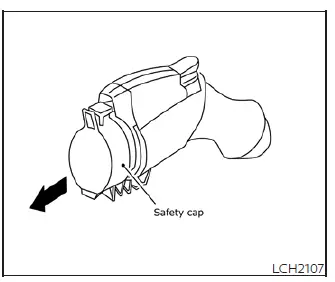
8. Remove the protective safety cap from the charge connector before attempting to connect it to the vehicle.
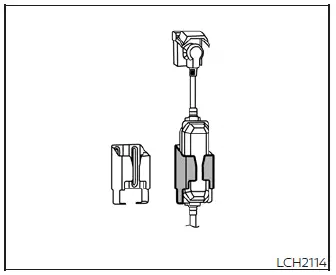
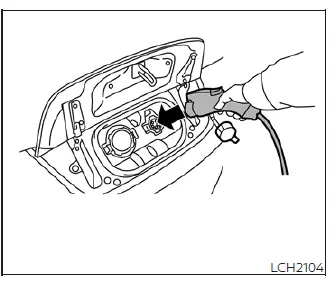
8. Firmly connect the charge connector to your Nissan Leaf charge port. A single audible beep will signify that the connection is secure and communication between the charger and the vehicle has been established.
9. Once the charging process initiates, or if the Nissan Leaf is correctly queued for a scheduled timer charge, you will hear two consecutive beeps, and the charging status indicator lights on your dashboard will update to reflect the current status.
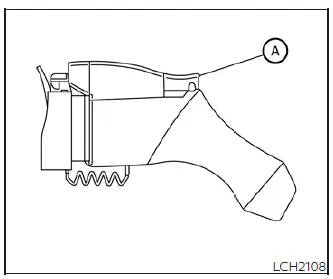
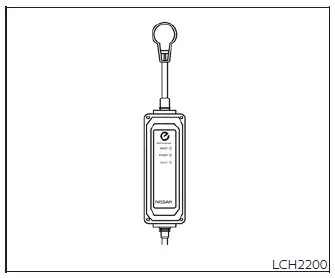
10. If you are recharging your Nissan Leaf in an outdoor environment, such as a shared or open driveway, you may use a commercially available padlock at position A to secure the connector, effectively preventing unauthorized removal or theft.
To stop trickle charge:
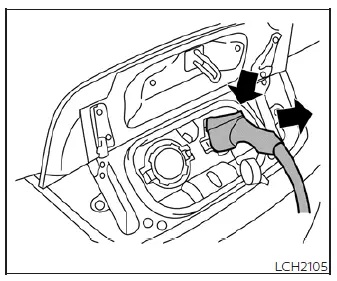
1. Before disconnecting, always confirm that the charge connector lock is not engaged. For detailed troubleshooting, refer to the "Charge connector lock system" section.
2. Press the release button located on the charge connector, wait for the mechanical lock to disengage, and then carefully withdraw the connector from the vehicle port.
3. Always reattach the protective safety cap to the EVSE connector head to keep the pins clean.
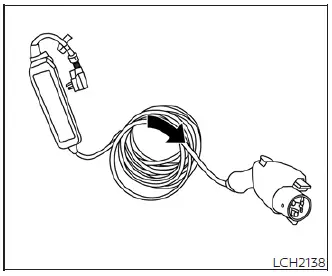
4. Carefully remove the electrical plug from the dedicated AC 110-120 volt, 15A wall outlet.
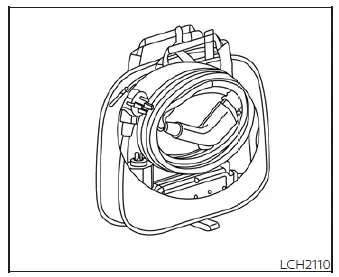
5. Safely coil the cable and store the EVSE components in the provided carrying case.
NOTE:
Follow this specific sequence to ensure the EVSE is packed correctly into its storage case:
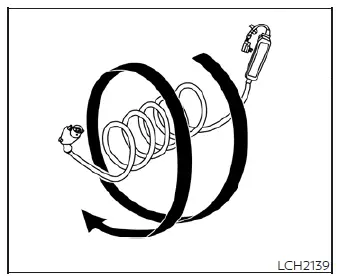
1. Coil the charging cable into a uniform size that fits easily within the case (approximately 14 inches or 36 cm in diameter). Winding the cable in the consistent direction shown above helps prevent kinking and internal wire damage, significantly extending the service life of your equipment.
2. Carefully place the bundled EVSE into the designated carrying case.
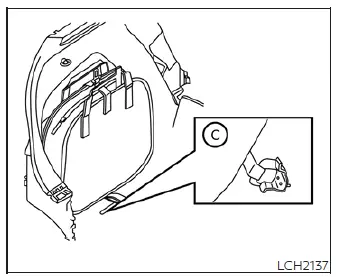
3. Thread the lower side belt of the storage case through the retention fastener located on the bottom of the luggage board (C).
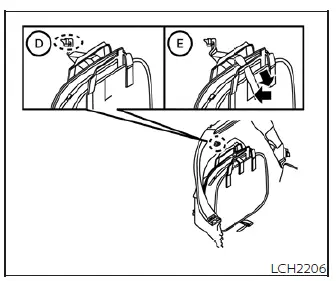
4. Hook the case clasp (D) onto the trim ring for added stability.
5. Tighten the belt (E) by pulling the end firmly and securing it with the hook-and-loop fastener on the side of the case.
WARNING
You must pass the lower side belt of the EVSE storage case securely through the luggage board fastener. If the case is left unsecured, it can shift violently during a sudden stop or collision, which may result in serious injury or death.
1. After the internal connector is removed and the safety cap is secured, close the outer charge port lid on your Nissan Leaf until it is fully latched.
NOTE:
If you need to stop the charging process before it is complete, simply remove the charge connector from the vehicle. The Nissan Leaf charging system will detect the disconnection and automatically terminate all power flow instantly.
 How to trickle charge (AC 110-120 volt) by L1 EVSE
WARNING
If you utilize a pacemaker or an implantable cardiovascular defibrillator (ICD), ensure you maintain a minimum distance of 6 inches (15 cm) from the EVSE (Electric Vehicle Suppl ...
 How to normal charge (AC 220-240 volt) by L1 & L2 EVSE
WARNING
Adhering strictly to the following safety protocols is mandatory. Failure to observe these warnings may result in severe property damage, critical system failure, or life-threatening inju ...
Other materials:
System
System Description
Fan speed of blower motor is changed by the combination of fan control dial
(fan switch) operation and blower
fan resistor control.
Door Control
SWITCHES AND THEIR CONTROL FUNCTIONS
1. Intake door
2. Blower motor
3. Air conditioner filter
4. Max. cool door
5. Upper ...
Additional service when replacing TCM
Description
Always perform the following items when the TCM is replaced.
CHECK LOADING OF CALIBRATION DATA
• The TCM acquires calibration data (individual characteristic value) of each
solenoid that is stored in the
ROM assembly (in the control valve). This enables the TCM to perform accur ...
B27A6, B27A7, B27A8, B27A9 mode door motor
DTC Logic
DTC DETECTION LOGIC
NOTE:
• If DTC is displayed along with DTC U1000, first perform the trouble diagnosis
for DTC U1000. Refer to HAC-
51, "DTC Logic".
• If DTC is displayed along with DTC U1010, first perform the trouble diagnosis
for DTC U1010. HAC-52,
"DTC L ...
