
Nissan Leaf 2018-2025 (ZE1) Owner's Manual : How to normal charge (AC 220-240 volt) by L1 & L2 EVSE
WARNING
Adhering strictly to the following safety protocols is mandatory. Failure to observe these warnings may result in severe property damage, critical system failure, or life-threatening injury.
- If you are fitted with a pacemaker or an implantable cardiovascular defibrillator (ICD), you must maintain a physical separation of at least 6 inches (15 cm) from the EVSE during operation to avoid electromagnetic interference.
- Before initiating any charging sequence for your Nissan Leaf, consult with the manufacturer of your implantable medical device to confirm the potential impact of the charging equipment's electromagnetic field on your specific device.
- To mitigate the risk of electric shock or fire resulting from short circuits, the EVSE must be connected exclusively to a dedicated GFI (Ground Fault Interrupter) circuit breaker and a properly rated, waterproof grounded electrical outlet.
- Immediately cease using the EVSE if you detect excessive heat buildup at the plug or outlet, or if you notice any unusual burning odors, which may indicate a hazardous electrical fault.
- Under no circumstances should you utilize extension cords or third-party electrical plug adapters, as these items are not designed to handle the continuous high-current load required by the Nissan Leaf charging system.
- Always use only the Genuine NISSAN Adapter designed specifically for your equipment; attempting to use unauthorized adapters can compromise the integrity of the connection and the vehicle's electrical safety.
- Disconnect the EVSE from the power source promptly when the charging session is complete and the equipment is not in active use.
- The Genuine NISSAN L1 & L2 EVSE is engineered to draw 30 amps continuously while charging the Li-ion battery on an AC 220-240 volt circuit. Before connecting your Nissan Leaf, you must have a licensed electrician verify that your electrical infrastructure can safely sustain this sustained 30-amp load. Residential electrical systems are significantly more prone to failure under the following dangerous conditions:
- Incorrect operation or installation of the EVSE poses a severe risk of fire, property destruction, and fatal injury.
- Avoid using the EVSE in residential properties constructed more than 40 years ago, as legacy wiring may not meet the safety standards required for high-load EV charging.
- Do not utilize the EVSE in homes that rely on outdated, fuse-based circuit protection systems.
Charging must only be performed on electrical circuits equipped with modern, properly functioning circuit breakers.
- Do not attempt to connect the EVSE to electrical circuits using ungrounded, two-prong outlets.
- Ensure the charging circuit is dedicated; do not plug the EVSE into an outlet if other high-consumption appliances are drawing power from the same circuit.
- When disconnecting the equipment, always grasp the plug housing firmly; never pull on the cable itself, as this can cause internal wire fatigue and breakage.
- Avoid mechanical stress on the charging cable; do not pull, twist, sharply bend, step on, or drag the cable across abrasive surfaces.
- If you are using an EVSE holder, exercise caution during installation to avoid accidental cuts or injuries from the device's edges or mounting components.
- Immediately stop use if the charging cable or power cord shows signs of fraying, compromised insulation, or visible internal wiring.
- Discontinue the charging process immediately if the Nissan Leaf stops charging prematurely when the plug or cord is moved, as this indicates a loose connection.
- Do not operate the EVSE if the control box, plug, or charge connector appears cracked, structurally compromised, corroded, or otherwise damaged.
- Do not use the EVSE if the plug does not fit snugly into the outlet, or if the wall outlet itself exhibits signs of rust, scorching, or physical wear.
- Always verify the rated current specifications on the EVSE before connection to ensure your outlet and circuit capacity match the vehicle’s power requirements; failing to do so may lead to dangerous wiring overheating or fire.
- If you harbor any doubts regarding the safety or capacity of your wall outlet and electrical circuit, contact a qualified, licensed electrician for a professional assessment.
- Because the EVSE may generate internal sparks during normal operation, never use the unit in environments where gasoline, paints, or other volatile flammable chemicals are stored or utilized.
- In the event of a malfunction or if the EVSE sustains any physical impact or damage, stop using the unit immediately. It is strongly recommended that you visit a NISSAN certified LEAF dealer to obtain a certified, safe replacement.
- The EVSE is a sealed, high-voltage component containing no user-serviceable parts; any attempt to perform internal repairs will be hazardous and will immediately void your vehicle warranty.
- Ensure the lower side belt of the EVSE case is passed securely and tightly through the retention fastener located on the bottom of the luggage board to prevent the kit from shifting during transit.
- Ensure the lower side belt of the EVSE storage case is passed securely through the retention fastener located on the bottom of the luggage board. If the case is not properly anchored and suddenly becomes loose during vehicle operation, it may shift, potentially resulting in serious injury or death.
- Charging must only be performed using a standard, dedicated AC 220-240 volt, 50A electrical outlet. Never attempt to use an electric generator, as the inconsistent power supply can result in charging failure or significant damage to your Nissan Leaf and the EVSE equipment due to voltage surges.
- NISSAN strongly recommends using only Genuine NISSAN charging equipment to charge your vehicle. Utilizing non-NISSAN or third-party hardware can cause the Li-ion battery to fail to charge correctly and may cause permanent damage to your vehicle or the charging unit.
- Avoid storing the EVSE and Genuine NISSAN Adapter in locations subject to direct, prolonged exposure to sunlight.
- Keep the EVSE and Genuine NISSAN Adapter away from areas exposed to moisture, wind, or rain to prevent component degradation.
- Always ensure the protective cap is securely attached to the charge connector terminal during storage to safeguard the contacts from dirt, dust, and debris.
- Never store the EVSE with the cable or power cord wound tightly around the control box, as this creates excessive mechanical stress on the internal wiring.
- Do not store the equipment in a manner that leaves the cables or cords twisted or kinked.
- It is normal for the control box to become warm during a charging session; this is a standard thermal characteristic and does not indicate a malfunction.
- Normal charging for your Nissan Leaf (AC 220-240 volt) is conducted using the provided L1 & L2 EVSE connected to a dedicated AC 220-240 volt, 50A electrical outlet.
- The L1/L2 EVSE plug must be connected to a NEMA 14-50 outlet that is supplied by a single-phase power supply derived from a delta connection.
- If the EVSE is connected to an incompatible type of power supply, the unit will not operate normally.
CAUTION
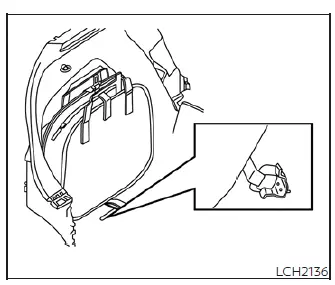
Precautions on storage
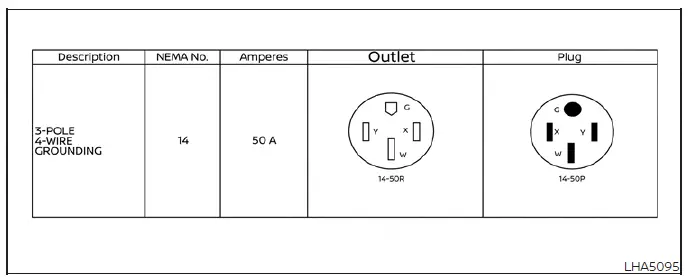
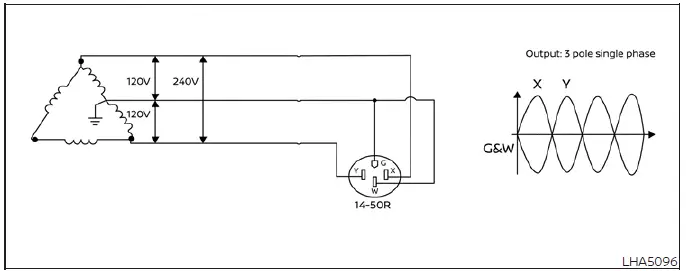
Correct electric outlet connection
If connected to a three-phase power supply, the EVSE will not function normally.
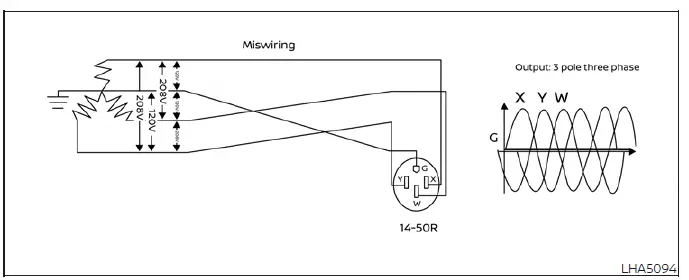
Incorrect electric outlet connection
If the EVSE is connected to a miswired outlet, the system will not initiate charging, and the POWER indicator light (orange) on the control box will blink.
To start normal charging
NOTE:
Flexible charging features, including the Charging Timer, remote charge commands (on models equipped with a navigation system), and immediate charge, are fully supported in the normal charge mode for the Nissan Leaf.
1. Secure the vehicle by engaging the P (Park) position switch and firmly applying the parking brake.
2. Before initiating the Li-ion battery charge, ensure the vehicle's power switch is in the OFF position.
3. Please note that if the power switch is left in the ON position, the Nissan Leaf will prevent the charging cycle from starting.
4. Open the exterior charge port lid to prepare for connection.
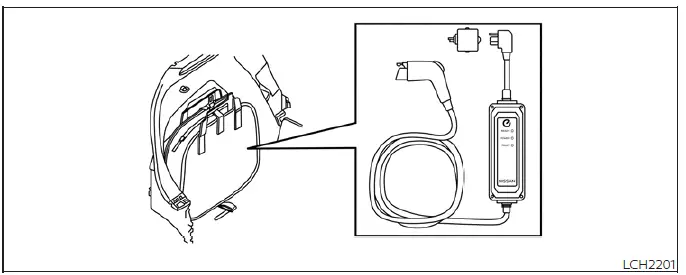
5. Retrieve your EVSE from the rear hatch area. Connect the electrical plug into a dedicated AC 220-240 volt, 50A electrical outlet. Upon a successful connection, the green indicator light on the EVSE control box will illuminate.
NOTE:
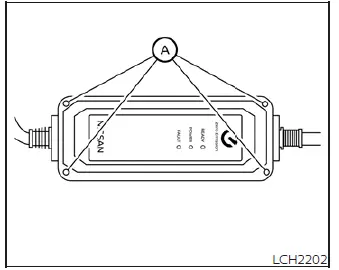
For your convenience, you may pass a rope through the integrated holes (A) on the control box or utilize the dedicated holder to keep the unit suspended safely while your Nissan Leaf is charging.
Always utilize the EVSE with the electrical plug oriented in an upright position. The power cord should be allowed to hang naturally and extend downward from the outlet to prevent unnecessary strain on the connection points.
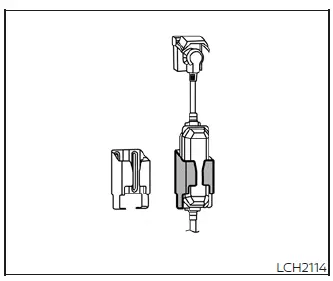
6. Carefully open the outer charge port cap on your Nissan Leaf.
7. Remove the protective safety cap from the charge connector before attempting to connect it to the vehicle.
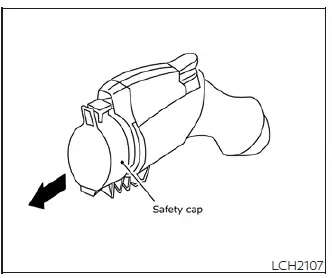
7. Remove the safety cap from the charge connector.
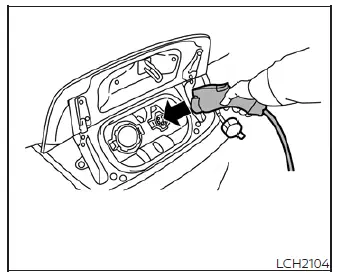
8. Firmly insert the charge connector into the Nissan Leaf charge port. A single audible beep confirms that the connector is properly seated and a connection has been established.
9. Once the charging cycle initiates, or if the Nissan Leaf is currently queued for a charging timer event, the system will emit two beeps, and the charging status indicator light on the dashboard will transition to show the updated status.
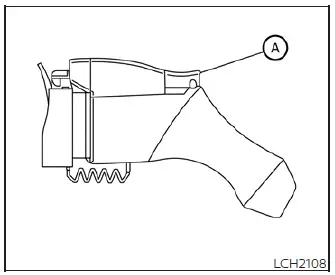
10. If you are recharging your Nissan Leaf in an exposed outdoor environment, such as a driveway, we recommend using a commercially available padlock through position A to secure the connector and prevent unauthorized removal or theft.
To stop normal charging:
1. Before attempting to disconnect, confirm that the charge connector lock is not engaged. For further details, refer to the "Charge connector lock system" section in your owner's manual.
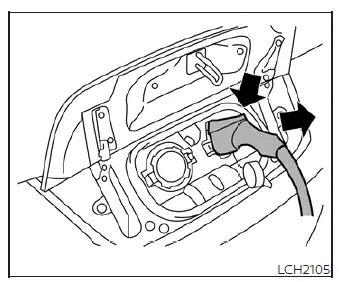
2. Firmly press the release button on the charge connector to disengage the mechanical lock, then withdraw the connector from the Nissan Leaf charge port.
3. Secure the protective safety cap back onto the EVSE connector.
4. Carefully remove the electrical plug from the dedicated AC 220-240 volt, 50A outlet.
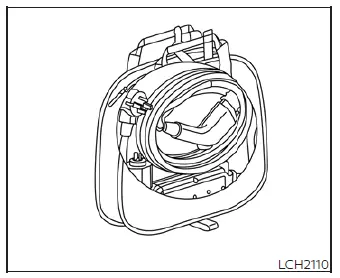
5. Return the EVSE to its protective storage case.
NOTE:
Follow this prescribed procedure to pack the EVSE into its case correctly:
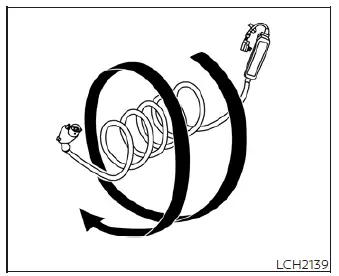
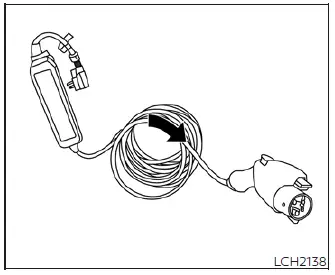
1. Coil the charge cable into a neat loop (approximately 14 inches or 36 cm in diameter) that fits comfortably within the case. Winding the cable in the consistent direction illustrated above helps prevent kinks and internal strain, preserving the long-term integrity of the cable.
2. Place the bundled EVSE components securely into the case.
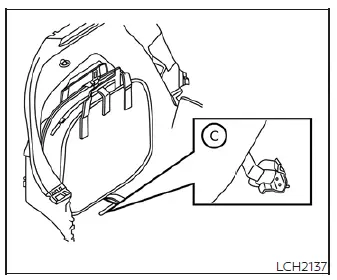
3. Thread the ring of the case’s lower side belt through the retention fastener located on the bottom of the luggage board (C).
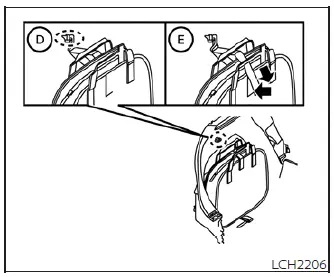
4. Securely attach the case hook (D) to the corresponding ring on the interior trim.
5. Tighten the belt (E) by pulling firmly and securing it with the hook-and-loop fastener located on the exterior of the case.
WARNING
You must ensure the lower side belt of the EVSE case is passed securely through the luggage board fastener. If the case is not properly anchored, it may shift during vehicle operation, creating a hazard that could lead to serious injury or even death.
NOTE:
To interrupt a charging session prematurely, simply remove the charge connector from the vehicle inlet. The Nissan Leaf charging system will detect the release and automatically cease all power delivery.
 How to trickle charge (AC 110-120 volt) by L1 & L2 EVSE
WARNING
If you use a pacemaker or an implantable cardiovascular defibrillator (ICD), you must maintain a distance of at least 6 inches (15 cm) from the EVSE (Electric Vehicle Supply Equ ...
 How to quick charge
Quick charging allows you to replenish your Nissan Leaf battery in a significantly shorter period by utilizing public high-capacity charging stations. Depending on your specific vehicle configuration, ...
Other materials:
Aluminum alloy wheels
Wash regularly with a sponge dampened in a mild soap solution, especially during
winter months in areas where road salt is used. Salt could discolor the wheels if
not removed.
CAUTION
Follow the directions below to avoid staining or discoloring the wheels:
• Do not use a cleaner that uses s ...
Vehicle loading information
WARNING
It is extremely dangerous to ride in the cargo area inside the vehicle.
In the event of a collision, individuals positioned in these unsecured areas are significantly more likely to suffer serious injury or fatalities.
Never allow passengers to ...
Air conditioning cut control
Air conditioning cut control : System Diagram
Air conditioning cut control : System Description
INPUT/OUTPUT SIGNAL CHART
*: ECM determines the start signal status by the signals of engine speed and
battery voltage.
SYSTEM DESCRIPTION
This system improves engine operation when the air ...
