
Nissan Leaf 2018-2025 (ZE1) Owner's Manual : Three-point type seat belt with retractor
WARNING
- Every person who drives or rides in this vehicle should use a seat belt at all times to ensure maximum protection.
- Never ride in a moving vehicle while the seatback is significantly reclined. This practice is inherently dangerous as the shoulder belt will not maintain proper contact with your body. In the event of an accident, you could be forcefully thrown against the belt, resulting in severe neck or other critical injuries.
Furthermore, you risk sliding underneath the lap belt, which could lead to life-threatening internal injuries.
- For the most effective protection while the Nissan Leaf is in motion, ensure the seatback is in an upright position. Always sit well back in the seat with both feet firmly planted on the floor and adjust the seat belt for a precise, snug fit.
- Strictly prohibit children from playing with seat belts. Most seating positions in your Nissan Leaf are equipped with Automatic Locking Retractor (ALR) mode seat belts.
If a seat belt becomes wrapped around a child's neck while the ALR mode is activated, the child can suffer serious injury or death as the belt automatically retracts and tightens. This danger exists even while the vehicle is parked.
Immediately unbuckle the seat belt to release the child. If the mechanism is jammed or the belt cannot be unbuckled, prioritize the child's safety by cutting the seat belt with a suitable tool, such as a sturdy knife or heavy-duty scissors, to release the tension.
Fastening the seat belts
1. Before fastening, ensure your seat is properly adjusted for a comfortable and safe driving posture.
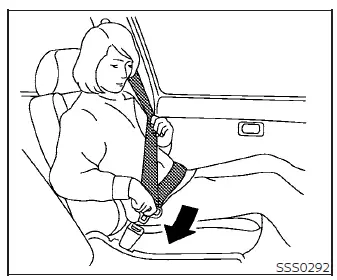
2. Slowly and steadily pull the seat belt out of the retractor and insert the metal tongue into the buckle until you hear a definitive click, confirming that the latch is securely engaged.
- The retractor is engineered to automatically lock during a sudden stop or impact to hold you securely in place.
A slow, fluid pulling motion allows the belt to extend smoothly, granting you the necessary freedom of movement during normal driving conditions in your Nissan Leaf.
- If you encounter resistance and the seat belt cannot be pulled from its retracted position, give the belt a firm, quick pull to reset the mechanism, then release it. You should then be able to smoothly pull the belt out from the retractor.
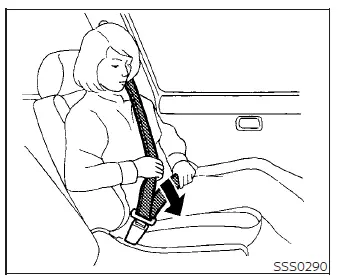
3. Always position the lap belt portion as low and snug as possible across your hips, as illustrated, to provide optimal security.
4. Pull the shoulder belt portion toward the retractor to eliminate any excess slack. Verify that the shoulder belt is routed properly over your shoulder and across your chest, never cutting into your neck.
The front passenger seat and rear seating positions in the Nissan Leaf are equipped with three-point seat belts that feature two distinct modes of operation:
- Emergency Locking Retractor (ELR)
- Automatic Locking Retractor (ALR)
The ELR mode is the standard operating mode, allowing the seat belt to extend and retract freely, giving the driver and passengers comfort and mobility. The ELR system will instantly lock the belt if the vehicle decelerates rapidly or during specific impact events.
The ALR mode (commonly known as the child restraint mode) is designed to lock the seat belt firmly in place, which is necessary for the proper installation of child safety seats.
Once ALR mode is engaged, the belt will not extend again until the tongue is detached from the buckle and the webbing is fully retracted into the housing. The system will automatically revert to ELR mode once the belt has fully retracted.
The ALR mode is intended exclusively for the installation of child restraints. During standard daily use by adult or child passengers, ensure the ALR mode is not activated. Engaging it during normal use can lead to uncomfortable and excessive seat belt tension.
WARNING
Before setting off, confirm that all seatbacks in your Nissan Leaf are completely secured in the latched upright position. Unsecured seatbacks pose a significant safety risk and may result in serious injury during an accident or emergency stop.
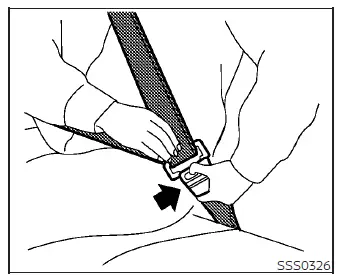
Unfastening the seat belts
To release the seat belt, simply press the release button located on the buckle. The belt is designed to retract automatically into the housing; guide it gently to ensure it does not twist.
Checking seat belt operation
The seat belt retractors in your Nissan Leaf are engineered to lock and secure the seat belt webbing through two distinct, highly responsive mechanisms:
- When the belt is pulled outward with sudden force or speed.
- When the vehicle experiences a rapid deceleration or impact.
To verify that your seat belt system is functioning correctly and to maintain confidence in your safety equipment, perform the following inspection:
- Grasp the shoulder belt firmly and pull it forward with a quick, sharp motion. The internal retractor should lock instantly, effectively restricting any further movement of the belt.
Should the retractor fail to lock during this test, the system requires immediate professional attention. It is strongly recommended that you visit a certified Nissan Leaf dealer for a comprehensive inspection or to learn more about the advanced operation of your safety systems.
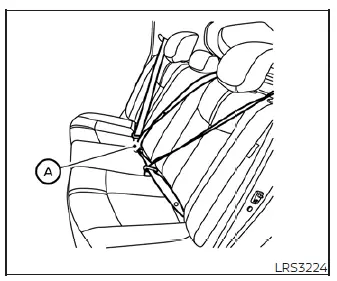
Center of rear seat
Selecting the correct set of seat belts:
To ensure proper safety for all passengers, the rear center seat belt buckle is clearly identified by the "CENTER" mark A. For your protection, the rear center seat belt tongue is uniquely designed to fasten exclusively into this specific matching center buckle.
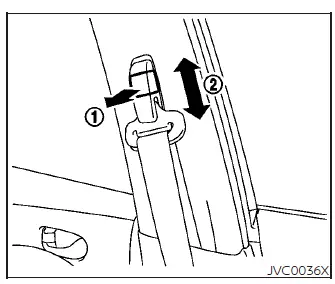
Shoulder belt height adjustment (front seats)
The shoulder belt anchor height can be customized, allowing you to adjust the belt to the precise position that offers the best fit for your body type.
For further details regarding optimal seating geometry, please refer to the "Precautions on seat belt usage" section.
To adjust the height, pull outward on the adjustment button 1, then slide the shoulder belt anchor to your preferred position 2. Ensure the belt is routed comfortably across the center of your shoulder. The belt should remain clear of your face and neck, while still sitting securely on your shoulder without sliding off.
Once you have achieved the ideal height, release the adjustment button to firmly lock the shoulder belt anchor into place.
WARNING
- After performing an adjustment, always release the button and physically attempt to slide the anchor up and down to confirm that it is locked securely in position.
- The shoulder belt anchor height must be tailored to your specific stature. Failure to adjust this correctly may diminish the effectiveness of the entire occupant restraint system, thereby increasing the risk or potential severity of injuries during a collision.
Seat belt extenders
If you find that your seat belt does not properly fit due to body size or your preferred driving position, a compatible seat belt extender is available for purchase. This accessory provides an additional 8 in (200 mm) of length and is approved for use in both the driver and front passenger seating positions of your Nissan Leaf.
Should you require an extender, please consult a certified Nissan Leaf dealer for assistance in acquiring a unit specifically designed for your vehicle.
WARNING
- Use only genuine Nissan seat belt extenders, manufactured by the original equipment supplier, to ensure full compatibility and safety with your existing seat belt system.
- Seat belt extenders are intended solely for those who cannot fit into the standard belt. Adults and children who can comfortably use the standard seat belt should never use an extender, as unnecessary use could lead to serious injury in the event of an accident.
- Never utilize a seat belt extender when installing a child restraint system. Failure to secure a child restraint correctly can lead to catastrophic consequences for the child in a collision or during sudden braking.
Seat belt maintenance
- To maintain the integrity of your seat belts, clean the webbing using a mild soap solution or a dedicated upholstery and carpet cleaner. Gently wipe the belts with a clean cloth and allow them to air dry completely in the shade. Do not allow the belts to retract back into the housing until they are thoroughly dry.
- If you notice the belts retracting slowly, it may be due to dirt buildup within the shoulder belt guides. Clean these guides periodically using a clean, dry cloth.
- Regularly inspect the seat belt assembly, including buckles, tongues, retractors, flexible wires, and anchor points, to ensure they remain in peak working order. If you detect loose components, significant deterioration, fraying, or cuts in the webbing, the entire seat belt assembly must be replaced immediately to ensure the continued safety of your Nissan Leaf.
 Seat belt warning light and chime
To ensure maximum safety for all occupants, your Nissan Leaf is equipped with an advanced seat belt reminder system for both the driver and front passenger positions. This system ...
 Child safety
WARNING
Never allow children to play with the seat belts in your Nissan Leaf. Most seating positions are equipped with Automatic Locking Retractor (ALR) mode seat belts designed for child restrai ...
Other materials:
Security indicator lamp
Component Function Check
1.CHECK FUNCTION
1. Perform “THEFT IND� in the “ACTIVE TEST� mode of “BCM� using
CONSULT-III.
2. Check security indicator lamp operation.
Is the inspection result normal?
YES >> INSPECTION END
NO >> Go to SEC-227, "Diagnosis Procedure&q ...
NISSAN customer care program
NISSAN CARES ...
Both NISSAN and your NISSAN dealer are dedicated to serving all your automotive
needs. Your satisfaction with your vehicle and your NISSAN dealer are our primary
concerns. Your NISSAN dealer is always available to assist you with all your automobile
sales and service needs.
...
Fuel level sensor unit
Exploded View
1. Lock ring
2. Fuel level sensor unit
3. Seal packing
A. To fuel tank
: Always replace after every
disassembly
Removal and Installation
WARNING:
Read “General Precautions� when working on the fuel system. Refer to FL-45,
"General Precautions".
REMOVAL
1 ...
