
Nissan Leaf 2018-2025 (ZE1) Owner's Manual : Child safety
WARNING
Never allow children to play with the seat belts in your Nissan Leaf. Most seating positions are equipped with Automatic Locking Retractor (ALR) mode seat belts designed for child restraint installation. If a seat belt becomes wrapped around a child's neck while the ALR mode is engaged, the belt can automatically retract and tighten, posing a severe risk of injury or death. This dangerous situation can occur even while the vehicle is parked. If this happens, immediately unbuckle the seat belt to release the child. If the mechanism is jammed or the belt cannot be unbuckled, prioritize the child's safety by cutting the seat belt with a suitable tool, such as a sturdy knife or scissors, to release the tension.
Children rely on adults to ensure their protection, and they must always be properly restrained during travel.
Beyond the guidance provided in this manual, a wealth of child safety information is available from professionals and authorities, including pediatricians, educators, government traffic safety departments, and local community organizations. Because every child is unique in their development, take the time to research and implement the safest methods for transporting your child in the Nissan Leaf.
There are three primary categories of child restraint systems:
- Rear-facing child restraint
- Forward-facing child restraint
- Booster seat
Selecting the correct restraint depends entirely on the child's physical development and size. Generally, infants up to approximately 1 year of age and weighing less than 20 lbs. (9 kg) should be secured in rear-facing restraints. Once a child has outgrown their rear-facing seat and is at least 1 year old, they should transition to a forward-facing child restraint. Booster seats are designed to correctly position the standard lap/shoulder belt for children who have outgrown their forward-facing harnesses.
WARNING
Infants and children require specialized protection, as standard vehicle seat belts are not designed to fit their smaller frames. The shoulder belt may cross too close to a child's face or neck, and the lap belt may fail to sit securely over their hip bones. In the event of a collision, an improperly fitting seat belt can lead to severe or fatal injuries. Always utilize age- and size-appropriate child restraints.
Please note that all U.S. states and Canadian provinces or territories have strict legal requirements regarding the use of approved child restraints for infants and small children. For further technical details, see the "Child restraints" section of this guide.
A child restraint may be securely installed in your Nissan Leaf by utilizing either the LATCH (Lower Anchor and Tethers for CHildren) system or the vehicle's standard three-point seat belt system.
Nissan strongly recommends that all pre-teens and children be restrained in the rear seat.
According to comprehensive accident statistics, children are significantly safer when properly secured in the rear seating area compared to the front seat. This is particularly vital in the Nissan Leaf, as the front passenger seating position is equipped with a supplemental restraint system (air bag system) that could pose risks to smaller passengers.
Infants
Infants up to at least 1 year old should always be transported in a rear-facing child restraint. Nissan recommends utilizing child restraints that fully comply with Federal Motor Vehicle Safety Standards or Canadian Motor Vehicle Safety Standards. Always select a restraint that is compatible with your Nissan Leaf and strictly adhere to the manufacturer's installation and operational instructions.
Small children
Children over 1 year of age weighing at least 20 lbs. (9 kg) should remain in a rear-facing child restraint for as long as possible, adhering to the height or weight limits specified by the seat manufacturer. Once a child has reached the upper limits of their rear-facing seat and is at least 1 year old, they should be secured in a forward-facing child restraint equipped with a harness. Always refer to the restraint manufacturer's instructions regarding specific weight and height limitations.
Nissan recommends that small children be placed in child restraints that meet Federal or Canadian Motor Vehicle Safety Standards. Choose a restraint that fits your Nissan Leaf correctly and always follow the manufacturer's provided instructions for safe installation and use.
Larger children
Children should continue to use a forward-facing child restraint with an internal harness until they reach the maximum height or weight capacity allowed by the seat manufacturer. Once a child outgrows this harness-equipped restraint, Nissan recommends transitioning to a commercially available booster seat to ensure the vehicle's seat belt provides optimal fit and protection.
For a seat belt to function correctly, the booster seat must elevate the child so the shoulder belt is positioned securely across the center of the chest and the top-middle portion of the shoulder. The shoulder belt must never cross the neck or face, nor should it slide off the shoulder. The lap belt should sit snugly across the lower hips or upper thighs, rather than resting on the abdomen.
A booster seat may only be utilized in seating positions equipped with a three-point type seat belt. The booster seat must be compatible with the vehicle seat and feature a label certifying compliance with Federal or Canadian Motor Vehicle Safety Standards. Once a child has grown sufficiently that the shoulder belt no longer crosses the face or neck and the lap belt sits properly across the lower hips or upper thighs, they may safely transition to using the seat belt without a booster seat.
A booster seat should remain in use until the child can pass the following fitment test:
- Are the child's back and hips positioned firmly against the vehicle seatback?
- Is the child able to sit upright comfortably without slouching?
- Do the child's knees bend easily over the front edge of the seat with feet resting flat on the floor?
- Can the child safely wear the seat belt, with the lap belt low and snug across the hips and the shoulder belt crossing the mid-chest and shoulder?
- Is the child able to utilize the properly adjusted head restraint/headrest?
- Will the child be able to remain in this proper position for the duration of the entire ride?
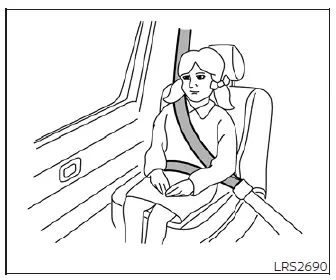
If you answer no to any of these criteria, the child should continue using a booster seat secured by the three-point seat belt system.
NOTE:
Regulations in certain communities may differ. Always verify local and state requirements to confirm that your child is using the correct, compliant restraint system before traveling.
WARNING
Never permit a child to stand or kneel on any seat, and strictly prohibit children from riding in the cargo areas of the Nissan Leaf. Any child not properly restrained could be seriously injured or killed during an accident or a sudden braking maneuver.
 Three-point type seat belt with retractor
WARNING
Every person who drives or rides in this vehicle should use a seat belt at all times to ensure maximum protection.
Never ride in a moving vehicle while the seatback is ...
 Child restraints
...
Other materials:
No engine braking
Description
CHART 11: NO ENGINE BRAKING
Diagnosis Procedure
1.CHECK ECM POWER SUPPLY AND GROUND CIRCUIT
Check ECM power supply and ground circuit. Refer to EC-885, "Diagnosis
Procedure".
Is the inspection result normal?
YES >> GO TO 2.
NO >> Repair or replace harne ...
Precaution for Supplemental Restraint System (SRS) "AIR BAG" and "SEAT BELT
PRE-TENSIONER"
The Supplemental Restraint System such as “AIR BAG� and “SEAT BELT PRE-TENSIONER�,
used along
with a front seat belt, helps to reduce the risk or severity of injury to the
driver and front passenger for certain
types of collision. Information necessary to service the system safely is
...
Precaution for Work
• When removing or disassembling each component, be careful not to damage or
deform it. If a component
may be subject to interference, be sure to protect it with a shop cloth.
• When removing (disengaging) components with a screwdriver or similar tool, be
sure to wrap the component
with a ...
