
Nissan Juke Owners Manual : Front-seat Active Head Restraints
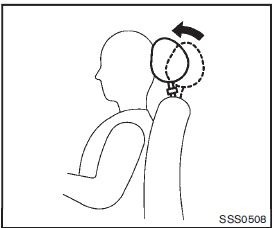
The Active Head Restraint moves forward utilizing the force that the seatback receives from the occupant in a rear-end collision. The movement of the head restraint helps support the occupant’s head by reducing its backward movement and helping absorb some of the forces that may lead to whiplash-type injuries.
Active Head Restraints are effective for collisions at low to medium speeds in which it is said that whiplash injury occurs most.
Active Head Restraints operate only in certain rear-end collisions. After the collision, the head restraints return to their original positions.
The front head restraints have multiple adjustment notches.
Properly adjust the Active Head Restraints as described in this section.
 Adjust
For adjustable head restraint/headrest
Adjust the head restraint/headrest so the center is level with the center of
your ears. If your ear position is still higher than the recommended alignment, ...
 Seat belts
...
Other materials:
P1726 throttle control signal
Description
Electric throttle control actuator consists of throttle control motor,
accelerator pedal position sensor, throttle
position sensor etc. The actuator sends a signal to the ECM, and ECM sends the
signal to TCM with CAN
communication.
DTC Logic
DTC DETECTION LOGIC
DTC CONFIRMATI ...
HR16DE : Inspection and Adjust
INSPECTION
Magnetic Switch Check
• Before starting to check, disconnect the battery cable from the negative
terminal.
• Disconnect “M� terminal of starter motor.
1. Continuity test [between “S� terminal (A) and switch body]
B : “B� terminal
C : “M� terminal
• Replace ...
Secondary speed sensor
Exploded View
1. Transaxle assembly
2. Secondary speed sensor
3. O-ring
: Always replace after every
disassembly.
: N·m (kg-m, in-lb)
: Genuine NISSAN CVT Fluid NS-2
Removal and Installation
REMOVAL
1. Remove air cleaner case. Refer to EM-26, "Removal and Installation".
2. ...
