
Nissan Juke Service and Repair Manual : Fluid cooler system
Exploded View
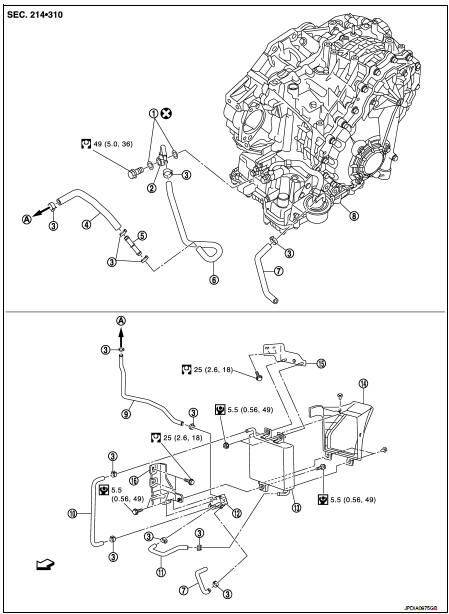
1. Copper washer
2. CVT fluid cooler tube
3. Hose clamp
4. Fluid cooler hose A
5. Fluid cooler tube
6. Fluid cooler hose B
7. Fluid cooler hose C
8. Transaxle assembly
9. Fluid cooler hose D
10. Fluid cooler hose E
11. Fluid cooler hose F
12. Bypass valve
13. Fluid cooler
14. Air guide
15. Bracket A
16. Bracket B
A. To radiator
 : Vehicle side
Removal and Installation
REMOVAL
1. Remove engine under cover.
2. Remove front bumper assembly. Refer to EXT-13, "Removal and Installation".
3. Remove air guide from fluid cooler.
4. Remove fluid cooler hose E and fluid cooler hose F.
5. Remove fluid cooler.
6. Remove air duct (inlet). Refer to EM-26, "Removal and Installation".
7. Remove fluid cooler hose C and fluid cooler hose D.
8. Remove bypass valve from bracket B.
9. Remove fluid cooler hose A and fluid cooler hose B.
10. Remove fluid cooler tube.
11. Remove bracket A and bracket B.
12. Remove CVT fluid cooler tube from transaxle assembly.
INSTALLATION
Note the following, and install in the reverse order of removal.
CAUTION:
Never reuse copper washer.
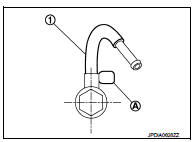
• When installing CVT fluid cooler tube (1) to transaxle assembly: - Contact CVT fluid cooler tube a boss portion (A) of the transaxle case.
- Tighten the bolt of CVT fluid cooler tube without moving the CVT fluid cooler tube
• Refer to the followings when installing fluid cooler hose.
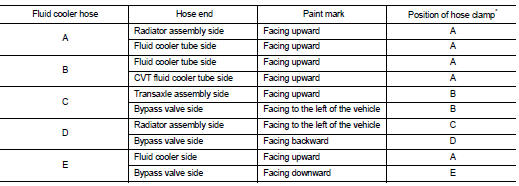

*: Refer to the illustrations for the specific position each hose clamp tab.
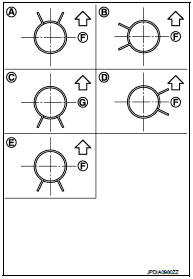
- The illustrations indicate the view from the hose ends.
F : Vehicle upper
 G : Vehicle front
- When installing hose clamps center line of each hose clamp tab should be positioned as shown in the figure.
- Insert fluid cooler hose according to dimension (L) described below.
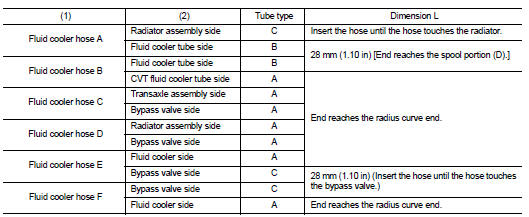
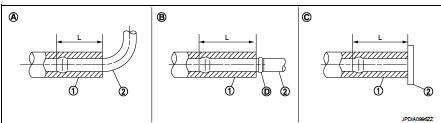
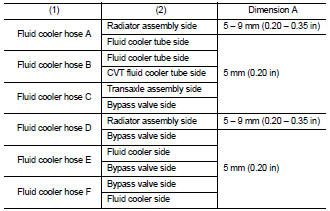
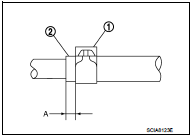
- Set hose clamps (1) at the both ends of fluid cooler hose (2) with dimension (A) from the hose edge.
- Hose clamp should not interfere with the bulge of fluid cooler tube.
Inspection
INSPECTION AFTER INSTALLATION
Check for CVT fluid leakage and CVT fluid level. Refer to TM-184, "Inspection".
 Water hose
Exploded View
1. Hose clamp
2. Water hose
A. Water outlet
B. Oil warm
Removal and Installation
REMOVAL
WARNING:
Never remove the radiator cap when the engine is hot. Serious burns could oc ...
 Unit removal and installation
Transaxle assembly
Exploded View
1. CVT fluid level gauge
2. CVT fluid charging pipe
3. O-ring
4. Transaxle assembly
5. Air breather hose
A. For tightening torque, refer to TM-301, "R ...
Other materials:
B2621 inside antenna
DTC Logic
DTC DETECTION LOGIC
DTC CONFIRMATION PROCEDURE
1.PERFORM DTC CONFIRMATION PROCEDURE
1. Select “INTELLIGENT KEY� of “BCM� using CONSULT-III.
2. Select “INSIDE ANT DIAGNOSIS� in “WORK SUPPORT� mode.
3. Perform inside key antenna (“INSIDE ANT DIAGNOSIS�) on “WORK ...
On board diagnostic (OBD) system
Diagnosis Description
This system is an on board diagnostic system that records exhaust
emission-related diagnostic information
and detects a sensors/actuator-related malfunction. A malfunction is indicated
by the malfunction indicator
lamp (MIL) and stored in ECU memory as a DTC. The diagnos ...
Engine oil
Inspection
OIL LEVEL AND MUDDINESS
• Before starting the engine, check the oil level placing vehicle
horizontally.
If the engine is already started, stop it and allow 10 minutes
before checking.
• Make sure the oil level is within the range shown in the figure.
• If it is out of rang ...
