
Nissan Leaf 2018-2025 (ZE1) Owner's Manual : AEB with Pedestrian Detection system limitations
WARNING
The following section details the inherent operational limitations of the Automatic Emergency Braking (AEB) with Pedestrian Detection system. Failure to remain fully engaged as the driver and to operate your Nissan Leaf in strict accordance with these limitations could result in a collision, causing serious injury or death.
- The AEB with Pedestrian Detection system is a sophisticated safety tool, but it is not capable of identifying all vehicles, pedestrians, or obstacles under every conceivable driving scenario.
- Be aware that the AEB with Pedestrian Detection system is designed for specific targets and will not detect or respond to the following:
- Small pedestrians, such as young children, individuals in seated positions, people operating toys, skateboards, or scooters, those using wheelchairs, or any person who is not in a fully upright standing or walking posture.
- Animals of any size, regardless of their proximity to the vehicle.
- Static roadway obstacles, including loose cargo, construction debris, or road-side objects.
- Vehicles that are oncoming, crossing your path, or parked in a stationary position.
- Vehicles where the rear profile is obstructed, distorted, or shaped in a way that makes the tires or body structure unclear to the system’s sensors.
- The system operates within defined performance parameters:
- When approaching a stationary vehicle in your path, the system’s automated braking intervention will not function if your Nissan Leaf is traveling at speeds exceeding approximately 50 mph (80 km/h).
- Pedestrian detection features are only active within a specific speed range; the system will not function if you are driving faster than approximately 37 mph (60 km/h) or slower than 6 mph (10 km/h).
- When identifying pedestrians, the AEB with Pedestrian Detection system does not issue the initial warning phase, moving directly to more urgent alerts.
- The AEB with Pedestrian Detection system may suffer from reduced detection accuracy or may fail to activate entirely under the following conditions:
- Poor environmental visibility, including heavy rain, snow, fog, thick dust or sand storms, smoke, or excessive spray generated by other vehicles on the road.
- Obstructions on the radar sensor or the camera’s field of view on the windshield, such as accumulated dirt, ice, snow, or fogging.
- Severe lighting interference, including direct, low-angle sunlight, high-beam glare from other vehicles, or sudden shifts in brightness, such as entering a dark tunnel or encountering lightning.
- Nighttime driving or low-light conditions, particularly if your Nissan Leaf headlights are dim or off, or if the vehicle ahead lacks functioning tail lights.
- Driving on extreme terrain, such as steep downhill slopes, roads with sharp, tight curves, or surfaces that are significantly bumpy, unpaved, or loose.
- Interference caused by other external radar or ultrasonic signal sources.
- Rapid, erratic changes in your vehicle’s position, including abrupt lane changes, sharp steering inputs, or sudden, aggressive acceleration and deceleration.
- High-speed relative movement of a target—such as a vehicle cutting across your lane at close range—which may exceed the system’s processing speed.
- Targets that are offset from the direct center of your Nissan Leaf’s forward path.
- Instances where the speed differential between your vehicle and the vehicle ahead is minimal.
- Pedestrian profiles that are obscured, such as those carrying bulky luggage, pushing strollers, wearing loose-fitting clothing, or adopting unique, non-standard postures.
- Low visual contrast between a pedestrian’s clothing and the surrounding background.
- During the initial 15-second initialization period immediately after starting the EV system.
- Vehicles with unusual dimensions, such as extremely low or high ground clearance, narrow profiles like motorcycles, or non-standard cargo configurations.
- Targets positioned near reflective surfaces, such as standing water, or those camouflaged by road signs or deep shadows.
- Situations involving groups of multiple pedestrians, which can confuse the system's pattern recognition.
- Pedestrians who are partially obscured by other vehicles or physical obstacles.
- Performance can be negatively impacted if the Nissan Leaf is being driven on surfaces with low traction (slippery roads), steep slopes, or if the vehicle is carrying an excessive load of heavy baggage in the rear seats or cargo area, which can alter the vehicle’s pitch.
- The system performs internal diagnostic checks on the radar and camera, but it cannot always detect external obstructions like thin layers of ice, snow, or small stickers. You must manually inspect and keep the sensor areas clean to ensure the AEB with Pedestrian Detection system remains functional.
- In complex traffic, the system may occasionally apply light, partial braking unexpectedly. Should you require immediate power, simply depress the accelerator pedal to manually override this intervention.
- Be aware that the system may trigger if it detects shapes, patterns, or light reflections that mimic the outline of a vehicle, motorcycle tail lights, or a pedestrian.
- The system may remain active even as a vehicle ahead begins a left or right turn, or as you maneuver to pass another vehicle.
- Road geometry, such as winding roads or construction zones, may lead to the system temporarily misidentifying an oncoming vehicle as an obstacle in your path.
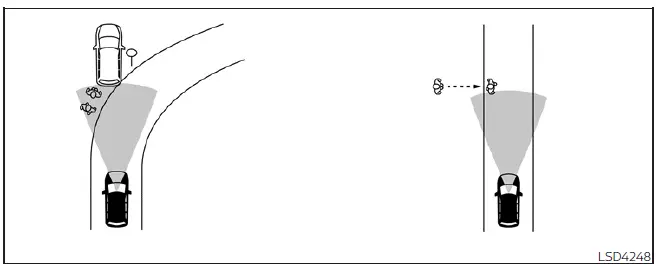
WARNING
Understanding the operational parameters of the Automatic Emergency Braking (AEB) with Pedestrian Detection system is essential for your safety. Failure to operate your Nissan Leaf in strict accordance with the limitations described below could lead to unexpected system engagement or a failure to brake when necessary, potentially resulting in serious injury or death.
- The AEB with Pedestrian Detection system is highly sensitive and may occasionally trigger an unnecessary warning or braking event in response to objects or scenarios that do not pose an immediate collision threat, such as:
- Stationary or moving objects situated along the roadside, including traffic signs, guardrails, pedestrians, motorcycles, or other vehicles that are not in your direct path of travel.
- Pedestrians detected while navigating through narrow urban alleys or tight passageways.
- Individuals who briefly step into your driving lane or approach it to navigate around obstacles parked or resting on the road shoulder.
- Objects suspended above the roadway, such as low-hanging bridges, overhead traffic signs, or signal gantries.
- Metallic or structural elements embedded in the road surface, such as railroad tracks, storm grates, or heavy steel construction plates.
- Structural elements within parking garages, including support beams, concrete pillars, or wall corners.
- Pedestrians or motorcyclists who are moving toward your lane, even if they remain at a safe distance.
- Vehicles, pedestrians, motorcycles, or miscellaneous objects located in adjacent lanes or parked in close proximity to your Nissan Leaf.
- Pedestrians walking toward your vehicle from the opposite direction.
- Large roadside objects, such as trees or utility poles, particularly when driving on curved roads.
- Be mindful that your stopping distance will be significantly extended when driving on slippery, icy, or loose surfaces; the AEB with Pedestrian Detection system cannot defy the laws of physics regarding tire traction.
- Elevated levels of cabin noise—such as high-volume audio, road noise, or wind from an open window—can effectively mask the system’s audible warning chime, preventing you from hearing vital safety alerts.
 AEB with Pedestrian Detection system operation
Vehicle ahead detection indicator
AEB with Pedestrian Detection emergency warning indicator
AEB with Pedestrian Detection system warning light
...
 System temporarily unavailable
Condition A
The AEB with Pedestrian Detection system in your Nissan Leaf may automatically deactivate, accompanied by a blinking warning light, when it encounters environmen ...
Other materials:
System setting
Temperature Setting Trimmer
DESCRIPTION
If the temperature felt by the customer is different from the air flow
temperature controlled by the temperature
setting, the A/C auto amp. control temperature can be adjusted to compensate for
the temperature setting.
HOW TO SET
With CONSULT-III
P ...
Fuel level sensor unit, fuel filter
and fuel pump assembly
2WD : Exploded View
1. Fuel tank
2. Lock ring
3.
Fuel level sensor unit, fuel filter and
fuel pump assembly
4. Rock ring
Vehicle front
: N?·m (kg-m, ft-lb)
: Always replace after every
disassembly.
2WD : Removal and Installation
WARNING:
Read ???General Precautions??? when worki ...
Operating range
The integrated NISSAN Intelligent Key functions are programmed to respond only when the transmitter fob is positioned within the specifically engineered proximity operating range from each localized door or hatch request switch 1.
When the internal coin-cell batt ...
