
Nissan Leaf 2018-2025 (ZE1) Owner's Manual : Towing your vehicle
When the need arises to tow your Nissan Leaf, you must ensure that all relevant state, provincial, and local regulations concerning vehicle transport are strictly observed. Utilizing incorrect towing equipment or improper techniques can lead to significant mechanical damage to your vehicle, so it is imperative that you consult with a NISSAN certified LEAF dealer for the most accurate and safe towing procedures specific to your model.
Professional service operators in your area are typically well-versed in the applicable laws and best practices for recovering and transporting electric vehicles. To guarantee proper handling and to eliminate the risk of accidental damage during transit, NISSAN strongly recommends that you utilize a qualified professional service operator. It is highly advisable to ensure that the service operator reviews the following precautions before initiating any towing operations.
WARNING
- Never remain inside or ride in a Nissan Leaf that is currently being towed.
- For your safety, never position yourself underneath the vehicle once it has been elevated by a tow truck.
CAUTION
- Prior to towing, verify that the steering system, axles, and powertrain are in sound working condition. If any of these critical systems are compromised, the vehicle must be transported using a flatbed truck or towing dollies to prevent further damage.
- Always ensure that appropriate safety chains are securely attached before the towing process commences.
Towing recommended by NISSAN
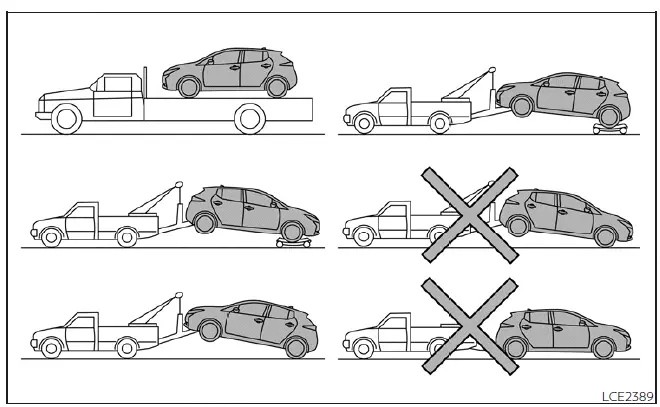
To ensure the integrity of the electric drivetrain, NISSAN recommends that your Nissan Leaf be towed either with the driving front wheels completely off the ground or by placing the entire vehicle on a flatbed transport truck, as shown in the provided illustration.
CAUTION
- Never attempt to tow your Nissan Leaf with the front wheels or all four wheels on the ground, whether moving forward or backward. This practice can induce rotation in the motor, leading to severe and costly internal damage to the propulsion system.
- If you must tow the vehicle with the rear wheels on the ground (using dollies for the front), you must ensure the parking brake is fully released.
NOTE:
In situations where the high-voltage battery is completely depleted, the transmission may not be able to manually shift into the Neutral position.
NOTE:
If your vehicle remains immobile because the transmission cannot be shifted into the N (Neutral) position, please consult the LEAF Roadside Assistance Guide available at www.NISSANUSA.com. If the issue is related to an unresponsive parking brake, refer to the "Parking brake" section of your owner's manual for emergency release procedures.
Vehicle recovery (freeing a stuck vehicle)
WARNING
To prevent irreparable vehicle damage, or the risk of serious personal injury or death during recovery operations, please adhere to these guidelines:
- If you have any uncertainty regarding the recovery procedure, contact a professional towing service immediately to handle the situation.
- Any tow chains, straps, or cables used must be attached exclusively to the main structural members of the Nissan Leaf chassis.
- Never utilize the vehicle's aesthetic or shipping tie-down points to tow or free a stuck vehicle, as these are not designed to bear the weight of a recovery pull.
- Utilize only equipment specifically rated and engineered for vehicle recovery and strictly follow the manufacturer's operational instructions.
- All recovery pulls must be performed in a straight line from the front of the vehicle; pulling at an angle can cause structural deformation or loss of control.
- Carefully route all recovery devices so they maintain contact only with the designated attachment point, ensuring they do not chafe or stress other parts of the vehicle.
If your Nissan Leaf becomes lodged in sand, deep snow, or mud, utilize a high-quality tow strap or recovery device designed for such applications, ensuring you strictly follow the device manufacturer's guidelines for safe use.
Rocking a stuck vehicle
If your vehicle is stuck, you may attempt to free it by following this careful procedure:
1. Deactivate the Vehicle Dynamic Control (VDC) system.
2. Perform a thorough visual check to ensure the path in front of and behind the Nissan Leaf is clear of any obstacles or people.
3. Gently rotate the steering wheel from side to side to clear a small path for the front tires.
4. Carefully attempt to rock the vehicle by slowly moving it forward and backward.
- Shift rhythmically between the R (Reverse) and D (Drive) positions.
- Apply the minimum amount of pressure to the accelerator pedal necessary to sustain the rocking motion.
- Always allow the vehicle to come to a near-stop and release the accelerator pedal fully before shifting between Drive and Reverse.
- Under no circumstances should you allow the tires to spin at speeds exceeding 35 mph (55 km/h).
5. If the vehicle fails to become free after several cautious attempts, cease the effort immediately and contact a professional towing service to assist with the recovery of your Nissan Leaf.
 If the Li-ion battery becomes completely discharged
Should the power limitation indicator light
illuminate while you are driving your Nissan Leaf, be aware that the system has restricted the output of the traction motor. This is an ...

Other materials:
Precaution for Brake Control system
• Always perform a pre-driving check to drive the vehicle.
• Always check speed and safety while driving the vehicle.
• To operate CONSULT-III while driving, more than one person is required to be
in the vehicle to avoid interference
to driving and ensure safety.
• Slight vibrations ar ...
System temporarily unavailable
When the system detects that the radar sensors are blocked, it will automatically deactivate to prevent inaccurate warnings. During this state, the BSW indicator (1) will blink in yellow on your vehicle information display, and the indicator adjacent to "Blind spot" within the ...
P0778 pressure control solenoid B
DTC Logic
DTC DETECTION LOGIC
DTC CONFIRMATION PROCEDURE
NOTE:
If “DTC CONFIRMATION PROCEDURE� has been previously performed, always turn
ignition switch
OFF and wait at least 10 seconds before performing the next test.
After the repair, perform the following procedure to confirm the ...
