
Nissan Juke Service and Repair Manual : Thermo plunger unit
Exploded View
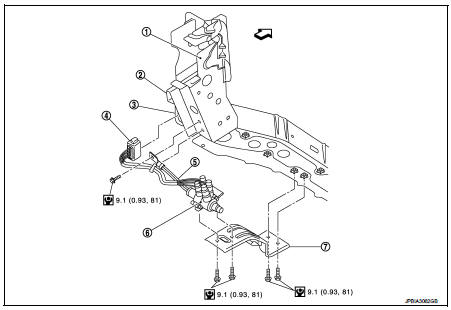
1. Side member LH
2. Thermo plunger control unit
3. Thermo plunger relay
4. Thermo plunger connector
5. Earth lead
6. Thermo plunger unit
7. Bracket stay
 Vehicle front
 : N·m (kg-m, in-lb)
Removal and Installation
REMOVAL
1. Remove battery cable from the negative terminal.
2. Drain engine coolant. Refer to CO-62, "Draining".
3. Remove the fender protector (LH). Refer to EXT-22, "Exploded View".
4. Disconnect thermo plunger connector.
5. Remove the earth lead nut (A
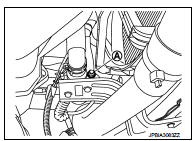
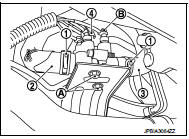
6. Remove the thermo plunger connection caps (4).
7. Remove the thermo plunger connection nuts (B) using the appropriate tool.
8. Remove the LH and RH clamps (1) and hoses (2) and (3).
9. Remove the fixing bolts (A) of the thermo plunger from the bracket and remove the thermo plunger unit.
Tightening torque of bolt : 9.1 N.m
INSTALLATION
Installation is basically the reverse order of the removal.
 Water pump
Exploded View
1. Water pump
2. Gasket
3. Cylinder block
Removal and Installation
WARNING:
Never remove the radiator cap when the engine is hot. Serious burns could occur
from high pressure ...
 Thermostat
Inspection
• Place a thread so that it is caught in the valves of the thermostat.
Immerse fully in a container filled with water. Heat while stirring.
(The example in the figure shows the the ...
Other materials:
B2628 outside antenna
DTC Logic
DTC DETECTION LOGIC
DTC CONFIRMATION PROCEDURE
1.PERFORM DTC CONFIRMATION PROCEDURE
1. Disconnect outside key antenna (rear bumper) connector.
2. Perform “INTELLIGENT KEY� Self Diagnostic Result.
Is outside key antenna DTC detected?
YES >> Refer to DLK-65, "Diagno ...
Range
The total driving distance your Nissan Leaf can cover on a single charge is dynamic. This range varies considerably based on a complex interplay of factors, including your current battery state of charge, prevailing weather conditions, ambient temperatures, specific usage patterns, the overall age o ...
Draining
WARNING:
• Never remove radiator cap when engine is hot. Serious burns may occur from
high-pressure engine
coolant escaping from radiator.
• Wrap a thick cloth around the radiator cap. Slowly turn it a quarter of a turn
to release built-up pressure.
Then turn it all the way.
1. Remove ...
