
Nissan Leaf 2018-2025 (ZE1) Owner's Manual : System maintenance
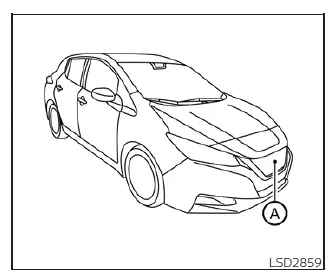
The Intelligent Cruise Control (ICC) radar sensor for your Nissan Leaf is integrated directly into the front fascia, specifically positioned to provide a clear, unobstructed view of the road ahead.
To guarantee that the ICC system continues to function with maximum accuracy and reliability, it is essential to adhere to the following maintenance protocols:
- Always ensure that the dedicated sensor area, including the front bumper and the surrounding emblem, remains clean and free from heavy accumulations of dirt, snow, or road grime.
- Exercise caution to avoid striking or physically damaging the delicate components housed within the bumper area immediately surrounding the sensor.
- Do not attach any stickers, decals, or transparent protective films, nor install any aftermarket accessories in the immediate vicinity of the sensor, as these can interfere with radar signals and lead to system failures or erratic behavior.
- Avoid mounting any metallic objects, such as brush guards or heavy-duty bull bars, near the sensor zone, as these structures can reflect or obstruct radar waves, compromising system performance.
- Do not attempt to alter, remove, or repaint the front bumper. If you are planning any cosmetic customizations or require restoration work on the front bumper of your Nissan Leaf, we strongly recommend consulting with a certified Nissan LEAF dealership to ensure the radar sensor remains properly calibrated and functional.
Radio frequency statement
For USA
This sophisticated electronic device is fully compliant with Part 15 of the FCC Rules. Its operation is strictly governed by the following two conditions:
1. This device must not generate any harmful radio frequency interference.
2. This device is required to accept any incoming interference, including signal disruptions that might result in unintended or non-standard system operation.
FCC Warning
Any unauthorized changes, adjustments, or modifications made to this system that are not expressly approved by the party responsible for regulatory compliance could invalidate your legal authority to operate the equipment.
For Canada
This equipment adheres to both Part 15 of the FCC Rules and the applicable Industry Canada license-exempt RSS standards. Operation is subject to the two conditions outlined below:
1. The device must not cause harmful interference.
2. The device must remain tolerant of all received interference, including disturbances that may cause suboptimal performance of the unit.
Le présent appareil est conforme aux CNR d'Industrie Canada applicables aux appareils radio exempts de licence. L'exploitation est autorisée aux deux conditions suivantes:
1. L'appareil ne doit pas produire de brouillage, et
2. L'utilisateur de l'appareil doit accepter tout brouillage radio électrique subi, même si le brouillage est susceptible d'en compromettre le fonctionnement.
Radio Frequency Radiation Exposure Information: This hardware complies with FCC radiation exposure limits established for operation in an uncontrolled environmental setting.
To maintain safety standards, this equipment should be professionally installed and operated while maintaining a minimum safety separation distance of 30 cm between the radiator and the occupants of the vehicle.
The integrated transmitter must not be co-located or utilized in conjunction with any other independent antenna or radio transmitter.
Cet équipement est conforme aux limites d'exposition aux rayonnements IC établies pour un environnement non contrôlé. Cet équipement doit être installé et utilisé avec un minimum de 30 cm de distance entre la source de rayonnement et votre corps.
FCC Notice
Any changes or modifications that are not expressly approved by the party responsible for compliance may void the user's authority to operate the equipment.
 Vehicle-to-vehicle distance control mode limitations
WARNING
Below are the critical operational limitations for the Intelligent Cruise Control (ICC) system in your Nissan Leaf. Operating the vehicle without strict adherence to these guidelines coul ...
 Conventional (fixed speed) cruise control mode
The conventional (fixed speed) cruise control mode in your Nissan Leaf offers a traditional driving experience, allowing you to maintain a constant speed between 25 and 90 mph (40 to 144 km/h) without ...
Other materials:
Headlamp aiming system (manual)
Component Inspection
1.CHECK HEADLAMP AIMING SWITCH
1. Remove headlamp aiming switch.
2. Check resistance among each headlamp aiming switch terminal.
Is the inspection result normal?
YES >> Headlamp aiming switch is normal.
NO >> Replace the headlamp aiming switch.
...
P0420 three way catalyst function
DTC Logic
DTC DETECTION LOGIC
The ECM monitors the switching frequency ratio of air fuel ratio (A/F)
sensor 1 and heated oxygen sensor 2.
A three way catalyst (manifold) with high oxygen storage capacity
will indicate a low switching frequency of heated oxygen sensor 2.
As oxygen storage c ...
Commercial Service Tools
CAUTION:
• Every time the vehicle is lifted up, maintain the complete vehicle curb
condition.
• Since the vehicle's center of gravity changes when removing main parts on the
front side (engine,
transmission, suspension etc.), support a jack up point on the rear side garage
jack with a ...
