
Nissan Leaf 2018-2025 (ZE1) Owner's Manual : NISSAN Advanced Air Bag System (front seats)
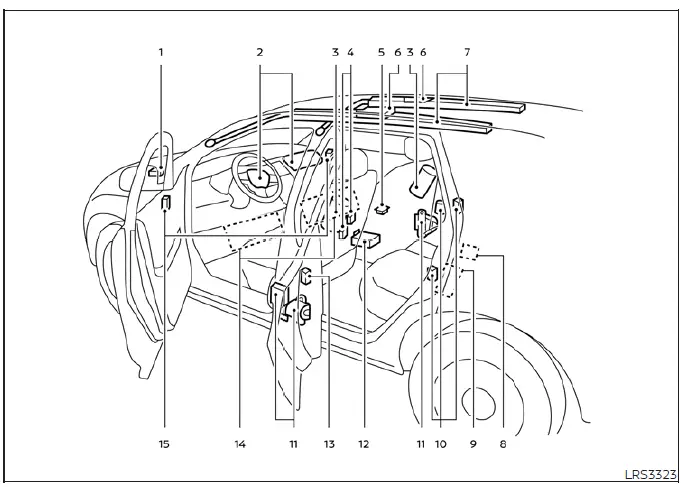
- Crash zone sensor
- Supplemental front-impact air bag modules
- Front seat-mounted side-impact supplemental air bag modules
- Occupant classification sensor (weight sensor)
- Occupant classification system control unit
- Roof-mounted curtain side-impact and rollover supplemental air bag inflators
- Roof-mounted curtain side-impact and rollover supplemental air bag modules
- Rear-outboard seat belts with pretensioners
- Rear outboard seat-mounted side-impact supplemental air bag modules
- Satellite sensors
- Seat belt with pretensioner(s) (front seats)
- Air bag Control Unit (ACU)
- Satellite sensors (driver's side shown; passenger's side similar)
- Driver and front passenger supplemental knee air bags
- Door sensors
WARNING
To maintain the integrity and proper operation of the front passenger's NISSAN Advanced Air Bag System in your Nissan Leaf, please strictly adhere to the following guidelines:
- Do not allow rear-seat passengers to pull on or push against the front seatback pocket.
- Avoid placing heavy loads exceeding 9.1 lbs. (4 kg) on the headrest, seatback, or inside the seatback storage pocket.
- Ensure the rear of the front seatback remains unobstructed by objects on the floor or child restraints installed in the rear seating positions.
- Do not place any items beneath the front passenger seat.
- Keep the area between the seat cushion, the center console, and the door completely clear of any objects.
- If installing a forward-facing child restraint in the front passenger seat, ensure it does not press against the instrument panel. Physical contact with the dashboard can lead the occupant classification system to inaccurately detect an adult occupant, which may trigger the deployment of the front passenger air bag and knee air bag during a collision. Furthermore, this condition may cause the passenger air bag status light to remain unilluminated.
- Always verify the operational status of the system by checking the front passenger air bag status light.
- If the status light fails to illuminate or operate as expected, have the occupant classification system inspected immediately. It is recommended that you visit a NISSAN certified LEAF dealer for professional diagnostic services.
- Until a certified technician confirms the system is functioning correctly, relocate occupants to the rear seating positions.
- Avoid positioning the front passenger seat so far back that it contacts the rear seat. Such contact can be interpreted by the air bag system as a sensor malfunction, potentially causing the passenger air bag status light to illuminate and the supplemental air bag warning light to flash.
The Nissan Leaf is equipped with the NISSAN Advanced Air Bag System for both the driver and front passenger, engineered to meet rigorous U.S. and Canadian safety certification requirements. All cautions and operating instructions contained within this manual are critical to your safety and must be followed.
The driver’s supplemental front-impact air bag is housed centrally within the steering wheel, while the front passenger’s counterpart is mounted in the instrument panel above the glove compartment. These air bags are engineered to deploy during higher-severity frontal impacts, though they may also trigger in other collision types if the force exerted is equivalent to a severe frontal impact. Please note that they may not deploy in every frontal collision, and the presence or absence of vehicle damage is not a reliable indicator of whether the system performed as intended.
The NISSAN Advanced Air Bag System continuously monitors data from the crash zone sensor and the Air bag Control Unit (ACU). Inflator activation is determined by a sophisticated analysis of collision severity and seat belt usage. For the front passenger, the system further monitors the occupant classification sensor to determine if the air bags should be activated.
Depending on the specific dynamics of an accident, it is possible for only one front air bag to deploy. Furthermore, the front passenger’s front and knee air bags may be automatically deactivated if the system detects weight levels or seat belt configurations that warrant it; in such cases, the passenger air bag status light will illuminate. One front air bag inflating alone does not signify a system malfunction.
If you have questions regarding the safety systems in your Nissan Leaf, or if you are considering vehicle modifications due to a disability, we recommend contacting a NISSAN certified LEAF dealer or the manufacturer directly, as noted in the front section of your Owner's Manual.
When an air bag deploys, it is common to hear a loud noise followed by the release of a fine powder or smoke. This byproduct is non-toxic and is not an indication of a fire; however, it can cause throat or respiratory irritation. Individuals with pre-existing breathing conditions should seek fresh air promptly. While these air bags, when used in conjunction with seat belts, are life-saving technologies that cushion the head and chest, deployment can result in minor facial abrasions or other superficial injuries. Note that front air bags—excluding the dedicated knee air bags—are not designed to provide restraint to the lower body.
Even with the advanced protection of the Nissan Leaf safety systems, seat belts must always be worn correctly. Drivers and passengers should sit upright and maintain as much distance as possible from the steering wheel and instrument panel. Because the air bags inflate with significant velocity to provide protection, being positioned too close to the module at the moment of deployment increases the risk of injury. Following a collision, these air bags will deflate rapidly.
The supplemental front air bags are operational only when the power switch is in the ON position. Upon placing the power switch in the ON position, the supplemental air bag warning light will illuminate to perform a self-diagnostic. If the system is fully operational, this warning light will extinguish after approximately 7 seconds.
 Precautions on SRS
The Supplemental Restraint System (SRS) integrated into your Nissan Leaf is engineered to provide an advanced layer of protection. This section details essential operational information concerning the ...
 Front passenger air bag and status light
WARNING
The front passenger air bag and front passenger supplemental knee air bag in your Nissan Leaf are engineered to automatically deactivate under specific conditions. I ...
Other materials:
On board diagnostic (OBD) system
Diagnosis Description
This system is an on board diagnostic system that records exhaust
emission-related diagnostic information
and detects a sensors/actuator-related malfunction. A malfunction is indicated
by the malfunction indicator
lamp (MIL) and stored in ECU memory as a DTC. The diagnos ...
Front and rear outboard seat-mounted side-impact supplemental air bag and roof-mounted curtain side-impact and rollover supplemental air bag systems
The side-impact air bags are integrated into the outer sections of the front seatbacks and the rear outboard seatbacks, while the protective curtain air bags are housed within the vehicle's side roof rails. All safety protocols, cautions, and operational guidelines outlined in ...
U1000 can comm
Description
CAN (Controller Area Network) is a serial communication line for real time
applications. It is an on-vehicle multiplex
communication line with high data communication speed and excellent error
detection ability. Modern
vehicle is equipped with many electronic control unit, and eac ...
