
Nissan Leaf 2018-2025 (ZE1) Owner's Manual : Front passenger air bag and status light
WARNING
The front passenger air bag and front passenger supplemental knee air bag in your Nissan Leaf are engineered to automatically deactivate under specific conditions. It is essential to read and understand this section thoroughly to comprehend how this safety system functions.
Optimal safety protection is only achieved through the proper use of vehicle seats, seat belts, and child restraints. Failing to adhere to the instructions provided in this manual regarding these critical safety components can significantly increase the risk or severity of injuries in the event of an accident.
Status light
The front passenger seat of the Nissan Leaf is equipped with a sophisticated occupant classification sensor (weight sensor). This component monitors the weight applied to the passenger seat cushion and automatically toggles the front passenger air bag and knee air bag between ON and OFF states based on the detected weight.
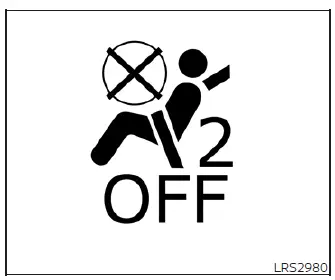
The current operational status of these air bags—whether they are active (ON) or deactivated (OFF)—is clearly indicated by the front passenger air bag status light  , which is conveniently located on your instrument panel.
Upon setting the power switch to the "ON" position, the status light will illuminate for approximately 7 seconds as part of the system’s self-diagnostic check. After this period, the light will either extinguish or remain illuminated based on the current occupancy status of the front passenger seat. The light functions according to the following logic:

Beyond the presence of an occupant, please be aware that certain heavy objects placed on the front passenger seat may also trigger the light, as the system will respond to the weight of the items.
Front passenger air bag
In accordance with U.S. federal regulations, the front passenger air bag and front passenger supplemental knee air bag are designed to automatically deactivate when the Nissan Leaf is operated under specific conditions. If the status light indicates that these air bags are OFF, they will not deploy in the event of a collision.
It is important to note that the driver's air bag and other supplemental restraint systems in your vehicle operate independently and are not controlled by this specific occupant classification system.
The primary purpose of this regulatory requirement is to minimize the risk of serious injury or fatality caused by air bag deployment to occupants who may be vulnerable, such as children, by ensuring the air bags are disabled when such occupants are detected.
The occupant classification sensor is a precise weight-sensing device. It identifies both human occupants and inanimate objects based on their mass. For instance, if a child is seated in the front passenger position, the Nissan Leaf Advanced Air Bag System is designed to automatically turn the front passenger air bags OFF to comply with safety regulations. Similarly, if a child restraint system of a type specified by these regulations is placed on the seat, the combined weight of the seat and the child will be detected, prompting the system to deactivate the front passenger air bag and the front passenger supplemental knee air bag.
Adult passengers who are properly seated and utilizing the seat belt as instructed in this owner's manual should not cause the air bags to deactivate. However, for smaller adults, the system may occasionally toggle the bags to the OFF position. This can also occur if an occupant shifts their weight off the seat cushion—such as by sitting on the edge of the seat, slouching, or sitting in an awkward position. Always ensure you are sitting upright with the seat belt correctly fastened to guarantee the most effective protection from both the seat belt and the supplemental air bag system.
For the highest level of occupant safety, NISSAN strongly recommends that pre-teens and children be properly restrained in a rear seat. It is also advised that all appropriate child restraint systems and booster seats be securely installed in the rear seating positions of your Nissan Leaf.
If installing a child restraint in the rear is not an option, the occupant classification sensor in your Nissan Leaf is engineered to function as described, automatically deactivating the front passenger air bag and the front passenger supplemental knee air bag for specific child restraints in compliance with safety regulations. Failure to correctly secure a child restraint or to properly utilize the Automatic Locking Retractor (ALR) mode may allow the seat to shift or tip during a sudden stop or collision. Such instability could cause the passenger air bags to remain active and inflate during a crash, rather than being disabled as intended. For comprehensive instructions on this, please refer to the "Child restraints" section.
When the front passenger seat is unoccupied, the front passenger air bag and knee air bag are designed to remain inactive during a crash. However, note that heavy objects placed on the seat may be detected by the occupant classification sensor as a passenger, potentially resulting in air bag inflation. Likewise, unusual conditions—such as a child standing on the seat or multiple children occupying it—can lead to unpredictable system behavior that contradicts the safety protocols outlined in this manual. Always ensure that you and all passengers in the Nissan Leaf are seated and restrained correctly.
You can verify the current operational status of the front passenger's supplemental restraint system by monitoring the front passenger air bag status light on the instrument panel, which informs you when the air bags are automatically turned OFF.
If an adult is seated in the front passenger seat but the status light remains illuminated—signaling that the front passenger air bag and knee air bag are OFF—it may indicate that the occupant is of a smaller stature, or that they are not sitting upright and properly positioned, or perhaps failing to wear the seat belt correctly.
If you must use a child restraint in the front seat, the status light's behavior may vary based on the child's size and the specific type of restraint employed. If the status light is not illuminated, it suggests that the system may deploy the front passenger air bag and knee air bag in a collision, which could be a sign that the child restraint or seat belt is not being used as required.
In such cases, verify that the child restraint is properly installed, the seat belt is routed correctly, and the occupant is positioned as instructed. If the status light still fails to illuminate, you should immediately relocate the occupant or the child restraint to a rear seat.
If you believe the child restraint, seat belts, and occupant are all positioned perfectly, yet the status light refuses to illuminate, it is strongly recommended that you visit a NISSAN certified LEAF dealer. A professional technician can utilize a specialized diagnostic tool to confirm the system's status. Until you have received professional confirmation that your air bag system is operating correctly, please keep all child occupants or restraints in the rear seating area.
Please note that the NISSAN Advanced Air Bag System and the status light may require a few seconds to register a change in the seat's occupancy status. This delay is a normal part of the system's operation and is not a cause for concern.
Should a malfunction occur within the front passenger air bag system, the supplemental air bag warning light  , located within the instrument panel’s gauge cluster, will activate by either blinking or remaining steadily lit. If this occurs, the system requires immediate attention; we recommend scheduling a service visit to a NISSAN certified LEAF dealer at your earliest convenience.
Normal operation
To ensure the occupant classification sensor system in your Nissan Leaf accurately categorizes the front passenger based on weight, it is essential to observe the following precautions and operational steps:
Precautions
- Ensure no objects exceeding 9.1 lbs. (4 kg) are hanging from the seat or stored within the seatback pocket.
- Confirm that no child restraint systems or other items are applying pressure to the rear of the front passenger seatback.
- Prevent rear-seat passengers from pushing or pulling on the back of the front passenger seat.
- Avoid forcing the front passenger seat or its backrest against any items located on the floor or seat directly behind it.
- Ensure the area underneath the front passenger seat remains completely free of any objects.
Steps
1. Adjust the seat to your preference as detailed in the "Seats" section of this manual. Sit in an upright position, maintaining firm contact with the seatback, and keep your body centered on the seat cushion with both feet comfortably resting on the floor.
2. Verify that your lap is entirely clear of any objects, bags, or devices.
3. Secure your seat belt following the instructions in the "Seat belts" section. The Nissan Leaf occupant classification system monitors whether the front passenger seat belt buckle is engaged to help determine occupancy status; therefore, we strongly recommend that the front passenger always fasten their seat belt.
4. Remain in the correct, seated position for at least 30 seconds to allow the system to successfully classify the front passenger before the vehicle begins moving.
5. Confirm the system has correctly classified the passenger by observing the front passenger air bag status light on the dashboard.
NOTE:
The occupant classification sensor system in the Nissan Leaf generally retains its classification once the vehicle is in motion, making it critical that you confirm correct classification prior to driving. However, because the system may perform recalculations while the vehicle is both stopped and in motion, occupants should maintain a correct, upright seated position throughout the entire trip.
Troubleshooting
If you suspect the front passenger air bag status light is providing an incorrect reading, please review the following:
1. If the light is ON while an adult occupies the front passenger seat:
- If the occupant is a person of small stature, the air bag light is functioning exactly as intended. In this scenario, the front passenger air bag and the front passenger supplemental knee air bag are automatically suppressed for safety.
If the occupant is not a small adult, the status light may be indicating a discrepancy due to environmental factors interfering with the weight sensors:
- The occupant is not sitting upright, leaning fully against the seatback, or is not centered on the seat cushion with feet resting on the floor.
- A child restraint or other heavy object is pressing against the rear of the seatback.
- A passenger in the rear seat is applying pressure to the back of the front passenger seat.
- The seat or seatback is being forced against an object located on the seat or floor behind it.
- An item has been placed underneath the front passenger seat, hindering sensor accuracy.
- An object has become wedged between the seat cushion and the center console or between the seat cushion and the door panel.
If the vehicle is currently in motion, please maneuver to a safe location and bring it to a complete stop. Carefully inspect and rectify any of the conditions mentioned above that may be interfering with the seat sensors. Once resolved, restart your Nissan Leaf and allow the system to initialize for at least 1 minute.
NOTE:
During the ignition cycle, the system performs an automated self-check, during which the front passenger air bag status light will remain illuminated for approximately 7 seconds.
If the status light remains ON after this initial check, the occupant should be advised not to use the front passenger seat, and the vehicle should be inspected by a professional as soon as possible. It is highly recommended that you visit a certified Nissan Leaf dealer for this diagnostic service.
2. If the status light is OFF despite a small adult, child, or child restraint system occupying the front passenger seat:
This may occur due to external factors that interfere with the precision weight sensors:
- The occupant—whether a small adult or child—is not seated in an upright, centered position, or their feet are not resting comfortably on the floor.
- The child restraint is not installed in strict accordance with the guidelines found in the "Child restraints" section of this owner's manual.
- An object weighing more than 9.1 lbs. (4 kg) is hanging on the seat or stored within the seatback pocket (if equipped).
- A child restraint or any other item is applying pressure against the rear of the seatback.
- A rear-seat passenger is inadvertently pushing or pulling on the back of the front passenger seat.
- The front seat or seatback is being forced against an object on the seat or floor directly behind it.
- An object is stowed underneath the front passenger seat.
- An item has been inadvertently placed between the seat cushion and the center console.
If the vehicle is moving, please pull over safely. After verifying and correcting the conditions above, restart your Nissan Leaf and allow the system to re-scan for 1 minute.
NOTE:
The system performs a diagnostic check during which the front passenger air bag status light will remain lit for about 7 seconds initially.
If the light remains OFF following this check, the occupant or child restraint should be relocated to the rear seating area, and the vehicle must be checked by a professional. We recommend visiting a certified Nissan Leaf dealer for a thorough system inspection.
3. If the status light is OFF even when the front passenger seat is completely empty and clear of all objects, the vehicle requires immediate inspection. It is recommended that you schedule a service appointment at a certified Nissan Leaf dealer.
Other supplemental front-impact air bag precautions
WARNING
- Never place any objects on the steering wheel pad or across the instrument panel. Additionally, do not position any items between an occupant and the steering wheel or dashboard, as these can transform into dangerous projectiles and cause severe injury during air bag deployment in your Nissan Leaf.
- Avoid placing sharp-edged objects on the seat or heavy items that could leave permanent impressions. Such items can damage the seat upholstery or the sensitive occupant classification (weight) sensor, which may compromise the air bag system's effectiveness and lead to serious personal injury.
- Do not clean the seats using water, steam cleaners, or acidic agents. Excessive moisture or harsh chemicals can damage the seat structure or the internal weight sensors, potentially causing a malfunction in the supplemental air bag system and risking significant injury.
- Following an air bag inflation event, several components of the system will be extremely hot. Do not attempt to touch them, as you may suffer severe burns.
- Do not perform any unauthorized modifications to the components or wiring of the supplemental air bag system in your Nissan Leaf.
- These precautions are strictly required to prevent the accidental or unintended inflation of the supplemental air bag, as well as to avoid any permanent damage to the sensitive components of the supplemental air bag system in your Nissan Leaf.
- Do not perform any unauthorized modifications to your vehicle's electrical infrastructure, suspension setup, or front-end structural components. Such alterations can interfere with the crash sensing and deployment logic, negatively impacting the reliable operation of the front air bag system.
- Tampering with the front air bag system poses a severe risk of personal injury. Tampering is defined as any unauthorized modification, including placing materials over the steering wheel pad, covering the instrument panel, or installing aftermarket trim that encroaches upon the designated air bag deployment zones.
- Removing or modifying the front passenger seat is strictly prohibited, as this seat contains specialized sensors essential to the vehicle's safety architecture. Any alteration can compromise the air bag system's function, potentially leading to fatal or serious personal injury.
- Modification of the front passenger seat carries significant risks. Specifically, do not place unauthorized materials on the seat cushion or install aftermarket seat covers that are not certified to allow for proper air bag inflation. Furthermore, avoid stowing any items beneath the seat or within the crevices between the seat cushion and the backrest, as these objects can obstruct the occupant classification sensor (weight sensor) and cause a critical system failure.
- No unauthorized changes should ever be made to the seat belt system's components or wiring, as this is intrinsically linked to the front air bag system's decision-making process. Any interference with the seat belt mechanism may result in catastrophic personal injury.
- For all service, maintenance, or repairs involving or located near the front air bag system, it is strongly recommended that you rely exclusively on a NISSAN certified LEAF dealer. Additionally, for the installation of any aftermarket electrical equipment, a certified dealer ensures that the modifications do not compromise your vehicle's safety features.
Professional installation of electrical accessories at a NISSAN certified LEAF dealer is essential to maintain the integrity of the vehicle's safety systems.
The Supplemental Restraint System (SRS) wiring harnesses* must never be modified, bypassed, or disconnected. Furthermore, the use of unauthorized electrical testing equipment or probing devices on the air bag system is strictly prohibited to prevent system damage.
- A damaged or cracked windshield should be replaced without delay by a qualified automotive repair facility. A compromised windshield can negatively affect the structural integrity required for the optimal performance of the supplemental air bag system.
*The SRS wiring harness connectors are distinctively colored yellow and orange for rapid identification by qualified technicians.
When transferring ownership of your vehicle, we request that you provide the new owner with full disclosure regarding the presence and function of the Nissan Leaf front air bag system, and strongly encourage them to review the relevant safety sections within this Owner's Manual.
 NISSAN Advanced Air Bag System (front seats)
Crash zone sensor
Supplemental front-impact air bag modules
Front seat-mounted side-impact supplemental air bag modules
Occupant classificati ...
 Front and rear outboard seat-mounted side-impact supplemental air bag and roof-mounted curtain side-impact and rollover supplemental air bag systems
The side-impact air bags are integrated into the outer sections of the front seatbacks and the rear outboard seatbacks, while the protective curtain air bags are housed within th ...
Other materials:
Precaution for Diesel Equipment
CLEANLINESS
CLEANLINESS INSTRUCTIONS WHICH MUST BE FOLLOWED WHEN WORKING ON THE HIGH
PRESSURE
DIRECT INJECTION SYSTEM
Risks relating to contamination
The system is very sensitive to contamination. The risks caused by the
introduction of contamination are:
• Damage or destruction of the hi ...
Precaution Necessary for Steering Wheel Rotation after Battery Disconnect
NOTE:
• Before removing and installing any control units, first turn the ignition
switch to the LOCK position, then disconnect
both battery cables.
• After finishing work, confirm that all control unit connectors are connected
properly, then re-connect both
battery cables.
• Always us ...
I-FCW system limitations
WARNING
The following list details the specific operating limitations of the I-FCW system. Failure to operate your Nissan Leaf while mindful of these technical boundaries could lead to a failure in system alerts and result in serious injury or death.
...
