
Nissan Leaf 2018-2025 (ZE1) Owner's Manual : Jump starting
If the 12-volt auxiliary system in your Nissan Leaf requires a boost to activate, follow the procedures and safety precautions outlined below. Please understand that jump starting is intended solely to provide the necessary power to operate the vehicle's electrical control systems, which in turn allows the Li-ion battery to accept a charge. Jump starting does not charge the primary Li-ion traction battery; the Li-ion battery must be charged via an appropriate external source before the vehicle can be safely driven.
WARNING
- Executing a jump start improperly carries the risk of a 12-volt battery explosion, which can lead to catastrophic vehicle damage or severe personal injury and death.
- 12-volt batteries naturally emit explosive hydrogen gas. Always ensure the area is well-ventilated and keep all potential ignition sources, such as sparks, cigarettes, or open flames, away from the battery at all times.
- Battery fluid is a highly corrosive sulfuric acid solution. Avoid any contact with your skin, eyes, clothing, or the vehicle's painted surfaces, as it can cause deep, severe burns. If accidental exposure occurs, immediately flush the area with large amounts of water and seek medical attention.
- Store all 12-volt batteries securely and out of the reach of children.
- The booster battery must be a 12-volt system. Using a battery with a different voltage rating can cause irreversible damage to the electrical components of your Nissan Leaf.
- Always prioritize safety: wear protective eyewear such as industrial goggles and remove all metallic jewelry, rings, or bands before working near the battery. Never lean over the battery during the connection process.
- Never attempt to jump start a battery that is frozen, as it is highly unstable and could explode upon connection, resulting in grave injury.
- Be aware that your vehicle is equipped with an automatic cooling fan that may engage without warning. Keep all loose clothing, hands, and tools clear of the engine compartment to avoid injury.
- Strict adherence to the following sequence is mandatory. Skipping steps or reversing connections can damage the vehicle's sophisticated DC/DC converter and cause physical harm.
- Do not attempt to jump start the 12-volt battery while the Nissan Leaf is simultaneously connected to a charging station. This can damage both the vehicle's internal systems and the charging equipment.
CAUTION
A Nissan Leaf cannot function as a booster vehicle for others, as it is not designed to supply the surge power required to crank a traditional gasoline engine. However, a conventional gasoline-powered vehicle can be used to safely jump start the 12-volt battery of your Nissan Leaf.
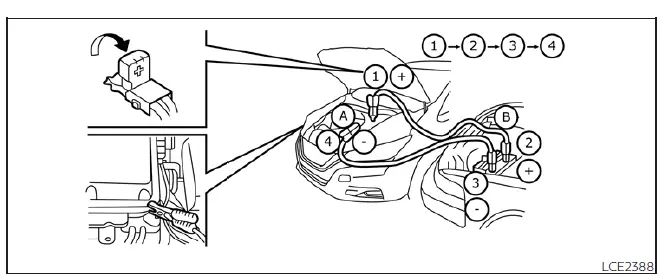
1. If the booster battery is provided by another vehicle (B), position it near your Nissan Leaf (A) so that the 12-volt batteries are within easy reach of the jumper cables.
Ensure that the two vehicles do not make physical contact, as this can create an unintended ground path.
2. Engage the parking brake on both vehicles.
If your 12-volt battery is completely discharged, the power switch will remain locked in the OFF position. You must connect the jumper cables to the booster vehicle (B) before attempting to operate your vehicle's power switch.
3. Ensure your vehicle is securely placed in the P (Park) position using the shift selector.
4. Disable all unnecessary electrical loads, including headlights, climate control (heater/AC), and infotainment systems.
5. Verify that your vehicle's power switch is set to the OFF position.
6. Inspect the 12-volt battery to ensure that all vent caps are properly seated and level.
7. Connect the jumper cables in the following mandatory sequence: ( 1 → 2 → 3 → 4 ).
CAUTION
- Always connect the positive (+) cable to the positive (+) terminal, and the negative (−) cable to a secure metal body ground on your vehicle, rather than directly to the negative terminal of the 12-volt battery.
- Carefully route the jumper cables to ensure they remain clear of all moving parts within the motor compartment and that the metal clamps do not touch any unintended metal components.
8. Start the engine of the booster vehicle (B).
9. While the booster vehicle (B) is running, press your Nissan Leaf power switch to place the EV system into the READY to drive mode.
CAUTION
If the system does not enter READY mode on the first attempt, switch the power to OFF, wait at least 10 seconds to allow the electronics to reset, and then try again.
10. Once your Nissan Leaf system is active, carefully disconnect the jumper cables in the reverse order ( 4 → 3 → 2 → 1 ). Keep the vehicle in the READY mode for at least 20 minutes to allow the DC/DC converter to sufficiently recharge the 12-volt battery.
11. If necessary, connect your Nissan Leaf to a public charging station or your home EVSE to replenish the Li-ion traction battery. Refer to the "Charging" section of your owner's manual for detailed procedures. Note that the vehicle cannot be driven until the Li-ion battery has achieved an adequate state of charge.
12. Following any instance of a dead battery requiring a jump start, it is highly recommended that you take your Nissan Leaf to a certified dealer to have the 12V battery health professionally tested.
NOTE:
If your Nissan Leaf fails to enter the READY state despite following these steps, contact a certified dealer immediately for professional diagnostic assistance.
 Repairing a flat tire
WARNING
After utilizing the Genuine NISSAN Emergency Tire Sealant to temporarily patch a minor puncture, strictly limit your driving speed to no more than 50 mph (80 km/h) to maintain s ...
 If the Li-ion battery becomes completely discharged
Should the power limitation indicator light
illuminate while you are driving your Nissan Leaf, be aware that the system has restricted the output of the traction motor. This is an ...
Other materials:
Trip computer
The switch for the trip computer is located on the meter panel.
When the ignition switch is placed in the ON position, modes of the trip computer
can be selected by pushing the trip computer mode switchA .
Each time the trip computer mode switchA is pushed, the display will change as
follows ...
P0717 input speed sensor A
DTC Logic
DTC DETECTION LOGIC
DTC CONFIRMATION PROCEDURE
CAUTION:
Always drive vehicle at a safe speed.
NOTE:
If “DTC CONFIRMATION PROCEDURE� has been previously performed, always turn
ignition switch
OFF and wait at least 10 seconds before performing the next test.
After the repai ...
Precaution for Supplemental Restraint System (SRS) "AIR BAG" and "SEAT BELT
PRE-TENSIONER"
The Supplemental Restraint System such as “AIR BAG� and “SEAT BELT
PRE-TENSIONER�, used along
with a front seat belt, helps to reduce the risk or severity of injury to the
driver and front passenger for certain
types of collision. Information necessary to service the system safely is
...
