
Nissan Leaf 2018-2025 (ZE1) Owner's Manual : Repairing a flat tire
WARNING
- After utilizing the Genuine NISSAN Emergency Tire Sealant to temporarily patch a minor puncture, strictly limit your driving speed to no more than 50 mph (80 km/h) to maintain stability.
- Following the application of the Genuine NISSAN Emergency Tire Sealant, it is vital that you travel immediately to a NISSAN certified LEAF dealer. This sealant is an emergency measure only and cannot permanently repair a punctured tire. Operating your Nissan Leaf indefinitely without a professional, permanent tire repair poses a severe safety risk and could lead to a sudden tire failure or a crash.
- Using this sealant may contaminate your wheel sensors; therefore, it is recommended that you have a NISSAN certified LEAF dealer inspect or replace the TPMS sensor along with the tire repair or replacement.
- Always use exclusively the Genuine NISSAN Emergency Tire Sealant provided with your vehicle. The use of incompatible, third-party tire sealants can corrode or damage the valve stem seal, leading to persistent air pressure loss and potential system failure.
Your Nissan Leaf is not equipped with a conventional spare tire. In its place, the vehicle includes an emergency tire puncture repair kit, which features the Genuine NISSAN Emergency Tire Sealant designed to provide a temporary, roadside solution for minor tread punctures.
Whenever possible, we strongly advise having your vehicle professionally towed to a service facility that can safely and properly repair or replace your flat tire.
Please be aware that the application of tire repair sealant may lead to a malfunction of the internal tire pressure sensor, which can cause the low tire pressure warning light to remain illuminated on your dashboard.
CAUTION
- To ensure the longevity and reliability of your emergency tire puncture repair kit, observe the following:
- The kit is intended solely for use on your specific Nissan Leaf. Do not attempt to use it to service other vehicles.
- Use the kit only for its intended purposes: inflating your tires and monitoring their current pressure.
- The compressor must only be connected to a 12-volt DC power outlet.
- Protect the kit from moisture and dirt, which can compromise its internal components.
- Do not attempt to disassemble, modify, or tamper with any part of the repair kit.
- Handle the kit with care; avoid dropping it or subjecting it to sharp, physical impacts.
- Do not attempt to use the emergency tire puncture repair kit under any of the following circumstances. If you encounter these issues, contact a NISSAN certified LEAF dealer or a professional roadside assistance provider:
- If the sealant has exceeded its expiration date, as indicated on the bottle label.
- If the puncture or cut in the tire tread exceeds approximately 0.25 inches (6 mm) in length.
- If the tire sidewall has sustained any visible damage or tears.
- If the vehicle was operated for an extended period with extremely low tire pressure, causing structural degradation.
- If the tire bead has separated from the inner or outer rim of the wheel.
- If the wheel rim itself has been bent or damaged.
- If more than one tire is currently flat or damaged.
If you encounter a flat tire, please adhere to the following safety procedures:
Stopping the vehicle
1. Calmly and safely maneuver your Nissan Leaf off the main roadway and as far away from moving traffic as possible.
2. Activate your hazard warning flashers immediately to alert other drivers.
3. Ensure you have parked on a flat, stable surface, then engage the parking brake firmly.
4. Press the P (Park) position button on the shift selector to lock the transmission.
5. Power down the EV system entirely.
6. Raise the vehicle hood. This serves as a universal warning signal to other traffic and helps professional roadside assistance personnel locate your vehicle quickly.
7. For their protection, ensure all passengers exit the Nissan Leaf and gather in a safe, designated area well clear of the road and the vehicle.
WARNING
- Double-check that the parking brake is fully engaged and that the transmission is correctly set to the P (Park) position before exiting.
- Never attempt to repair a tire if your vehicle is positioned on an incline, on icy ground, or in any slippery area where the vehicle could shift unpredictably.
- Do not attempt any tire repairs if you are in a high-traffic area where oncoming vehicles are passing dangerously close to your position. In such instances, remain safely away from the vehicle and wait for professional roadside assistance.
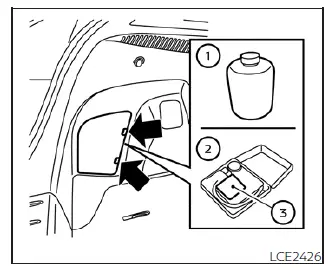
Getting the emergency tire puncture repair kit
To address a flat tire, locate and retrieve the emergency tire puncture repair kit stored in your Nissan Leaf's cargo area. This essential kit is designed for roadside convenience and includes the following components:
- Tire sealant bottle
- Air compressor*
- Speed restriction sticker
*Note that the physical design and shape of the compressor may vary depending on your specific Nissan Leaf model year and trim.
Before using the emergency tire puncture repair kit
- If you identify a foreign object—such as a screw, nail, or shard of metal—embedded in the tire tread, do not attempt to remove it. Leaving the object in place helps the sealant bond more effectively.
- Always verify the expiration date of the sealant, which is clearly marked on the label attached to the bottle. Never attempt to use a sealant that has passed its expiration date, as the chemical properties may have degraded, rendering it ineffective.
Repairing the tire
WARNING
Exercise extreme caution and observe the following safety protocols when handling the tire repair compound.
- The repair compound is hazardous if ingested. If swallowed, immediately drink as much water as possible to dilute the substance and seek emergency medical assistance without delay.
- Should the compound come into direct contact with your skin or eyes, flush the affected area thoroughly with copious amounts of water. If irritation or discomfort persists after rinsing, consult a medical professional promptly.
- Always store the repair compound securely and keep it completely out of the reach of children.
- Be aware that the emergency repair compound can interfere with the internal electronics of the tire pressure sensors, which may cause the low tire pressure warning light to illuminate on the instrument cluster.
Because of this, it is necessary to have your tire pressure sensor inspected or replaced by a technician as soon as you reach a service facility.
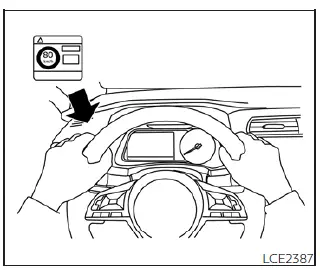
1. Carefully remove the speed restriction sticker from the air compressor housing and affix it in a prominent location where it will remain clearly visible to the driver throughout the journey.
CAUTION
Ensure the speed restriction label is placed appropriately. Do not obstruct critical areas such as the steering wheel pad, the speedometer face, or the instrument cluster warning light displays.
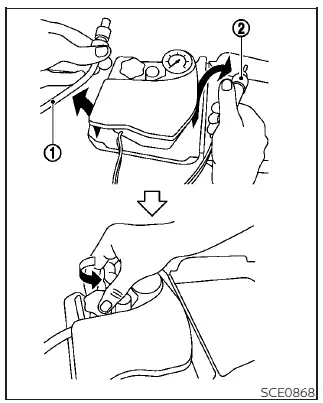
2. Uncoil hose (1) and retrieve the power plug (2) from the storage compartment of the air compressor. Remove the cap from the sealant bottle holder located on the compressor unit.
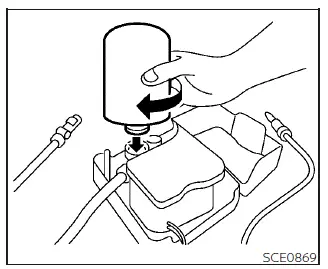
3. Unscrew the cap from the tire sealant bottle, but leave the internal bottle seal intact. Insert the bottle into the holder on the compressor and screw it clockwise firmly; this action is designed to pierce the seal, allowing the fluid to flow into the system.
4. Locate the flat tire on your Nissan Leaf and remove the valve stem cap.
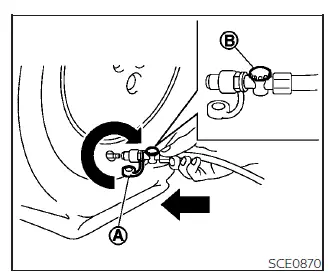
5. Remove the protective cap (A) from the hose and thread the hose securely onto the tire valve stem. Verify that the pressure release valve (B) is fully tightened and closed.
Ensure the main air compressor switch is set to the OFF (O) position before inserting the power plug into your vehicle’s 12V DC power outlet.
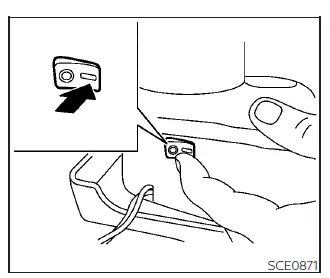
6. Switch the vehicle's power mode to the ACC position to provide electrical power.
Toggle the compressor switch to the ON (−) position to begin inflation. You should aim to inflate the tire to the recommended pressure specified on the Tire and Loading Information label located on the driver's side center pillar. If that data is unavailable, ensure you reach a minimum pressure of 26 psi (180 kPa). Periodically turn the compressor switch to OFF to accurately check the current inflation level using the integrated pressure gauge.
If you inadvertently over-inflate the tire beyond the recommended specification, use the integrated pressure release valve on the hose to bleed off excess air until the desired pressure is achieved.
NOTE:
You may observe the compressor pressure gauge spiking to approximately 87 psi (600 kPa) for the first 30 seconds of operation. This is normal; the gauge is reflecting the back-pressure of the sealant moving through the hose. As the sealant enters the tire and the flow stabilizes, the needle will drop to reflect the actual air pressure inside the Nissan Leaf tire.
WARNING
To maintain your safety and prevent personal injury while utilizing the emergency tire puncture repair kit for your Nissan Leaf, please observe the following precautions:
- Ensure the compressor hose is threaded firmly and securely onto the tire valve. An improper connection can result in pressurized sealant spraying into the air, creating a significant risk of eye or skin irritation upon contact.
- Do not stand in close proximity to the damaged tire while the compressor is actively inflating it, as there is a latent risk of tire rupture. If you observe any physical deformation, such as bumps or cracks forming on the tire surface, deactivate the compressor immediately.
If the tire pressure fails to reach the target of 26 psi (180 kPa) within a 10-minute operating window, the tire has likely sustained structural damage that exceeds the capabilities of the emergency kit. In such cases, discontinue use and contact a certified Nissan LEAF dealer for professional assistance.
7. Once the tire has reached the specified pressure, turn the air compressor to the OFF position. If achieving the recommended pressure is not possible, the compressor may be deactivated once the minimum safety threshold of 26 psi (180 kPa) is met. Carefully disconnect the power plug from the vehicle's outlet and swiftly detach the hose from the tire valve. Replace the protective cap and the valve cap, then securely stow the emergency tire puncture repair kit in the designated area of your cargo space.
CAUTION
To prevent injury when storing the emergency tire puncture repair kit:
- Ensure the sealant bottle remains screwed into the compressor unit during storage. Failure to keep this seal intact can lead to accidental leakage, which may cause the sealant to spray into the air and come into contact with your skin or eyes.
8. To properly distribute the sealant throughout the internal structure of the tire, immediately drive your Nissan Leaf for approximately 10 minutes or 2 miles (3 km), ensuring you do not exceed a speed of 50 mph (80 km/h).
9. After completing this short drive, ensure the air compressor switch is in the OFF position and reconnect the hose securely to the tire valve to re-check the pressure using the integrated gauge. If the pressure has stabilized and shows no signs of dropping, your temporary repair is successful.
Before continuing your journey, verify that the inflation pressure matches the exact specifications listed on the Tire and Loading Information label of your Nissan Leaf.
10. If the pressure reading indicates a drop, you must repeat the inflation process outlined in steps 5 through 9. If the pressure continues to fall or drops below 19 psi (130 kPa), the tire is beyond the scope of this repair kit and is not safe for further operation. In this situation, do not attempt to drive the vehicle; have it towed to the nearest professional service center.
Please note that the sealant bottle and hose assembly are single-use components and cannot be repurposed to repair a second puncture. It is recommended that you visit a certified Nissan LEAF dealer to purchase a fresh replacement kit.
After repairing the tire
Even after a successful temporary patch, it is essential that you arrange for a professional inspection or permanent replacement of the affected tire at a certified Nissan LEAF dealer as soon as possible.
WARNING
- Following the use of Genuine NISSAN Emergency Tire Sealant to address a puncture, never drive your Nissan Leaf at speeds exceeding 50 mph (80 km/h).
- Since Genuine NISSAN Emergency Tire Sealant is only a temporary solution and cannot achieve a permanent structural seal, you must visit a NISSAN certified LEAF dealer promptly. Continued operation of the vehicle without a professional, permanent repair increases the risk of a sudden tire failure and a potential crash.
- Do not introduce any unauthorized liquids or aerosol-based sealants into your tires, as these may permanently damage the internal tire pressure sensors, leading to a system malfunction.
- If you have deployed the Genuine NISSAN Emergency Tire Sealant, it is recommended that you have the TPMS sensor replaced by a NISSAN certified LEAF dealer at the time of your tire repair or replacement.
- Always use only the Genuine NISSAN Emergency Tire Sealant supplied with your vehicle. Other third-party sealants can degrade the valve stem seal, potentially causing chronic air pressure loss that compromises your Nissan Leaf's performance.
 Tire Pressure Monitoring System (TPMS)
Your Nissan Leaf is equipped with a sophisticated Tire Pressure Monitoring System (TPMS) that continuously tracks the inflation pressure of all four tires. When the dedicated low tire pressure warning ...
 Jump starting
If the 12-volt auxiliary system in your Nissan Leaf requires a boost to activate, follow the procedures and safety precautions outlined below. Please understand that jump starting is intended solely t ...
Other materials:
Engine stalling
Description
CHART 7: ENGINE STALLING
Diagnosis Procedure
1.CHECK FUEL
Check that the fuel reservoir is correctly filled and with the right fuel.
>> GO TO 2.
2.CHECK ECM POWER SUPPLY AND GROUND CIRCUIT
Check ECM power supply and ground circuit. Refer to EC-885, "Diagnosis
Proc ...
Back door finisher
Exploded View
1. Rear view camera
2. Back door opener request switch
3. Emblem
4. Back door finisher
: Clip
: Pawl
: Do not reuse
Removal and Installation
REMOVAL
1. Remove back door trim. Refer to INT-35, "BACK DOOR LOWER FINISHER :
Removal and Installation".
2. Remove ba ...
Transmission range switch
Exploded View
1. Transmission range switch
2. Transaxle assem
Removal and Installation
REMOVAL
1. Remove battery. Refer to PG-124, "Removal and Installation".
2. Remove transmission range switch connector.
3. Remove control cable. Refer to TM-273, "Removal and Installation&q ...
