
Nissan Leaf 2018-2025 (ZE1) Owner's Manual : Forward-facing child restraint installation using the seat belts
WARNING
You must utilize the three-point seat belt system equipped with an Automatic Locking Retractor (ALR) whenever you install a child restraint in your Nissan Leaf.
Failure to properly engage the ALR mode prevents the child restraint from being secured correctly. A loose or unstable restraint could tip over during a sudden stop or collision, leading to severe injury to the child. Furthermore, improper installation may negatively affect the performance of the front passenger air bag system.
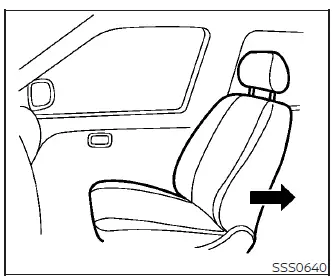
Forward-facing (front passenger seat) - step 1
It is important to note weight limitations: do not use the lower LATCH anchors if the combined weight of the child and the child restraint exceeds 65 lbs. (29.5 kg). If the combined weight exceeds this limit, you are required to use the vehicle's standard seat belt instead of the lower anchors. Always consult and adhere to the installation instructions provided by the child restraint manufacturer for the safest fit.
Follow these precise steps to install a forward-facing child restraint using the vehicle seat belt in either the rear seating positions or the front passenger seat of your Nissan Leaf:
1. If you must install a child restraint in the front passenger seat, it must be oriented in the forward-facing position only. Adjust the vehicle seat to its rearmost position to maximize clearance. Note that infant restraints are designed exclusively for rear-facing use and must never be installed in the front passenger seat.
2. Place the child restraint firmly on the seat. Always ensure the placement adheres to the manufacturer's specific guidelines. The back of the child restraint should be positioned so that it sits flush against the vehicle seatback. If necessary, adjust or remove the head restraint/headrest to achieve an optimal, stable fit for the child restraint. If the headrest is removed, keep it in a secure location and ensure it is reinstalled immediately once the child restraint is removed. If the seat lacks an adjustable headrest and it interferes with the restraint's fit, please select a different seating position or an alternative child restraint model.
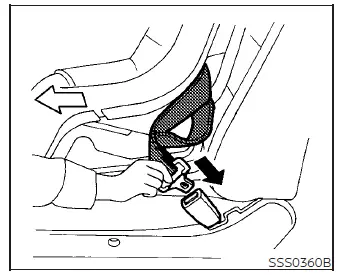
Forward-facing - step 3
3. Thread the seat belt tongue through the child restraint according to the manufacturer’s routing instructions, then insert it into the buckle until you hear and feel it click firmly into place. If the child restraint is equipped with a top tether strap—and you are installing it in a rear seating position—route and secure the tether to the vehicle's tether anchor point. Note: never attempt to install a restraint requiring a top tether in a position that is not equipped with one.
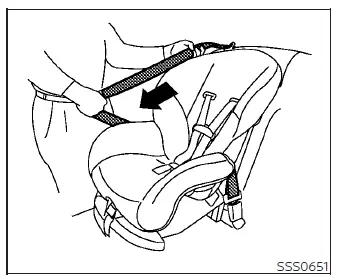
Forward-facing - step 4
4. Pull the shoulder belt out until it is fully extended. In this position, the retractor engages the ALR mode (the specific child restraint mode). The system will return to standard ELR mode only after the belt has been allowed to fully retract.
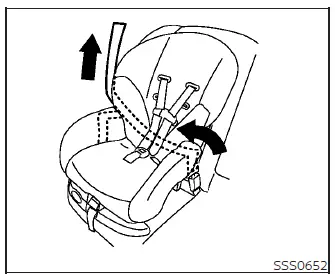
Forward-facing - step 5
5. Allow the seat belt to retract. Use your hand to pull up on the shoulder portion of the belt to remove any slack from the system.
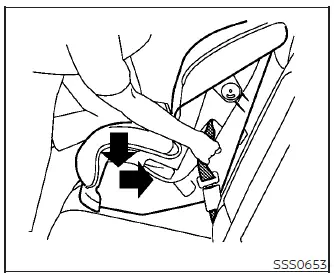
Forward-facing - step 6
6. To ensure a tight installation, remove any remaining slack from the seat belt. Press downward and rearward firmly in the center of the child restraint—using your knee for leverage—to compress the Nissan Leaf seat cushion and seatback, while simultaneously pulling up on the seat belt webbing.
7. If applicable, tighten the top tether strap according to the manufacturer's directions to eliminate all remaining slack.
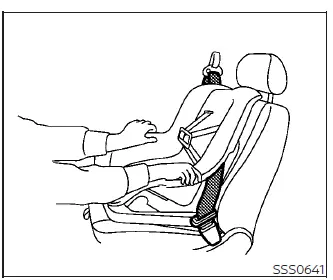
Forward-facing - step 8
8. Before placing your child in the seat, verify the installation by pushing the child restraint side-to-side and tugging it forward while holding it near the belt path. It should move no more than 1 inch (25 mm) in any direction. If the restraint is not stable, tighten the belt further or move it to a different seating position. Not all child restraint models are compatible with every type of vehicle seat.
9. Always check that the child restraint is properly secured before each use. If the seat belt is not locked, repeat steps 2 through 8.
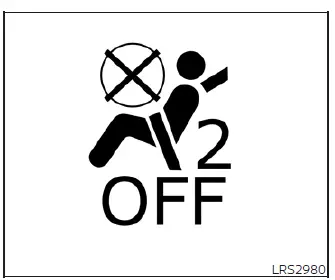
10. If installed in the front passenger seat, move the power switch to the ON position. The front passenger air bag status light  should illuminate. If it does not, refer to the "Front passenger air bag and status light" section and move the restraint to a different position. Have the system inspected by a NISSAN certified LEAF dealer for professional service.
After the child restraint is removed and the belt is fully retracted, the ALR mode is automatically canceled.
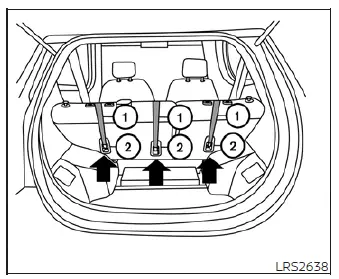
- Top tether strap
- Tether anchor point
Installing top tether strap
The top tether strap must be used whenever installing a child restraint with vehicle seat belts. Begin by securing the child restraint with the seat belt first.
Rear bench seat
1. Remove the head restraint/headrest and store it securely. Ensure it is reinstalled when the restraint is removed. Refer to "Head restraints/headrests" for details.
2. Position the top tether strap 1 as illustrated.
3. Secure the tether strap to the tether anchor point 2 as shown.
4. Review the relevant child restraint installation procedure steps before applying final tension to the tether strap.
If you have any questions when installing a top tether strap, it is recommended that you visit a NISSAN certified LEAF dealer for this service.
WARNING
Child restraint anchorages are engineered to withstand only those loads imposed by correctly fitted child restraints.
Under no circumstances are they to be used for adult seat belts, harnesses, or for attaching other cargo or equipment to the vehicle. Doing so could damage the child restraint anchorages, preventing proper future installation and potentially resulting in serious injury or death to a child in the event of a collision.
 Forward-facing child restraint installation using LATCH
A critical safety limitation applies to the LATCH system: do not utilize the lower anchors if the combined weight of the child and the child restraint exceeds 65 lbs. (29.5 kg). If the total weight su ...
 Booster seats
For detailed guidance on safely installing a booster seat within your Nissan Leaf, please carefully follow the instructions and safety standards outlined in this section.
Precautions on booster s ...
Other materials:
B1116 satellite sensor RH
DTC Logic
DTC DETECTION LOGIC
DTC CONFIRMATION PROCEDURE
1.CHECK SELF-DIAG RESULT
With CONSULT-III
1. Turn ignition switch ON.
2. Perform “Self Diagnostic Result� mode of “AIR BAG� using CONSULT-III.
Without CONSULT-III
1. Turn ignition switch ON.
2. Check the air bag warning la ...
B1066, B1071 passenger air bag module
DTC Logic
DTC DETECTION LOGIC
DTC CONFIRMATION PROCEDURE
1.CHECK SELF-DIAG RESULT
With CONSULT-III
1. Turn ignition switch ON.
2. Perform “Self Diagnostic Result� mode of “AIR BAG� using CONSULT-III.
Without CONSULT-III
1. Turn ignition switch ON.
2. Check the air bag warning la ...
P0340 CMP sensor (phase)
DTC Logic
DTC DETECTION LOGIC
Diagnosis Procedure
1.CHECK GROUND CONNECTIONS
1. Turn ignition switch OFF.
2. Check ground connection E38. Refer to Ground inspection in GI-44, "Circuit
Inspection".
Is the inspection result normal?
YES >> GO TO 2.
NO >> Repair or ...
