
Nissan Leaf 2018-2025 (ZE1) Owner's Manual : Booster seats
For detailed guidance on safely installing a booster seat within your Nissan Leaf, please carefully follow the instructions and safety standards outlined in this section.
Precautions on booster seats
WARNING
Improper use of a booster seat or the vehicle's seat belt significantly increases the risk of serious injury or fatality to a child during sudden braking or a collision. Adhere to these safety requirements:
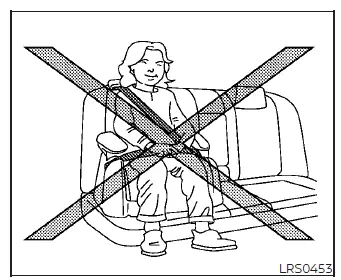
- Ensure the shoulder belt portion is positioned away from the child's face and neck, and that the lap portion rests securely across the hips rather than crossing the child's stomach.
- Always verify that the shoulder belt is not positioned behind the child’s back or under their arm.
- A booster seat must be installed exclusively in a seating position equipped with a functional three-point lap/shoulder belt.
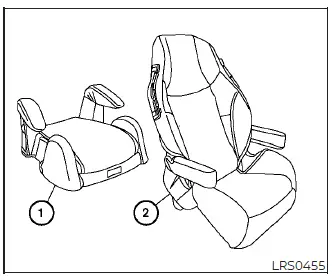
Various booster seats are available from different manufacturers. When selecting the appropriate model for your Nissan Leaf, keep these professional recommendations in mind:
- Select only a booster seat that carries a label certifying compliance with Federal Motor Vehicle Safety Standard 213 or the Canadian Motor Vehicle Safety Standard 213.
- Verify that the specific booster seat model is physically compatible with your vehicle’s seat contour and the seat belt system.
- Ensure the child's head receives proper support, either from the booster seat itself or the vehicle’s seatback. The seatback must reach at or above the center of the child’s ears. For example, if you opt for a low-back booster seat 1, the Nissan Leaf seatback must be high enough to provide this support. If the vehicle seatback is lower than the center of the child's ears, you must utilize a high-back booster seat 2.
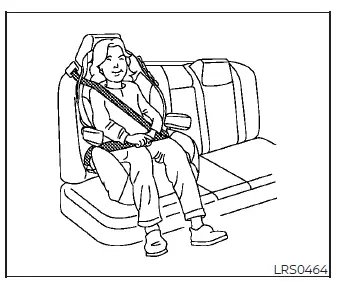
- Once you have confirmed compatibility, place your child in the seat and perform all necessary adjustments to ensure the booster seat fits the child correctly. Always execute the procedures recommended by the seat manufacturer.
All U.S. states and Canadian provinces or territories require that infants and small children be restrained in an approved child restraint at all times while the vehicle is being operated.
The instructions in this section apply to booster seat installation in the rear seats or the front passenger seat of your Nissan Leaf.
Booster seat installation
WARNING
To avoid injury, do not engage the lap/shoulder belt in the Automatic Locking Retractor (ALR) mode when using a booster seat.
Follow these steps to install a booster seat in the rear seats or front passenger seat of your Nissan Leaf:
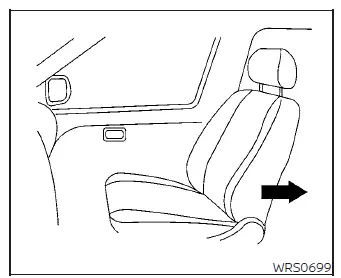
1. If you are installing a booster seat in the front passenger seat, move the seat to its rearmost position to provide adequate space.
2. Position the booster seat on the vehicle seat. It must be placed only in a front-facing direction. Always adhere to the specific instructions provided by the booster seat manufacturer.
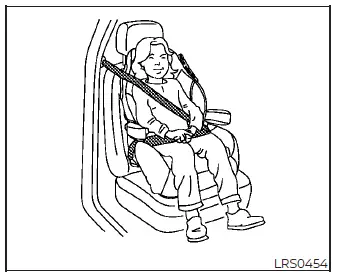
Front passenger position
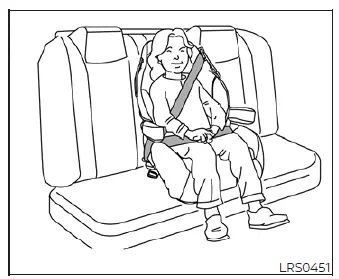
Rear center position
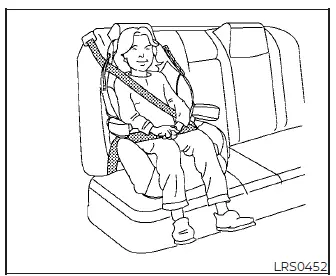
Rear outboard position
3. Ensure the booster seat is positioned so that it remains stable on the Nissan Leaf seat cushion. If necessary, adjust or remove the head restraint/headrest to achieve a correct, flush fit. If you remove the head restraint/headrest, store it in a secure location and reinstall it once the booster seat is removed. If the seating position has a fixed head restraint that prevents a proper fit, select a different seating position or use a different booster seat model.
4. Position the lap portion of the seat belt low and snug across the child's hips. Refer to the manufacturer's instructions regarding proper seat belt routing.
5. Pull the shoulder portion of the seat belt toward the retractor to remove any excess slack. Ensure the belt crosses the top, middle portion of the child's shoulder, again consulting the manufacturer's routing guidelines.
6. Carefully follow the warnings and instructions for fastening the seat belt as detailed in the "Three-point type seat belt with retractor" section.
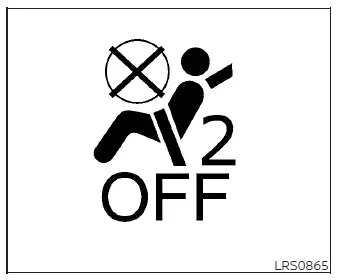
7. If the booster seat is installed in the front passenger seat, set the power switch to the ON position. The front passenger air bag status light  may or may not illuminate, depending on the child's weight and the specific type of booster seat utilized.
 Forward-facing child restraint installation using the seat belts
WARNING
You must utilize the three-point seat belt system equipped with an Automatic Locking Retractor (ALR) whenever you install a child restraint in your Nissan Leaf.
Failure to properly e ...

Other materials:
Symptom diagnosis
Squeak and rattle trouble diagnoses
Work Flow
CUSTOMER INTERVIEW
Interview the customer if possible, to determine the conditions that exist
when the noise occurs. Use the Diagnostic
Worksheet during the interview to document the facts and conditions when the
noise occurs and any of
the cu ...
P2138 APP sensor
DTC Logic
DTC DETECTION LOGIC
NOTE:
If DTC P2138 is displayed with DTC P0643, first perform the trouble diagnosis
for DTC P0643. Refer to
EC-307, "DTC Logic".
DTC CONFIRMATION PROCEDURE
1.PRECONDITIONING
If DTC Confirmation Procedure has been previously conducted, always perform ...
Configuration (bcm)
Description
Vehicle specification needs to be written with CONSULT-III because it is not
written after replacing BCM.
Configuration has three functions as follows.
NOTE:
Manual setting item: Items which need selection by vehicle specifications
Automatic setting item: Items which are written ...
