
Nissan Leaf 2018-2025 (ZE1) Owner's Manual : Driving the vehicle
Electric shift control system
This sophisticated vehicle is electronically controlled by an advanced powertrain management unit to produce maximum available torque, rapid throttle acceleration, and smooth, seamless operation under all regular driving conditions.
The factory recommended operating procedures and safety techniques for navigating this vehicle are thoroughly shown and described on the following pages.
Starting the vehicle
1. After successfully placing the advanced EV powertrain in the stable READY to drive position, fully depress and hold down the foot brake pedal before attempting to move the electronic shift lever away from park and into the active D (Drive) position.
The unique shift lever layout of this vehicle is specifically engineered with an electronic interlock system so that the primary foot brake pedal must be completely depressed by the driver before shifting from the secure P (Park) position to any active driving position while the main power switch remains in the ON position.
The electronic shift lever cannot be physically or mechanically moved out of the protective P (Park) position and into any of the other operational positions if the dashboard power switch is placed in the secure LOCK, manual OFF, or auxiliary ACC position, or if the paired NISSAN Intelligent Key fob is removed from the immediate cabin proximity.
2. Keep the main foot brake pedal firmly depressed with your right foot, and smoothly slide the selector shift lever across the gate to engage the dynamic D (Drive) position.
3. Completely release the electronic parking brake assembly and smoothly transition off the foot brake pedal, and then gradually apply pressure to the accelerator to start the vehicle in a smooth forward motion.
WARNING
- Do not depress or tap the accelerator pedal while actively shifting the selector from the static P (Park) or N (Neutral) states to the functional R (Reverse) or D (Drive) positions. Always keep the foot brake pedal firmly depressed until the digital shifting sequence is fully completed on the cluster.
Failure to carefully follow this warning could cause the vehicle to jump forward or backward unexpectedly, causing you to lose immediate control, which could result in a serious accident or property damage.
- Never attempt to shift to the P (Park) or R (Reverse) position while your Nissan Leaf is actively moving forward at any speed, and do not shift into the P (Park) or D (Drive) position while the vehicle is actively reversing. Doing so can cause severe mechanical or electronic binding, which could cause you to lose steering control and have a sudden accident.
- Do not shift to the high-regeneration B position abruptly when traveling on wet, icy, or otherwise slippery roads. This sudden change in wheel torque may cause a momentary traction loss and a subsequent loss of vehicle stability control.
CAUTION
- To avoid possible permanent thermal or mechanical damage to your electric vehicle powertrain components, when stopping or holding the vehicle on a steep uphill grade, do not hold the vehicle stationary against gravity by depressing the accelerator pedal. The heavy-duty hydraulic foot brake or the integrated auto-hold system should always be strictly used for this purpose to prevent system overheating.
- Do not hang heavy key chains, bags, or other storage items directly on the ergonomic shift lever assembly.
The weight of these items may accidentally force the selector out of position during travel, which may cause a dangerous accident due to a sudden unexpected start or gear change.
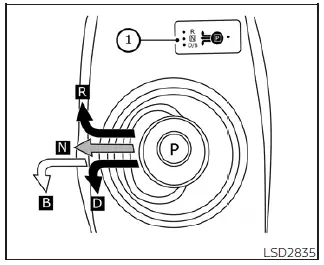
Shifting
To successfully move the electronic shift lever and change gears,
 : Slide the selector knob firmly along the designated shift gate layout while the primary foot brake pedal remains fully depressed.
 : After sliding the selector knob to the neutral side zone, maintain it steadily in that same position for a brief moment until the digital cluster confirms the vehicle is safely placed in the N (Neutral) position.
 : When already traveling in the D (Drive) position, slide the knob backward along the gated channel to toggle or change modes.
NOTE:
- Always confirm that your Nissan Leaf is resting in the desired target shift position by checking the integrated shift position indicator 1 located directly near the physical shift lever assembly or by verifying the gear letter readout on the vehicle information display screen inside the meter panel.
- To place the vehicle smoothly back into the standard D (Drive) position from the high-regeneration B mode, simply perform the same shifting gesture and move the physical shift lever down into the D (Drive) position once again.
After successfully placing your vehicle in the operational READY to drive position, fully depress the primary foot brake pedal, and smoothly move the electronic shift lever to any of your preferred driving or reverse shift positions to begin your journey.
If the push-button power switch is placed in the manual OFF or auxiliary ACC position for any reason while the transmission logic is left in any active position other than the primary P (Park) position, the vehicle interlock system will engage, meaning the power switch cannot be placed into the final locked LOCK position.
If the dashboard power switch cannot be placed in the target LOCK position due to an incorrect shutdown sequence, perform the following troubleshooting steps precisely:
1. Securely apply the parking brake mechanism once the vehicle is brought to a complete and safe stop.
2. Place the power switch back into the active ON position while simultaneously depressing the foot brake pedal with firm pressure.
3. Push the physical P (Park) position switch located on the shift lever assembly and verify via the cluster that the vehicle is securely locked in the P (Park) position.
4. Place the push-button power switch back in the OFF position to allow the system to clear its interlock status.
NOTE:
As an integrated safety override, the Nissan Leaf automatically applies the secure P (Park) position mechanically when the master power switch is placed directly into the OFF position.
Furthermore, when the following specific cabin and driving conditions overlap, the smart shift position logic may be automatically switched over to P (Park) to prevent accidental vehicle rollaway:
- When maintaining a complete stop and vehicle hold utilizing the intelligent e-Pedal system.
- When the driver unbuckles and takes off the primary safety seatbelt assembly.
- When physically unlatching and opening the driver-side door while stationary.
WARNING
- The ergonomic shift lever is spring-loaded and is designed to always snap back into its central home position immediately when released by the driver's hand. When the ignition power switch is placed in the active READY to drive position, the driver must explicitly look to confirm that the vehicle is safely sitting in the secure P (Park) position before releasing the brake. Always verify that the dedicated indicator next to the physical "P" button by the shift lever is brightly illuminated and that the corresponding "P" symbol is prominently displayed on the main dashboard meter display. If the vehicle is accidentally left in the D (Drive) position or R (Reverse) position when the powertrain enters the READY to drive mode, this oversight may cause an immediate, sudden start or vehicle lurch which could quickly result in a dangerous accident.
- When navigating a steep incline or hilly road, never allow the vehicle to roll backwards under gravity while the transmission is left in the D (Drive) position or high-regeneration B mode, and do not allow the vehicle to roll forward down a slope while the selector is placed in the R (Reverse) position. Failure to maintain positive torque control on inclines may cause an unexpected vehicle collision or serious accident.
CAUTION
- Do not attempt to slide or force the shift lever along its gate layout while simultaneously pushing down on the standalone P (Park) position switch button.
Engaging both commands at the same time can cause electronic conflicts and may damage the sensitive electric shift control motor.
- When switching to your preferred driving or reverse position by operating the gated shift lever, always verify that the shift lever returns freely to its central neutral position the moment you release your hand from the knob. Attempting to hold or jam the shift lever in a mid-way position during operation may also cause permanent damage to the delicate shift control system electronics.
- Do not operate or cycle the shift lever while your right foot is actively depressing the accelerator pedal, except during the specific contextual transition when switching over to the high-regeneration B mode from standard drive. Attempting to change gears under active throttle load may induce a sudden unexpected acceleration start which could result in a severe road accident.
- The following driving operations are strictly prohibited because excessive mechanical force would be instantaneously applied to the high-torque traction motor, and this severe reverse loading may result in expensive structural damage to the vehicle powertrain:
- Forcefully moving the electronic shift lever to the R (Reverse) position while your Nissan Leaf is actively driving or moving forward.
- Forcefully moving the electronic shift lever to the D (Drive) position while the vehicle is actively reversing or rolling backward.
- If these forbidden directional override operations are ever attempted while moving, an automated safety chime warning sounds in the cabin and the smart control module immediately shifts the vehicle safely into the protective N (Neutral) position to isolate the drivetrain.
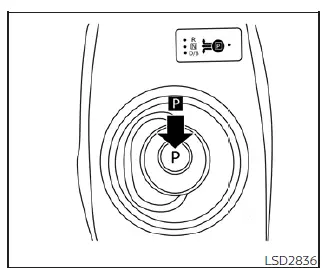
P (Park)
Use this primary transmission lock position whenever the vehicle is safely parked, remaining stationary, or when initially placing the advanced EV system into the active READY to drive position. Before attempting to engage this mode, make absolutely sure that the vehicle has come to a full and complete stop. In order to properly switch your Nissan Leaf to the secure P (Park) position, firmly press the standalone P (Park) position switch button as clearly shown in the graphic illustration above once the vehicle is entirely motionless. As a built-in electronic safeguard, if the physical P (Park) position switch is accidentally pushed by the driver while the vehicle is still actively in motion, an audible warning chime sounds in the cabin and the current active shift position is safely maintained to protect the mechanical parking pawl assembly.
Immediately after successfully switching to the secure P (Park) position, always apply the electronic parking brake for added safety. When parking on a steep incline or hill, ensure proper weight distribution by applying the parking brake mechanism first while keeping the main foot brake pedal firmly depressed; only after the parking brake is set should you push the P (Park) position switch to place the vehicle in the final P (Park) position lock.
NOTE:
- While the vehicle is completely stationary, if the internal electronic shift position is left placed in any active driving position other than the standard P (Park) position when the main push-button power switch is pressed to OFF, the onboard computer will automatically switch the transmission configuration to the secure P (Park) position.
- If the standalone P (Park) position switch button is pressed while the driver is simultaneously sliding the electronic shift lever across the gate, the command will be ignored and the system will not switch to the P (Park) position. When pushing the P (Park) position switch, be sure to first release the shift lever and allow it to return entirely to its spring-loaded central home position.
R (Reverse)
Select this position exclusively to back up and drive the car in reverse. Make absolutely certain that the vehicle has reached a complete, motionless stop before navigating the selector knob into the R (Reverse) position. If the electronic shift selector is pushed into the forward D (Drive) position while the car is actively reversing or rolling backward, a protective diagnostic chime will sound immediately and the vehicle system will automatically switch into the safe N (Neutral) position to prevent sudden mechanical stress.
N (Neutral)
In this non-driving position, the electric powertrain is decoupled, meaning neither forward propulsion nor reverse gear is electronically engaged by the traction motor.
The vehicle powertrain can safely be initialized and placed into the active READY to drive position while resting in this neutral state if necessary.
Do not manually shift your Nissan Leaf into the N (Neutral) position while actively driving down streets or highways. The advanced energy-recovering regenerative brake system does not operate at all when the transmission logic is set to the N (Neutral) position, which eliminates battery-charging deceleration forces when lifting off the accelerator.
However, if an emergency shift occurs, the vehicle's standard hydraulic service brakes remain fully powered and will still reliably slow down and stop the car.
D (Drive)
Engage this standard position for all normal forward driving situations, maximizing efficiency and smooth acceleration. If the shift selector is accidentally moved into the D (Drive) position while your Nissan Leaf is actively reversing, an integrated safety chime will sound and the control module will immediately switch the vehicle into the protective N (Neutral) position to isolate the drivetrain.
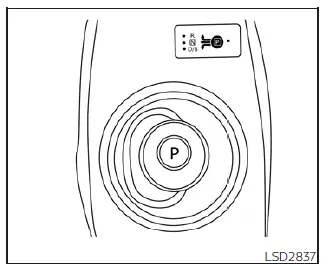
B mode
The specialized B mode engages the advanced regenerative braking system much more aggressively, which is highly beneficial when descending long, steep downhill slopes as it generates more electricity for the battery and helps significantly reduce mechanical brake pads use and wear. It is easily activated while driving in forward gear by moving the spring-loaded shift lever fully to the left and pulling it straight down. Once the mode is engaged on the electronic cluster, the shift lever will automatically return to its central home position while the aggressive braking profile remains active.
 Starting the EV system
1. Confirm that the electronic parking brake is fully applied and the brake indicator light is illuminated on the dashboard cluster.
2. Ensure and confirm that the vehicle transmission ...
 Parking brake
WARNING
Be absolutely sure that the mechanical or electronic parking brake is completely released before driving your vehicle. Failure to do so could cause rapid brake overheating, subs ...
Other materials:
P183B solenoid power supply
DTC Logic
DTC DETECTION LOGIC
DTC CONFIRMATION PROCEDURE
1.PRECONDITIONING
If “DTC CONFIRMATION PROCEDURE� has been previously conducted, always turn
ignition switch OFF and
wait at least 10 seconds before conducting the next test.
>> GO TO 2.
2.DTC REPRODUCTION PROCEDURE
W ...
Units
• The UNITS given in this manual are primarily expressed as the SI UNIT
(International System of Unit), and
alternatively expressed in the metric system and in the yard/pound system.
Also with regard to tightening torque of bolts and nuts, there are descriptions
both about range and about ...
Fluid cooler system
Exploded View
1. Copper washer
2. CVT fluid cooler tube
3. Hose clamp
4. Fluid cooler hose A
5. Fluid cooler tube
6. Fluid cooler hose B
7. Fluid cooler hose C
8. Transaxle assembly
9. Fluid cooler hose D
10. Fluid cooler hose E
11. Fluid cooler hose F
12. Bypass valve
13. Flu ...
