Nissan Leaf 2018-2025 (ZE1) Owner's Manual : Brake fluid
For comprehensive technical specifications and details regarding recommended fluids, lubricants, and system capacities for your Nissan Leaf, please refer to the "Recommended fluids/lubricants and capacities" section of your manual.
WARNING
- Always utilize fresh, high-quality brake fluid sourced from a factory-sealed container. Fluid that is old, improperly stored, or contaminated can introduce moisture and impurities, which may critically compromise the performance of your Nissan Leaf brake system.
The application of incorrect or contaminated brake fluid can cause internal damage to hydraulic seals and components, significantly degrading the vehicle's stopping ability and overall safety.
- Before removing the reservoir cap, meticulously clean the area around it to prevent any dirt or debris from entering the system.
- Brake fluid is a toxic substance; it must be handled with extreme care and stored exclusively in clearly labeled, original containers, kept strictly out of the reach of children and pets.
CAUTION
Be highly cautious when handling brake fluid to avoid any spills on the painted body panels of your Nissan Leaf.
Brake fluid is chemically aggressive and will permanently damage the paint finish. If a spill occurs, immediately flush the affected area with an abundance of clean water to neutralize and remove the chemical.
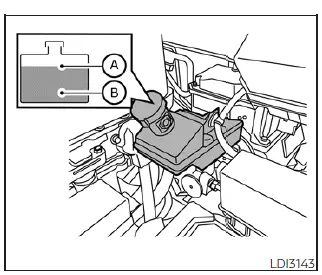
Regularly inspect the fluid level in the brake reservoir. If the fluid is observed to be below the "MIN" line (B), or if the brake warning light illuminates on the dashboard, you must replenish the system using Genuine NISSAN Super Heavy Duty Brake Fluid or an equivalent DOT 3 brake fluid, filling it carefully up to the "MAX" line (A).
If you find that the fluid level requires frequent topping off, it may indicate a potential leak or excessive wear within the hydraulic system. It is strongly recommended that you visit a NISSAN certified LEAF dealer for a professional inspection.
 Cooling system
The cooling system in your Nissan Leaf is factory-filled with a high-performance, pre-diluted mixture consisting of 50% Genuine NISSAN Long Life Antifreeze/Coolant (blue) and 50% demineralized water. ...
 Windshield-washer fluid
Maintain clear visibility by checking and filling the windshield-washer fluid reservoir periodically. You should replenish the reservoir promptly when the "Low Washer Fluid" noti ...
Other materials:
Oil pan
Exploded View
1. Baffle plate
2. Gasket
3. Oil pan
4. O-ring
5. Drain plug
6. Oil level gauge guide
7. Transaxle
8. Crankshaft position sensor (POS)
: N·m (kg-m, ft-lb)
: N·m (kg-m, in-lb)
: Always replace after every
disassembly.
Removal and Installation
REMOVAL
CAUTION:
N ...
Differential side oil seal
Exploded View
1. Transaxle assembly
2. Differential side oil seal (left side)
3. Differential side oil seal (right side)
: Always replace after every
disassembly.
: Genuine NISSAN CVT Fluid NS-2
Removal and Installation
REMOVAL
NOTE:
Cap or plug openings to prevent fluid from spilling ...
Maintenance schedules
To guarantee the long-term reliability, safety, and operational economy of your vehicle, NISSAN provides two distinct maintenance schedules tailored to your specific driving habits. These structured plans cover both distance and time-based intervals, extending up to 120,000 miles (192,000 km) or 96 ...
