
Nissan Leaf 2018-2025 (ZE1) Owner's Manual : Cooling system
The cooling system in your Nissan Leaf is factory-filled with a high-performance, pre-diluted mixture consisting of 50% Genuine NISSAN Long Life Antifreeze/Coolant (blue) and 50% demineralized water. This specialized formulation is designed to provide comprehensive, year-round protection against both freezing temperatures and overheating. Furthermore, this antifreeze solution is engineered with advanced inhibitors that proactively prevent rust and internal corrosion within the cooling circuit. Consequently, the use of additional cooling system additives is unnecessary and is not recommended.
WARNING
- Never attempt to remove the coolant reservoir cap while the motor compartment is hot. High-pressure steam and hot liquid may be present; always allow the system to cool down completely before inspecting or servicing.
- The coolant reservoir is engineered with a specialized pressure-type cap essential for maintaining the system's operational integrity.
To prevent thermal damage or pressure loss in your Nissan Leaf motor compartment, always ensure you replace the cap with a genuine NISSAN component only.
CAUTION
- Never introduce foreign additives, such as radiator sealers or stop-leak products, into the cooling system. These substances can cause severe, long-term damage to sensitive electrical and electronic components, including the electric motor and the power inverter.
- When topping off or replacing coolant, you must use only Genuine NISSAN Long Life Antifreeze/Coolant (blue) or a chemically equivalent product. The genuine solution is pre-diluted to maintain freeze protection down to −34ºF (−37ºC). If you operate your Nissan Leaf in extreme climates requiring additional protection, you may add Genuine NISSAN Long Life Antifreeze/Coolant (blue) concentrate by strictly following the mixing ratios on the container. If you choose an equivalent coolant, it is your responsibility to follow the manufacturer's directions to ensure the mixture maintains a minimum freeze protection point of −34ºF (−37ºC). Utilizing incorrect coolant chemistries can cause permanent damage to your vehicle's thermal management system.
Checking coolant level
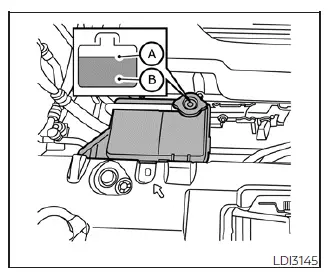
Always inspect the coolant level within the reservoir while the high-voltage components are cool to the touch. If the coolant level has dropped below the "MIN" indicator (B), carefully open the reservoir cap and replenish the fluid until it reaches the "MAX" level (A). In instances where the reservoir is found to be empty, perform a more thorough inspection: ensure the system is cool, fill the reservoir through the cap opening until it is full, and also top off the auxiliary reservoir to the "MAX" level (A).
Ensure the reservoir cap is tightened securely after the replenishment process is complete.
For guidance regarding the exact positioning of the reservoir under the hood, refer to the "Motor compartment check locations" section.
If you find that your Nissan Leaf frequently requires additional coolant, it is a strong indicator of a potential leak or system issue; please visit a NISSAN certified LEAF dealer for a professional inspection.
Changing coolant
Major repairs or complete coolant exchanges should be performed by a NISSAN certified LEAF dealer. Comprehensive service procedures for these tasks are documented in the official NISSAN Service Manual.
Please note that incomplete or improper servicing of the cooling system can significantly degrade cabin heater performance.
WARNING
- To eliminate the risk of scalding, never perform a coolant change while the motor compartment is hot.
- Never remove the coolant reservoir cap while the system is hot. The sudden release of high-pressure fluid from the radiator can cause severe, immediate burns.
- Avoid direct skin contact with used coolant. If the fluid comes into contact with your skin, wash the area thoroughly with soap or a dedicated hand cleaner as soon as possible.
- Always store coolant safely out of the reach of children and household pets.
Used coolant is considered hazardous waste; you must dispose of it according to your local environmental regulations.
Reduction gear fluid
If your Nissan Leaf requires an inspection or replacement of the reduction gear fluid, we recommend scheduling this service at a NISSAN certified LEAF dealer.
CAUTION
- Use only Genuine NISSAN Matic S ATF for the reduction gear.
Do not mix this fluid with any other types or brands.
- Utilizing any reduction gear fluid other than Genuine NISSAN Matic S ATF will result in degraded driveability, reduced gear durability, and potential mechanical failure of the reduction gear assembly. Please be aware that damage resulting from the use of unauthorized fluids is not covered under the NISSAN New Vehicle Limited Warranty.
 Motor compartment check locations
Fuse/Fusible link holder
Brake fluid reservoir
12-volt battery
Fuse holder
Windshield-washer fluid reservoir
Fuse/Fusible l ...
 Brake fluid
For comprehensive technical specifications and details regarding recommended fluids, lubricants, and system capacities for your Nissan Leaf, please refer to the "Recommended fluids/lubricants and capa ...
Other materials:
S terminal circuit
Description
The output voltage of the alternator is controlled by the IC voltage
regulator at the “S� terminal detecting the
input voltage.
The “S� terminal circuit detects the battery voltage to adjust the alternator
output voltage with the IC voltage
regulator.
Diagnosis Procedu ...
C1121, C1123, C1125, C1127 ABS out valve system
DTC Logic
DTC DETECTION LOGIC
wait at least 10 seconds before conducting the next test.
>> GO TO 2.
2.CHECK DTC DETECTION
With CONSULT-III
1. Turn the ignition switch OFF to ON.
2. Perform self-diagnosis for “ABS�.
Is DTC “C1121�, “C1123�, “C1125� or “C1127� ...
B1147 curtain air bag module RH
DTC Logic
DTC DETECTION LOGIC
DTC CONFIRMATION PROCEDURE
1.CHECK SELF-DIAG RESULT
With CONSULT-III
1. Turn ignition switch ON.
2. Perform “Self Diagnostic Result� mode of “AIR BAG� using CONSULT-III.
Without CONSULT-III
1. Turn ignition switch ON.
2. Check the air bag warning la ...
