
Nissan Leaf 2018-2025 (ZE1) Owner's Manual : 12-volt battery
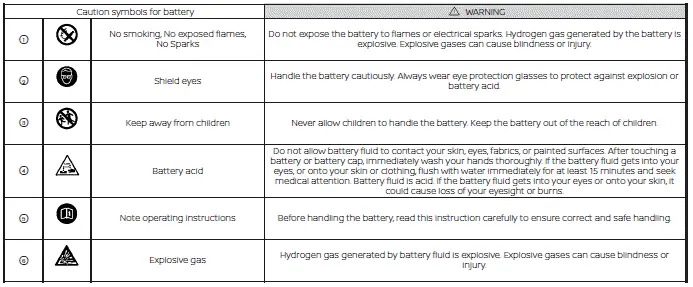
- Maintain the external surface of the 12-volt battery in a clean and dry condition. Should corrosion appear on the terminals or casing, clean the battery using a mild solution of baking soda mixed with water, ensuring that none of this solution enters the battery cells.
- Periodically inspect the terminal connections to confirm they remain free of oxidation and are securely tightened to ensure optimal electrical conductivity.
NOTE:
Proactive care is necessary to avoid circumstances that can lead to excessive battery discharge and potential starting failures, including:
1. The installation or prolonged use of aftermarket electronic accessories—such as phone chargers, GPS units, or multimedia players—that draw power from the 12-volt system while the Nissan Leaf EV system is powered off.
2. Situations where the vehicle is left idle for extended periods or is primarily driven for very short distances, which prevents the system from maintaining a full charge.
In such scenarios, you may need to utilize an external charger to maintain the health and longevity of your 12-volt battery.
WARNING
- Never expose the 12-volt battery to open flames, cigarettes, or electrical sparks. The battery produces hydrogen gas during normal operation, which is highly explosive. Prevent battery electrolyte fluid from making contact with your skin, eyes, clothing, or the painted surfaces of your vehicle. If you handle a battery or its vent caps, avoid touching your eyes; wash your hands thoroughly afterward. In the event of acid contact with your eyes or skin, flush the affected area with clean water for a minimum of 15 minutes and seek immediate professional medical attention.
- Do not operate your Nissan Leaf if the fluid level within the 12-volt battery is low. Insufficient electrolyte increases the internal electrical load, which can cause the battery to overheat, drastically shorten its operational lifespan, and in extreme cases, lead to a catastrophic rupture or explosion.
- Always wear appropriate eye protection and remove all metal jewelry, such as rings or watches, when working on or near the 12-volt battery to prevent accidental short-circuits.
- The battery posts, terminals, and internal components contain lead and lead compounds, which are hazardous. Always wash your hands thoroughly after handling these parts.
- Store the 12-volt battery and all associated components in a secure location, strictly out of the reach of children.
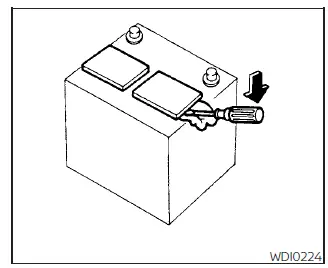
1. Carefully remove the battery vent caps using a flat-head screwdriver. It is recommended to place a clean cloth over the battery case during this process to protect the housing from scratches or fluid drips.
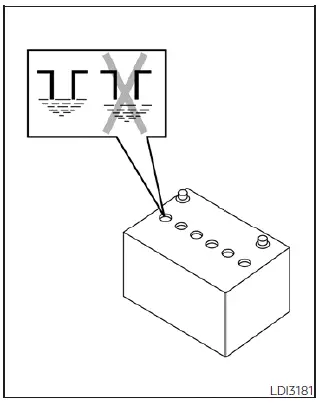
2. Inspect the fluid level within each individual cell. If the level is low, add only high-purity distilled water to bring the fluid up to the bottom of the filler opening. Do not overfill the cells, as this can lead to acid spray during operation. Once finished, reinstall the vent caps firmly.
For Nissan Leaf vehicles operated in high-ambient-temperature regions or subjected to severe driving conditions, it is necessary to inspect the 12-volt battery fluid levels more frequently to account for higher rates of evaporation.
Jump starting
Jump starting is intended solely to provide enough power to the 12-volt system to activate the vehicle's onboard electronics. These systems must be fully operational to enable the high-voltage Li-ion battery to engage its charging cycle. Please note that jump starting does not charge the high-voltage Li-ion battery directly; that battery must be sufficiently charged before the vehicle can be safely driven.
For detailed safety instructions, refer to the "Jump starting" section of your manual. If the power switch fails to transition into the "READY to drive" position after a successful jump start, the 12-volt battery has likely reached the end of its service life and requires replacement. In this instance, it is highly recommended that you visit a NISSAN certified LEAF dealer for professional service.
 Windshield-washer fluid
Maintain clear visibility by checking and filling the windshield-washer fluid reservoir periodically. You should replenish the reservoir promptly when the "Low Washer Fluid" noti ...
 Windshield wiper blades
Cleaning
If your windshield fails to clear properly after utilizing the washer system, or if you notice the wiper blades "chattering" and skipping across the glass during operation, this is often ...
Other materials:
P0730 incorrect gear ratio
Description
TCM selects the gear ratio using the engine load (throttle position), the
primary pulley revolution speed, and
the secondary pulley revolution speed as input signal. Then it changes the
operating pressure of the primary
pulley and the secondary pulley and changes the groove width ...
U1010 control unit (CAN)
Description
CAN (Controller Area Network) is a serial communication line for real time
application. It is an on-vehicle multiplex
communication line with high data communication speed and excellent malfunction
detection ability.
Many electronic control units are equipped onto a vehicle, and ...
Brake booster
Inspection
OPERATION
Depress the brake pedal several times at 5-second intervals with the engine
stopped. Start the engine with the
brake pedal fully depressed. Check that the clearance between brake pedal and
dash lower panel decreases.
NOTE:
A slight impact with a small click may be fel ...
