
Nissan Leaf 2018-2025 (ZE1) Owner's Manual : Vehicle loading information
WARNING
- It is extremely dangerous to ride in the cargo area inside the vehicle.
In the event of a collision, individuals positioned in these unsecured areas are significantly more likely to suffer serious injury or fatalities.
- Never allow passengers to ride in any part of your Nissan Leaf that is not specifically equipped with designated seating and functioning seat belts.
- To ensure maximum safety, confirm that every occupant in the vehicle is properly seated and secured with a fastened seat belt before the vehicle is in motion.
Terms
To safely and effectively manage the weight distribution of your Nissan Leaf, please familiarize yourself with these essential industry terms regarding vehicle loading:
- Curb Weight: This represents the actual base weight of your vehicle, which includes all standard and optional factory-installed equipment, a full supply of required fluids, and essential emergency tools. Importantly, this figure excludes the weight of any passengers or cargo.
- GVW (Gross Vehicle Weight): This is calculated by taking the Curb Weight of the vehicle and adding the total combined weight of all passengers and any onboard cargo.
- GVWR (Gross Vehicle Weight Rating): This is the maximum total weight limit authorized by the manufacturer for the vehicle, including the unloaded vehicle itself, all passengers, cargo, any installed hitches, trailer tongue loads, and other optional accessories. You can find this critical rating on your vehicle’s F.M.V.S.S./C.M.V.S.S. certification label.
- GAWR (Gross Axle Weight Rating): This refers to the maximum load limit specified for either the front or the rear axle specifically.
This information is clearly displayed on the F.M.V.S.S./C.M.V.S.S. certification label.
- GCWR (Gross Combined Weight Rating): This defines the maximum total allowable weight of the entire Nissan Leaf configuration, including the vehicle, all passengers, all cargo, and any towed trailer.
- Vehicle Capacity Weight (Load Limit / Total Load Capacity): This is the maximum specified weight for the combined load of passengers and cargo that the vehicle can safely carry. If you are using your Nissan Leaf to tow a trailer, ensure the trailer tongue weight is included in your calculation. This limit is found on the Tire and Loading Information label.
- Cargo Capacity: This is the permissible weight remaining for your cargo, calculated by subtracting the total weight of all vehicle occupants from the vehicle's total load limit.
Vehicle load capacity
Before you begin your journey with a loaded vehicle, it is essential to confirm that your total weight does not exceed the Gross Vehicle Weight Rating (GVWR) or the Gross Axle Weight Rating (GAWR) for your specific Nissan Leaf model. Both the GVWR and GAWR are conveniently located on the F.M.V.S.S./C.M.V.S.S. certification label.
For further technical guidance, please refer to the "Measurement of weights" section of this manual.
Ensure you never exceed the specified load limit for your vehicle, which is listed as "The combined weight of occupants and cargo" on the Tire and Loading Information label. Additionally, never exceed the "Seating Capacity" limit indicated on the same label.
To calculate the "combined weight of occupants and cargo," sum the individual weights of all passengers and then add the total weight of your stowed cargo. The following illustration provides visual examples to assist you in these calculations.
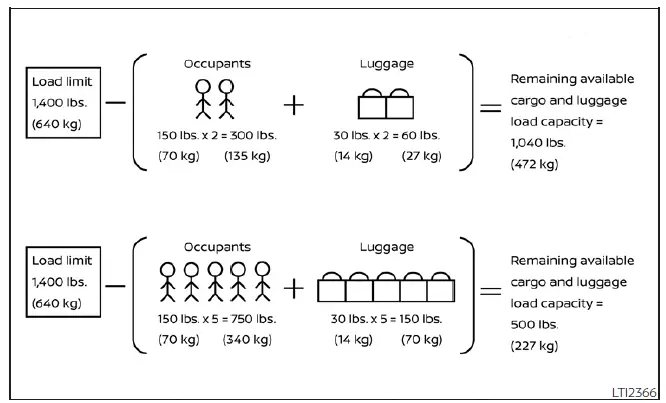
Steps For Determining Correct Load Limit
1. Locate the specific statement, "The combined weight of occupants and cargo should never exceed XXX kg or XXX lbs," on the placard attached to your Nissan Leaf.
2. Calculate the total combined weight of the driver and all passengers who will be riding in the vehicle.
3. Subtract the combined weight of the driver and all passengers from the total load limit value (XXX kg or XXX lbs) specified on your vehicle's placard.
4. The resulting figure represents the available capacity for your cargo and luggage. For example, if your total load limit is 1,400 lbs. and you are transporting five passengers weighing 150 lbs. each, the remaining cargo capacity is 650 lbs. (Calculation: 1,400 lbs. − 750 lbs. (5 occupants × 150 lbs.) = 650 lbs. of available cargo room).
5. Carefully calculate the combined weight of all luggage and cargo you intend to load into your Nissan Leaf. Ensure that this total weight does not exceed the available cargo capacity determined in the previous step.
6. Please note that the Nissan Leaf is not designed for towing. If you were to attempt to tow a trailer, the weight transferred to the vehicle would compromise your available cargo capacity and severely impact vehicle safety.
Towing a trailer with a vehicle not engineered for such purposes poses a severe risk of accidents, which could result in serious injury or even death.
WARNING
Do not attempt to tow a trailer with your Nissan Leaf.
Any attempt to tow a trailer may result in a loss of vehicle control, leading to accidents, serious injury, or death.
Before driving your Nissan Leaf while heavily loaded, always verify that your total load remains within the Gross Vehicle Weight Rating (GVWR) and the individual Gross Axle Weight Ratings (GAWR) specified for your vehicle.
Additionally, always perform a safety check to ensure your tires are inflated to the recommended pressures for the current load conditions.
Loading tips
- The total Gross Vehicle Weight (GVW) must never exceed the GVWR or the individual GAWR limits as specified on your vehicle's F.M.V.S.S./C.M.V.S.S. certification label.
- Be mindful that loading both the front and rear axles to their maximum individual GAWR simultaneously will exceed the total GVWR of your Nissan Leaf.
WARNING
- Always use appropriate ropes, nets, or tie-down straps to secure all cargo, preventing any shifting or sliding while the vehicle is in motion. Never stack cargo higher than the height of the seatbacks. In the event of a sudden stop or a collision, unsecured items can become projectiles, causing significant personal injury.
- Never exceed the GVWR or the maximum front and rear GAWRs for your Nissan Leaf. Exceeding these limits can cause critical vehicle components to fail, lead to catastrophic tire damage, and fundamentally alter the handling characteristics of the vehicle.
Failure to adhere to these weight limits can result in a total loss of vehicle control, leading to serious personal injury.
- Overloading your vehicle not only accelerates wear on vital mechanical components and tires but also leads to unpredictable handling and significantly increased braking distances. Such conditions may trigger premature tire failure, creating a high risk of serious accidents.
Any mechanical or structural failures resulting directly from overloading are not covered under the terms of your vehicle's warranty.
Measurement of weights
To maintain optimal handling, ensure all loose items are securely fastened to prevent weight shifts that could disrupt the vehicle's balance. When the Nissan Leaf is fully loaded, it is recommended that you drive to a certified scale to weigh the front and rear wheels separately, confirming that your axle loads are properly distributed.
Individual axle loads must never exceed the specified Gross Axle Weight Ratings (GAWR), and the combined sum of these axle loads must stay below the Gross Vehicle Weight Rating (GVWR). These critical safety ratings are explicitly listed on your vehicle certification label. If you discover that you have exceeded any of these ratings, you must redistribute or remove items immediately to ensure all weights are brought back within the safe operating parameters.
Towing a trailer
Do not tow a trailer with your Nissan Leaf under any circumstances.
 Vehicle identification
Vehicle Identification Number (VIN) plate
The Vehicle Identification Number (VIN) plate is securely attached to your Nissan Leaf at the position indicated in the illustratio ...
 Flat towing
Flat towing refers to the practice of towing a vehicle with all four wheels in direct contact with the road surface.
This transport method is frequently employed by owners who wish to tow a vehic ...
Other materials:
Component parts
Component Parts Location
LHD models
1. ABS actuator and electric unit (control
unit)
Refer to BRC-97, "Component Parts
Location".
2. ECM
Refer to EC-25, "ENGINE CONTROL
SYSTEM :
Component Parts Location".
3. Front wheel sensor
Refer to BRC-97, "Component Parts
...
Does not operate
Description
ABS function and EBD function does not operate.
Diagnosis Procedure
CAUTION:
ABS function and EBD function never operate when the vehicle speed is 10 km/h
(6.2 MPH) or less.
1.CHECK ABS WARNING LAMP
Check that ABS warning lamp and brake warning lamp turn ON and turn OFF
appro ...
Three-way catalyst
The three-way catalyst is an emission control device installed in the exhaust
system. Exhaust gases in the three-way catalyst are burned at high temperatures
to help reduce pollutants.
WARNING
• The exhaust gas and the exhaust system are very hot. Keep people, animals
or flammable material ...
