
Nissan Leaf 2018-2025 (ZE1) Owner's Manual : System Temporarily Unavailable
When the advanced safety sensors detect radar blockage, the Nissan Leaf safety suite will automatically deactivate affected systems to ensure reliability. These features will remain unavailable until the environmental conditions clear and the sensors can once again accurately monitor the vehicle's surroundings.
The radar sensors integrated into your Nissan Leaf may experience temporary blockage due to adverse ambient conditions, such as heavy rain spray, thick mist, or dense fog that obscures the signal path.
Furthermore, persistent physical obstructions—including accumulated ice, compacted snow, frost, or road dirt—can interfere with sensor performance and trigger a system suspension.
NOTE:
Please be aware that if the Blind Spot Warning (BSW) system detects a disruption and stops working, the Rear Cross Traffic Alert (RCTA) system will also cease operation, as both rely on the same sensor data.
Action to Take
Once the environmental factors or physical obstructions causing the blockage are cleared, the system will automatically resume normal operation without requiring driver intervention.
Malfunction
In the event of a technical malfunction within the RCTA system, it will automatically deactivate. A "Malfunction: See Owner's Manual" warning message will be displayed on the vehicle's information screen to alert the driver.
NOTE:
As with blockage, if the BSW system experiences a malfunction and stops working, the RCTA system will also be disabled.
Action to Take
Should a malfunction occur, please stop your Nissan Leaf in a safe location, engage the P (Park) position, power down the EV system, and perform a restart. This can often resolve temporary electronic communication glitches.
If the system does not resume functionality after a restart, it is essential to have the vehicle inspected by a professional. We strongly recommend visiting a NISSAN certified LEAF dealer, where technicians have the specialized tools and training required to diagnose and service your vehicle's advanced safety systems.
System Maintenance
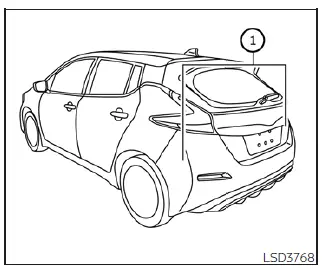
The two radar sensors responsible for the Blind Spot Warning and Rear Cross Traffic Alert systems are precision-mounted near the rear bumper of your Nissan Leaf. To maintain optimal safety performance, it is crucial to keep the exterior surface area surrounding these sensors clean and free of debris at all times.
Be mindful that radar sensors can be temporarily blinded by environmental factors such as heavy water splashing, mist, or fog, which scatter the radar waves.
Additionally, physical buildup—such as ice, frost, or road grime—can create a barrier that interferes with sensor accuracy. Regularly inspect these zones and remove any objects or substances obstructing the area.
To ensure the systems function as intended, never attach stickers, decals, or any protective films (including transparent materials) over the sensor locations. Similarly, avoid installing aftermarket accessories or applying additional layers of paint in these areas, as these can significantly degrade radar penetration.
Do not apply physical force or impact the area around the radar sensors. If the bumper or the area surrounding the sensors sustains damage due to a collision or accidental impact, it is highly recommended that you consult a NISSAN certified LEAF dealer for a professional repair and calibration.
Radio Frequency Statement (Type A) (if so equipped)
For USA
This device complies with part 15 of the FCC Rules. Operation is subject to the following two conditions:
(1) This device may not cause harmful interference, and (2) this device must accept any interference received, including interference that may cause undesired operation.
FCC Warning
Changes or modifications not expressly approved by the party responsible for compliance could void the user's authority to operate the equipment.
For Canada
Applicable law: Canada 310
This device complies with Industry Canada licence-exempt RSS standard(s).
Operation is subject to the following two conditions: (1) This device may not cause interference, and (2) This device must accept any interference, including interference that may cause undesired operation of the device.
Frequency bands: 24.05-24.25GHz
Output power: less than 20 milliwatts
Radio Frequency Statement (Type B) (if so equipped)
For USA
This device complies with part 15 of the FCC Rules. Operation is subject to the following two conditions:
(1) This device may not cause harmful interference, and (2) this device must accept any interference received, including interference that may cause undesired operation.
FCC Warning
Changes or modifications not expressly approved by the party responsible for compliance could void the user's authority to operate the equipment.
For Canada
Applicable law: Canada 310
This device contains licence-exempt transmitter(s)/receiver(s) that comply with Innovation, Science and Economic Development Canada's licence-exempt RSS(s). Operation is subject to the following two conditions:
1. This device may not cause interference.
2. This device must accept any interference, including interference that may cause undesired operation of the device.
Radiofrequency radiation exposure information:
This equipment complies with radiation exposure limits set forth for an uncontrolled environment. This equipment should be installed and operated with a minimum distance of 20 cm between the radiator and your body.
 How to enable/disable the RCTA system
Follow these steps to customize or toggle the RCTA system settings:
1. Press the button repeatedly until "Settings" appears on the vehicle information display.
...
 Cruise control
...
Other materials:
Precaution
Precaution for Supplemental Restraint System (SRS) "AIR BAG" and "SEAT
BELT
PRE-TENSIONER"
The Supplemental Restraint System such as “AIR BAG� and “SEAT BELT
PRE-TENSIONER�, used along
with a front seat belt, helps to reduce the risk or severity of injury to the
...
Component parts
Engine control system : Component Parts Location
1. IPDM E/R
Refer to PCS-5, "Component Parts
Location".
2. Battery current sensor
(with battery temperature sensor)
3. Mass air flow sensor
(with intake air temperature sensor)
4. Electric throttle control actuator
(with built in ...
B1067, B1072 passenger air bag module
DTC Logic
DTC DETECTION LOGIC
DTC CONFIRMATION PROCEDURE
1.CHECK SELF-DIAG RESULT
With CONSULT-III
1. Turn ignition switch ON.
2. Perform “Self Diagnostic Result� mode of “AIR BAG� using CONSULT-III.
Without CONSULT-III
1. Turn ignition switch ON.
2. Check the air bag warning la ...
