
Nissan Juke Service and Repair Manual : Reservoir tank cap
Inspection
• Check valve seat of reservoir tank cap.
- Check if valve seat (A) is swollen to the extent that the edge of the metal plunger (B) cannot be seen when watching it vertically from the top.
- Check if valve seat has no soil and damage.
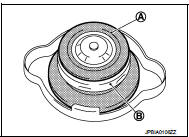
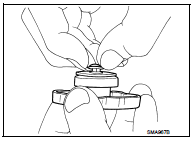
• Pull negative-pressure valve to open it, and check that it close completely when released.
- Check that there is no dirt or damage on the valve seat of reservoir tank cap negative-pressure valve.
- Check that there are no unusualness in the opening and closing conditions of negative-pressure valve.
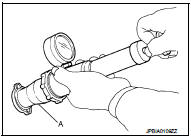
• Check reservoir tank cap relief pressure.
- When connecting reservoir tank cap to the radiator cap tester (commercial service tool) and the radiator cap tester adapter (commercial service tool) (A), apply engine coolant to the cap seal surface.
Standard and limit : Refer to CO-76, "Radiator".
• Replace reservoir tank cap if there is an unusualness related to the above three.
CAUTION:
When installing reservoir tank cap, thoroughly wipe out the reservoir tank
filler neck to remove any
waxy residue or foreign material.
 Engine coolant
Inspection
LEVEL
• Check that the reservoir tank engine coolant level is within the
“MIN� to “MAX� when the engine is cool.
A : MAX
B : MIN
• Adjust the engine coolant level if neces ...

Other materials:
Front disc brake
Brake pad : Exploded View
MR16DDT
1. Cylinder body
2. Inner shim
3. Inner pad (with pad wear sensor)
4. Pad retainer
5. Torque member
6. Outer pad
7. Outer shim
1: Apply MOLYKOTE® AS880N or
silicone-based grease.
2: Apply MOLYKOTE® 7439 or
equivalent.
: N·m (kg-m, ft-lb)
HR1 ...
Horn
To alert other drivers, simply push the center pad area of the steering wheel to sound the horn.
WARNING
Do not attempt to disassemble the horn assembly. Any unauthorized tampering could interfere with the critical operation of the supplemental front air bag system, w ...
Evaporative emission system
Inspection
1. Visually inspect EVAP vapor lines for improper attachment and for cracks,
damage, loose connections,
chafing and deterioration.
2. Check EVAP canister as follows:
a. Block port (A). Orally blow air through port (B).
Check that air flows freely through port (C).
b. Block port (B ...
