Nissan Leaf 2018-2025 (ZE1) Owner's Manual : Precautions on seat belt usage
Properly adjusting and wearing your seat belt is the single most effective way to protect yourself and your passengers. By sitting upright, positioning yourself well back in the seat, and keeping both feet planted on the floor, you significantly enhance the protective capabilities of your vehicle's safety systems, reducing both the likelihood and the severity of injuries during a collision. Nissan strongly encourages every occupant of your Nissan Leaf to buckle up for every trip, regardless of distance, even in seating positions equipped with supplemental air bags.
Most U.S. states and Canadian provinces or territories have strict regulations requiring that seat belts be worn at all times while the vehicle is in motion.
WARNING
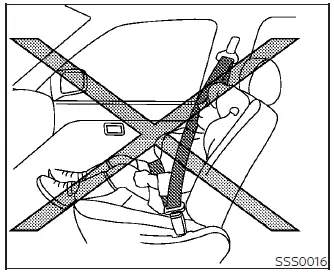
- Every person who drives or rides in this vehicle should use a seat belt at all times. Children must always be properly secured in the rear seats using an appropriate child restraint system suitable for their age, height, and weight.
- The seat belt must be adjusted to provide a snug, secure fit. Failing to maintain this tension can severely diminish the effectiveness of the entire occupant restraint system, drastically increasing the risk of serious injury or fatality in the event of an accident.
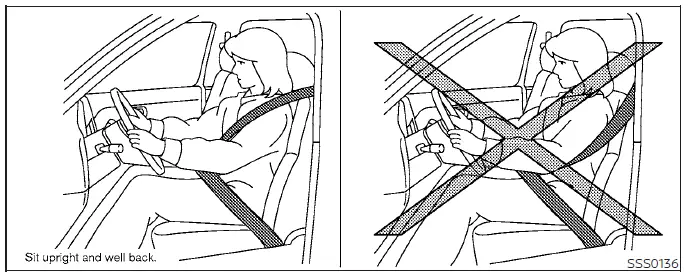
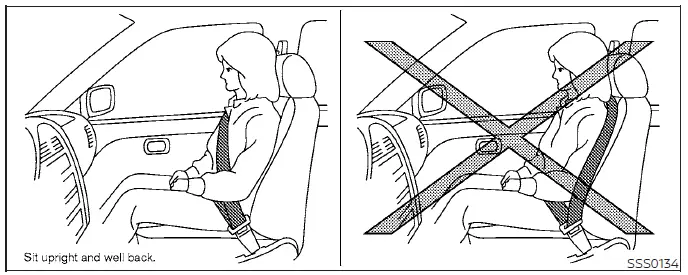
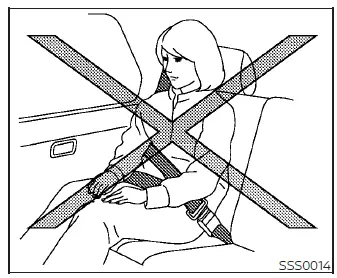
- Always route the shoulder belt comfortably over your shoulder and across your chest, ensuring it stays centered.
Never attempt to bypass the shoulder belt by placing it behind your back, tucking it under your arm, or allowing it to cross directly over your neck.
The belt should maintain a position away from your face and neck, yet remain firmly on your shoulder without slipping off.
- Position the lap belt as low and as snug as possible, ensuring it rests AROUND THE HIPS, NOT ACROSS THE WAIST. Wearing a lap belt too high significantly increases the risk of severe internal injuries during a collision.
- Before setting off, always double-check that the seat belt tongue is securely latched into the proper buckle for your specific seat.
- Ensure the seat belt is never worn inside out or twisted; these conditions can interfere with the belt’s locking mechanism and significantly reduce its protective effectiveness.
- Strictly avoid allowing more than one person to share a single seat belt; it is designed to protect only one occupant at a time.
- Never carry more passengers in your Nissan Leaf than there are available, functional seat belts.
- If the seat belt warning light remains illuminated continuously after the power switch is turned ON, with all doors securely closed and all seat belts properly fastened, this may signal a technical malfunction within the safety system.
Should this occur, have the system inspected immediately by an expert. It is highly recommended that you visit a certified Nissan Leaf dealer to have the diagnostic codes checked and the system serviced.
- Do not attempt to make any modifications or changes to the factory seat belt system. Avoid altering the belt assembly, adding unauthorized padding, or installing aftermarket devices that could alter the factory-designed routing or tension of the belt. Such modifications can compromise system operation and lead to grave personal injury in an accident.
- In the event that the seat belt pretensioners are activated during a collision, the entire assembly, including the retractor, must be replaced; they are designed for single-use and cannot be reused. Visit a certified Nissan Leaf dealer for professional replacement.
- Every seat belt assembly, including retractors and all attaching hardware, must undergo a thorough inspection following any collision, regardless of severity.
Professional inspection at a certified Nissan Leaf dealer is essential. Nissan advises that any seat belt assembly that was in use during a collision be replaced as a precaution, unless the impact was minor, the belts show no signs of physical damage, and they continue to function smoothly. Any seat belt assembly that was not in use but shows signs of damage or improper operation during the inspection must also be replaced.
- Always inspect child restraints and their mounting hardware after any collision. Strictly follow the manufacturer’s instructions regarding inspection and replacement criteria.
Any child restraint system that sustains damage must be immediately removed from service and replaced.
 Seat belts
...
 Seat belt warning light and chime
To ensure maximum safety for all occupants, your Nissan Leaf is equipped with an advanced seat belt reminder system for both the driver and front passenger positions. This system ...
Other materials:
C1140 actuator relay system
DTC Logic
DTC DETECTION LOGIC
DTC CONFIRMATION PROCEDURE
1.PRECONDITIONING
If “DTC CONFIRMATION PROCEDURE� has been previously conducted, always turn
ignition switch OFF and
wait at least 10 seconds before conducting the next test.
>> GO TO 2.
2.CHECK DTC DETECTION
With CON ...
Tire pressure
Tire Pressure Monitoring System (TPMS)
WARNING
Radio frequency signals emitted by the TPMS may potentially interfere with sensitive electric medical equipment. Individuals who rely on a pacemaker or other implantable medical devices should consult with the equipment manufacturer regarding ...
Special Service Tool
HFC-134a (R-134a) Service Tool and Equipment
• Never mix HFC-134a (R-134a) refrigerant and/or its specified lubricant with
CFC-12 (R-12) refrigerant and/
or its lubricant.
• Separate and non-interchangeable service equipment must be used for handling
each type of refrigerant/
lubricant.
...
