
Nissan Leaf 2018-2025 (ZE1) Owner's Manual : Tire pressure
Tire Pressure Monitoring System (TPMS)
WARNING
Radio frequency signals emitted by the TPMS may potentially interfere with sensitive electric medical equipment. Individuals who rely on a pacemaker or other implantable medical devices should consult with the equipment manufacturer regarding potential interference risks before operating the vehicle.
Your Nissan Leaf is equipped with a sophisticated Tire Pressure Monitoring System (TPMS) designed to enhance safety and efficiency by continuously monitoring the inflation status of all four tires.
If the low tire pressure warning light illuminates on your dashboard and a "Tire Pressure Low - Add Air" notification appears in the vehicle information display, it serves as a critical alert that one or more of your tires are operating significantly below the recommended inflation pressure.
Please note that the TPMS only activates when the Nissan Leaf is driven at speeds exceeding 16 mph (25 km/h). Furthermore, this system is intended as a supplemental aid and may not immediately detect sudden, catastrophic pressure loss, such as a blowout or rapid deflation caused by road debris.
Tire inflation pressure
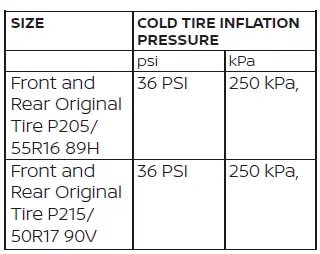
Regularly checking your tire pressure is a fundamental aspect of vehicle maintenance, particularly before embarking on long-distance journeys. You can locate the specific, manufacturer-recommended tire pressure specifications under the "Cold Tire Pressure" section on either the F.M.V.S.S./C.M.V.S.S. certification label or the Tire and Loading Information label, which is conveniently affixed to the center pillar on the driver's side of the Nissan Leaf. Consistent monitoring is essential because:
- All pneumatic tires experience a natural, gradual loss of air pressure over time due to osmosis and environmental factors.
- Tires can suffer from sudden pressure loss if the vehicle impacts deep potholes, sharp objects, or forcefully strikes a curb during parking maneuvers.
For accurate readings, always check tire pressures when the tires are "cold."
A tire is defined as COLD when the vehicle has remained stationary for 3 or more hours, or has been driven for less than 1 mile (1.6 km) at moderate, low-speed intervals, ensuring the tire temperature has not been elevated by friction.
Many Nissan Leaf models feature an enhanced TPMS with an "Easy-Fill Tire Alert" function. This intuitive system provides both audible chirps and visual exterior lighting signals to assist you in inflating your tires precisely to the recommended COLD pressure level at a service station.
Maintaining correct tire pressure is vital; under-inflation can negatively impact tire longevity, reduce energy efficiency, and compromise the precision handling characteristics of your Nissan Leaf.
WARNING
- Improperly inflated tires can suffer structural failure suddenly, which significantly increases the risk of an accident.
- The Gross Vehicle Weight Rating (GVWR) is detailed on the F.M.V.S.S./C.M.V.S.S. certification label, while the specific weight capacity for your vehicle is found on the Tire and Loading Information label. Never exceed these limits. Overloading the Nissan Leaf can lead to premature tire fatigue, dangerous handling dynamics, and potential component failure, all of which substantially increase the likelihood of a serious accident.
- Always utilize a calibrated tire pressure gauge to verify that pressures are exactly at the specified levels before starting a long trip or whenever the vehicle is carrying a heavy passenger or cargo load.
- For more extensive technical details regarding tire care, please consult the "Important Tire Safety Information" (US) or "Tire Safety Information" (Canada) section provided in your official Warranty Information Booklet.
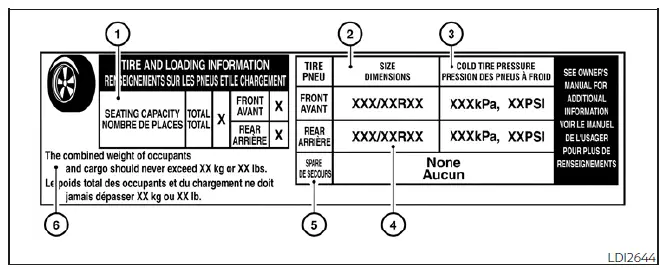
Tire and Loading Information label
- Seating capacity: The absolute maximum number of occupants permitted to be seated in the vehicle according to safety standards.
- Original size: The precise dimensions and specifications of the tires factory-fitted to your Nissan Leaf.
- Cold tire pressure: The required inflation pressure for your tires when they are cold. Tires are officially considered COLD only after the vehicle has been parked for 3 or more hours, or driven for less than 1 mile (1.6 km) at moderate, non-aggressive speeds.
The recommended cold tire inflation pressures for your Nissan Leaf are meticulously engineered by the manufacturer to provide the optimal balance of uniform tire wear, responsive vehicle handling, smooth driveability, and reduced road noise, ensuring safety up to the vehicle's maximum Gross Vehicle Weight Rating (GVWR).
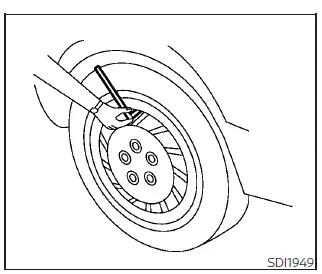
Checking tire pressure
1. Begin by removing the protective valve stem cap from the tire you intend to check.
2. Firmly and squarely press your calibrated pressure gauge onto the valve stem. Avoid applying excessive force or pushing the stem sideways, as this can break the seal and allow air to escape. If you hear a distinct hissing sound during the process, it indicates an improper seal; remove the gauge and reposition it until the leak is eliminated to ensure an accurate reading.
3. Once the reading is captured, remove the gauge from the stem.
4. Observe the pressure measurement on the gauge stem and compare it directly against the factory specifications indicated on the Tire and Loading Information label on your Nissan Leaf.
5. Add compressed air to the tire as needed to reach the target pressure.
If you inadvertently over-inflate the tire, gently depress the center core of the valve stem using the small nub on the back of your pressure gauge to bleed off the excess air. Re-check the pressure and continue adjusting until the reading is perfectly aligned with the manufacturer's recommendations.
6. Securely reinstall the valve stem cap to protect the valve core from dirt, moisture, and debris.
7. Repeat this precise process for all tires, including the spare if your vehicle is so equipped, to ensure balanced performance for your Nissan Leaf.
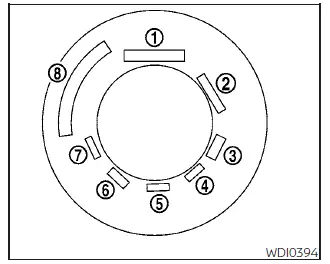
Tire labeling
Example
Federal safety regulations mandate that all tire manufacturers must mold standardized, comprehensive information directly into the sidewall of every tire.
This labeling is essential as it identifies and defines the fundamental physical and performance characteristics of the tire. It also displays the unique Tire Identification Number (TIN) required for safety standard certification, which is vital for identifying your tires in the event of a manufacturer recall.
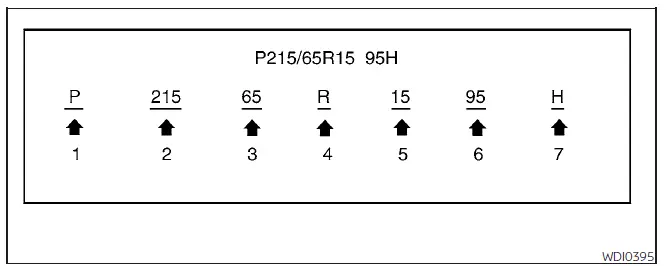
Example
- Tire size (example: P215/65R15 95H)
1. P: The prefix "P" designates that the tire is engineered specifically for passenger vehicle applications (note that not all tires utilize this prefix).
2. Three-digit number (215): This value represents the total cross-sectional width of the tire, measured in millimeters from one sidewall edge to the opposite side.
3. Two-digit number (65): This is the aspect ratio, indicating the relationship between the tire's sidewall height and its total width.
4. R: The "R" serves as the indicator for radial construction, the industry standard for modern vehicles like the Nissan Leaf.
5. Two-digit number (15): This number denotes the required wheel or rim diameter in inches.
6. Two- or three-digit number (95): This signifies the tire’s load index.
This index provides a standardized measurement of the maximum weight capacity each individual tire is certified to support under normal operating conditions.
7. H: This letter represents the tire speed rating. For safety and optimal vehicle stability, never operate your Nissan Leaf at speeds that exceed the limit established by this rating.
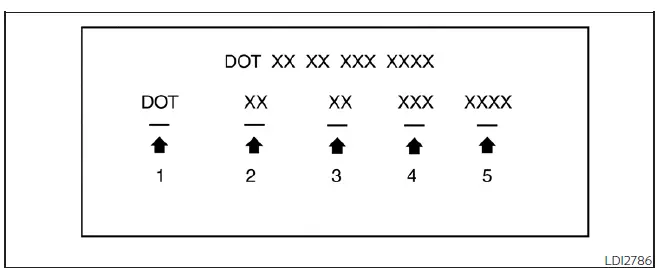
Example (Type A) (if so equipped)
- TIN (Tire Identification Number): A unique code for a new tire (example: DOT XX XX XXX XXXX) used for tracking and safety certification.
1. DOT: An abbreviation for the "Department of Transportation." This mandatory safety symbol may be positioned above, below, or to the left of the Tire Identification Number on the tire sidewall.
2. Two-digit code: Represents the specific identification mark assigned to the tire manufacturer.
3. Two-digit code: An identifier for the specific tire size.
4. Three-digit code: An optional tire type code utilized for internal manufacturing classification.
5. Four-digit sequence: These numbers precisely represent the week and the year the tire was manufactured. For instance, the sequence "3103" indicates the tire was produced during the 31st week of 2003. If you cannot locate this timestamp on the outer sidewall, be sure to inspect the inner sidewall of the tire.
Example (Type B) (if so equipped)
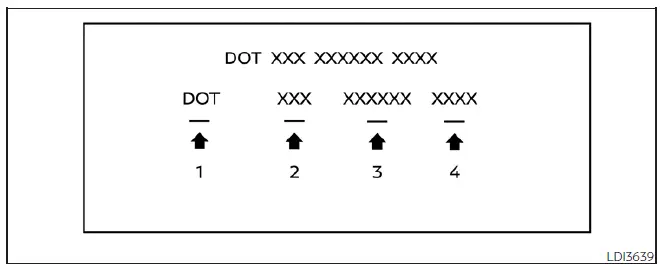
- TIN (Tire Identification Number) for a new tire (example: DOT XXX XXXXXX XXXX)
1. DOT: Abbreviation for the "Department of Transportation." The symbol can be found placed above, below, or to the left or right of the official Tire Identification Number.
2. Three-digit code: The manufacturer's designated identification mark.
3. Six-digit code: A descriptive code utilized to identify significant construction characteristics of the tire.
4. Four-digit sequence: These numbers represent the production week and year. For example, "3103" signifies the 31st week of 2003.
- Tire ply composition and material
This section specifies the number of layers (plies) of rubber-coated fabric used to construct the tire body. Tire manufacturers are legally required to disclose the structural materials used, which commonly include steel, nylon, polyester, and various other reinforced composites necessary for the durability of your Nissan Leaf.
- Maximum permissible inflation pressure
This figure represents the absolute maximum air pressure that the tire is designed to safely contain. It is imperative that you do not exceed this maximum permissible inflation pressure, as doing so can compromise the structural integrity of the tire.
- Maximum load rating
This value indicates the maximum weight, expressed in both kilograms and pounds, that the tire is rated to support. When it comes time to replace the tires on your Nissan Leaf, you must always select replacement tires that meet or exceed the load rating of the factory-installed originals to maintain vehicle safety.
- Terminology: "Tubeless" or "Tube type"
This marking clearly indicates whether the specific tire construction requires an internal rubber tube ("tube type") or if it is designed to hold air independently ("tubeless").
- The word "radial"
The label "radial" appears on the sidewall if the tire is engineered with radial ply structure, which is the industry standard for the Nissan Leaf.
- Manufacturer or brand name
The official manufacturer's name or commercial brand label is clearly molded into the sidewall.
Other Tire-related Terminology
In addition to the standard terminology defined throughout this manual, it is helpful to understand the concept of the "Intended Outboard Sidewall." This refers to: (1) the sidewall that features cosmetic enhancements such as a whitewall, white-lettering, or manufacturer/brand/model name molding that is finished with more depth or height than the opposing sidewall; or (2) the specific outward-facing sidewall of an asymmetrical tire, which has a distinct tread pattern that must always be oriented facing outward when correctly mounted on your Nissan Leaf.
 Wheels and tires
...
 Types of tires
WARNING
When selecting replacement tires for your Nissan Leaf, it is mandatory to ensure all four tires are of the identical type (e.g., Summer, All-Season, or Snow) and construction. A ...
Other materials:
P0710 transmission fluid temperature sensor A
DTC Logic
DTC DETECTION LOGIC
DTC CONFIRMATION PROCEDURE
CAUTION:
Always drive vehicle at a safe speed.
NOTE:
If “DTC CONFIRMATION PROCEDURE� has been previously performed, always turn
ignition switch
OFF and wait at least 10 seconds before performing the next test.
After the repai ...
Precaution
Precautions for Trouble Diagnosis
CAUTION:
• Never apply 7.0 V or more to the measurement terminal.
• Use a tester with open terminal voltage of 7.0 V or less.
• Turn the ignition switch OFF and disconnect the battery cable from the
negative terminal when
checking the harness.
Precauti ...
Tire Pressure Monitoring System (TPMS)
This vehicle is equipped with the Tire Pressure Monitoring System (TPMS). It
monitors tire pressure of all tires except the spare. When the low tire pressure
warning light is lit, and the CHECK TIRE PRES (pressure) warning message is displayed
in the vehicle information display, one or more of ...
