
Nissan Leaf 2018-2025 (ZE1) Owner's Manual : Precautions on charging
WARNING
- If you utilize medical electronic devices, such as an implantable cardiac pacemaker or an implantable cardiovascular defibrillator, please consult with the device manufacturer regarding potential electromagnetic interference. Charging your Nissan Leaf may impact the operation of such medical devices; always confirm safety protocols before initiating the charging process.
- Before beginning, meticulously inspect the charge port, charge connector, and electrical plug. Ensure they are free from water, debris, or foreign materials, and verify there is no evidence of rust or corrosion. Never attempt to charge the Li-ion battery if any of these components appear damaged or compromised, as this significantly increases the risk of a short circuit, electric shock, or fire, which can lead to catastrophic personal injury or death.
- To ensure your safety and avoid potential injury when charging your Nissan Leaf, please observe the following strictly:
- Never touch the metal contact points inside the charge port, on the charge connector, the electrical plug, or the Genuine NISSAN Adapter.
- Avoid contact with the vehicle and the EVSE (Electric Vehicle Supply Equipment) during lightning storms.
- Handle the charging cable with care: do not pull, twist, bend, step on, or drag the cable across rough surfaces.
- Always verify that the charge connector is fully removed from the charge port before attempting to start or move your Nissan Leaf. If the connector is only partially engaged and the latch is not secured, the vehicle may erroneously enter the "READY to drive" state.
- Never handle the electrical plug or the Genuine NISSAN Adapter with wet hands, or if the components themselves are wet. Do not submerge these items in water, other liquids, or snow, as this creates a severe risk of electric shock, which may result in serious injury or fatal consequences.
- Do not attempt to disassemble or modify the vehicle's charge port, the EVSE, or the Genuine NISSAN Adapter. Any unauthorized modification poses a high risk of fire or electric shock.
- Should you detect any unusual odors, observe smoke, or hear abnormal noises originating from the vehicle during the charging process, disconnect the power immediately and cease charging.
- Exercise caution around the traction motor cooling fan; keep your hair, jewelry, loose clothing, and hands well away from the assembly. The fan may engage automatically at any time during the charging cycle.
- Use only Genuine NISSAN parts; do not utilize third-party extension cords or unauthorized adapters.
- The Genuine NISSAN Adapter is designed exclusively for use with the Genuine NISSAN EVSE; do not attempt to use it with any other electronic devices.
- Children must never be left unattended to handle or operate charging equipment.
- Ensure that the EVSE is connected to an outlet and wiring system that has been installed in full compliance with local electrical regulations and safety standards.
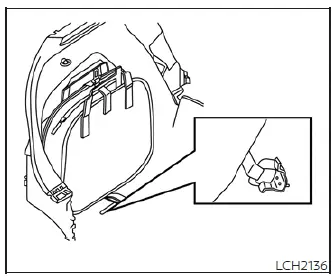
- When storing your EVSE, ensure the lower side belt of the case is passed securely through the designated fastener on the luggage board.
A loose or improperly secured case can become a projectile in the event of a sudden maneuver, potentially causing serious injury or death.
CAUTION
- To preserve the integrity of your charging equipment:
- Never close the exterior charge port lid without first securing the internal charge port cap.
- Protect the charging equipment from physical impacts or heavy drops.
- Avoid storing or utilizing charging hardware in environments where ambient temperatures exceed 185ºF (85ºC).
- Always ensure the charge port cap is securely closed once charging is complete. If the outer lid is shut while the internal cap remains open, environmental elements like moisture or grit may enter and damage the port.
- Do not perform charging while a full-body vehicle cover is installed, as this may place undue strain on and damage the charge connector.
- Never attempt a jump-start of the 12-volt auxiliary battery while the vehicle is simultaneously charging its main Li-ion battery, as this can result in severe damage to the vehicle's electrical system and potential personal injury.
- For standard AC charging (220–240 volt) and trickle charging (110–120 volt) using the supplied EVSE, NISSAN strongly recommends the use of a dedicated electrical circuit—50A for 220–240V, and 15A for 110–120V. Using a dedicated circuit prevents damage to your home wiring and stops household breakers from tripping due to the high power demand of the Nissan Leaf. Sharing a circuit may cause interference with other sensitive household appliances, such as televisions or audio equipment, and increases the likelihood of a tripped breaker. We advise having a qualified electrician verify or install a dedicated circuit to ensure the safest and most reliable charging experience.
NOTE:
- To successfully initiate the charging process for your Nissan Leaf, ensure the power switch is set to the OFF position. If the power switch remains in the ON position, the vehicle's electrical system will inhibit the charging sequence to ensure optimal safety.
- As a safety precaution, if the charge connector is inserted while the power switch is in the "READY to drive" position, the vehicle will automatically shift the power mode to ON. Since charging cannot proceed in this state, you must manually return the power switch to the OFF position to allow the Li-ion battery to begin receiving a charge.
- Please be aware that when ambient temperatures drop to 32ºF (0ºC) or below, the charging process for your Nissan Leaf may take significantly longer than under temperate conditions. Furthermore, the overall charge capacity achieved may be slightly reduced compared to charging in warmer weather.
- Avoid repetitive operation of the charging timer while the charge connector is engaged after a full charge cycle has concluded. Frequent triggering of the timer when the battery is already full can place an unnecessary load on the system and potentially drain the 12-volt auxiliary battery. For further configuration details, please refer to the "Charging timer" section. Should you find that the Li-ion battery has depleted, we recommend recharging the vehicle immediately to maintain battery health.
- While it is possible to set the power switch to the ON position to utilize climate control or the navigation system (on equipped models) during a charge cycle, please note that these systems draw power directly from the battery. Operating these features while charging will increase the total time required to reach a full state of charge. To minimize your wait time, we advise keeping the power switch in the OFF position whenever possible.
- In the event of an unexpected interruption to your home electrical supply, the Nissan Leaf is designed to automatically resume the charging process as soon as power is successfully restored.
- For models equipped with a Navigation System, we recommend keeping the charge cable connected whenever you utilize remote climate control operation. This allows the system to draw power directly from the grid to heat or cool the cabin, preserving your Li-ion battery's state of charge for your upcoming trip.
- If you find that the charge port on your Nissan Leaf has become frozen, gently thaw the area using a hair dryer. Once all ice has been safely melted, you may proceed with connecting the charge cable. Never force the connector into a frozen port, as doing so risks causing mechanical damage or electrical failure.
- Should you discover foreign debris inside the charge port or on the connector that prevents a clean connection, please do not attempt to force the two components together. Forcing the connection may damage your charging equipment and the vehicle's port. We highly recommend visiting a NISSAN certified LEAF dealer to have the area professionally cleaned and inspected.
- The charge port of the Nissan Leaf is engineered with a dedicated drainage hole to prevent water accumulation. If you notice that this hole is obstructed or if standing water is trapped within the port, refrain from charging the vehicle. In such cases, contact a NISSAN certified LEAF dealer for an expert assessment and to clear the blockage safely.
 Charging
...
 Types of charge and how to charge the Li-ion battery
*1: V2X (Vehicle to everything); The EV supplies electric power to a home or a building, etc. (e.g., Vehicle to Home (V2H), Vehicle to Building (V2B), Vehic ...
Other materials:
Precaution for Supplemental Restraint System (SRS) "AIR BAG" and "SEAT BELT
PRE-TENSIONER"
The Supplemental Restraint System such as “AIR BAG� and “SEAT BELT PRE-TENSIONER�,
used along
with a front seat belt, helps to reduce the risk or severity of injury to the
driver and front passenger for certain
types of collision. Information necessary to service the system safely is
...
Operation inspection
Work Procedure
The purpose of the operational check is to check that the individual system
operates normally.
Check condition : Engine running at normal operating temperature.
1.CHECK MEMORY FUNCTION
1. Set temperature to 30°C by operating the temperature control dial.
2. Press OFF switch.
...
Combination switch
Exploded View
1. Combination switch
2. Combination switch connector
Removal and Installation
REMOVAL
1. Remove steering column cover. Refer to IP-13, "Removal and
Installation".
2. Remove screws.
3. Disconnect the connector.
4. Pull up the combination switch to remove it.
I ...
