
Nissan Juke Service and Repair Manual : Engine stand setting
Setting
NOTE
:
Explained here is how to disassemble with engine stand supporting transaxle
surface. When using different
type of engine stand, note with difference in steps and etc.
1. Remove the engine and the transaxle assembly from the vehicle, and separate the transaxle from the engine.
2. Install engine to engine stand with the following procedure: a. Remove flywheel (M/T models) or drive plate (CVT models).
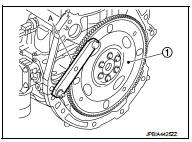
• Secure flywheel (M/T models) or drive plate (CVT models) (1) with a stopper plate [SST: KV11105210 (J-44716)] (A), and remove mounting bolts.
CAUTION:
• Never disassemble them.
• Never place them with signal plate facing down.
• When handling signal plate, take care not to damage or scratch them.
• Handle signal plate in a manner that prevents them from becoming magnetized.
NOTE
:
This figure shows CVT models as an example.
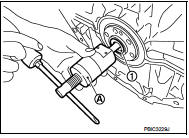
b. Remove pilot converter (1) using pilot bushing puller [SST: ST16610001 (J-23907)] (A) or suitable tool. (CVT models) NOTE
:
M/T models have no pilot bushing.
c. Lift the engine with a hoist to install it onto widely use engine stand.
CAUTION:
• Use the engine stand that has a load capacity [approximately 135 kg (298 lb)
or more] large
enough for supporting the engine weight.
• If the load capacity of stand is not adequate, remove the following parts beforehand to reduce the potential risk of overturning stand.
- Intake manifold: Refer to EM-28, "Exploded View".
- catalyst convertor: Refer to EM-33, "2WD : Exploded View" (2WD models) or EM-34, "4WD : Exploded View" (4WD models).
- Rocker cover: Refer to EM-53, "Exploded View".
NOTE:
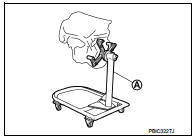
The figure shows an example of widely used engine stand (A) that can support mating surface of transaxle with flywheel (M/T models) or drive plate (CVT models) removed.
CAUTION:
Before removing the hanging chains, check the engine
stand is stable and there is no risk of overturning.
3. Drain engine oil. Refer to LU-9, "Draining".
CAUTION:
Be sure to clean drain plug and install with new drain plug washer.
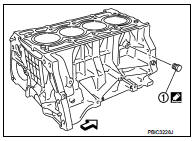
4. Drain engine coolant by removing water drain plug (1) from inside of the engine.
 : Engine front
Tightening torque : Refer to EM-104, "Disassembly and Assembly".
Use Genuine Liquid Gasket or equivalent.

 Engine unit
Disassembly
1. Remove intake manifold. Refer to EM-28, "Exploded View".
2. Remove catalyst convertor. Refer to EM-33, "2WD : Exploded View" (2WD models)
or EM-34, "4WD :
...
Other materials:
Periodic maintenance
IDLE SPEED
Inspection
1.CHECK IDLE SPEED
With CONSULT-III
Check idle speed in “DATA MONITOR� mode with CONSULT-III.
With GST
Check idle speed with Service $01 of GST.
Without CONSULT-III
Check idle speed by installing the pulse type tachometer clamp on the loop
wire or on suitable ...
Insufficient heating
Description
Symptom
• Insufficient heating
• No warm air comes out. (Air flow volume is normal.)
Diagnosis Procedure
NOTE:
Perform self-diagnoses with CONSULT-III before performing symptom diagnosis. If
any DTC is detected, perform
the corresponding diagnosis.
1.CHECK COOLING SYSTEM
...
Vehicle jerks during
Description
The vehicle jerks when ESP function, TCS function, ABS function, EBD function
or brake limited slip differential
(BLSD) function operates.
Diagnosis Procedure
1.CHECK SYMPTOM
Check that the vehicle jerks when ESP function, TCS function, ABS function,
EBD function or brake limite ...
