
Nissan Leaf 2018-2025 (ZE1) Owner's Manual : Rear hatch
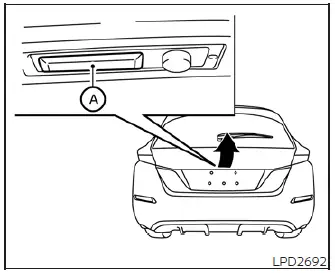
To access the cargo area and open the rear hatch, unlock the centralized locking system and firmly push the electronic rear hatch opener switch A situated under the molded handle lip. Pull up smoothly on the rear hatch assembly to raise it to its fully extended overhead position.
The rear hatch assembly can be successfully unlocked by utilizing any of the following methods:
- Pushing the master power door lock switch located on the interior driver's door trim panel to the global unlock position.
- Pushing the exterior rubberized rear hatch request switch while carrying the transponder key within close proximity.
- Pressing and holding the dedicated
 button on your registered Intelligent Key.
WARNING
- Always make sure that the rear hatch has been closed securely and latched tightly to prevent it from swinging open unexpectedly while driving.
- Do not operate or drive the vehicle with the rear hatch open, as this can allow dangerous exhaust turbulence or ambient debris to enter the passenger cabin and compromises structural safety.
- Make sure that all passengers have completely cleared their hands, fingers, and clothing inside the vehicle frame before firmly closing the rear hatch panel.
Secondary rear hatch release
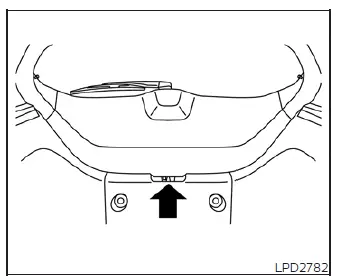
Follow the following technical override steps to manually unlock and release the rear hatch mechanism from inside the cargo area in the event that the 12-volt vehicle battery is completely discharged or disconnected.
NOTE:
Should your vehicle experience a complete loss of auxiliary power, it is strongly recommended that you visit a NISSAN certified LEAF dealer as soon as possible for a professional inspection of your electrical system.
Unlocking the rear hatch:
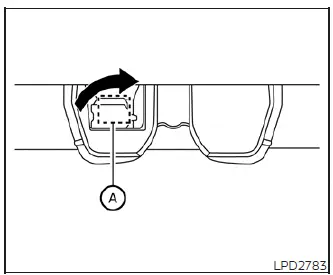
1. Carefully remove the protective access cover A from the interior lower tailgate trim by gently prying it free with a flat-head screwdriver or a similar rigid tool available on hand.
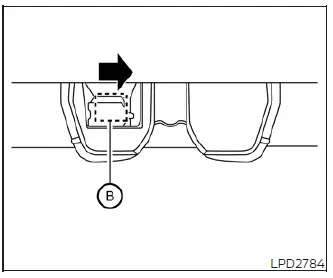
2. Insert your tool directly into the exposed opening and slide the mechanical inside lever B firmly in the direction of release using a screwdriver or similar tool available on hand. The latch will disengage, and the rear hatch will open outward.
 Hood
Hood
Before attempting to unlatch the front compartment, ensure that you securely close the outer charge port lid and disconnect any charging cables.
Firmly pull th ...
 Charge port lid
...
Other materials:
Front power seat adjustment (if so equipped for driver's seat)
Operating tips
The power seat motor in your Nissan Leaf is engineered with an auto-reset overload protection circuit. If the motor ceases operation during an adjustment, simply wait approximately 30 seconds for the system to reset, and then you may reactivate the ...
Push-button ignition switch illumination circuit
Description
Provides the power supply and the ground to control the push-button ignition
switch illumination.
Component Function Check
1.CHECK PUSH-BUTTON IGNITION SWITCH ILLUMINATION OPERATION
CONSULT-III ACTIVE TEST
1. Turn the ignition switch ON.
2. Select “ENGINE SW ILLUMI� of BCM (I ...
Front seat (2WD)
Exploded View
DRIVER SEAT
LHD models
1. Headrest
2. Headrest holder (locked)
3. Headrest holder (free)
4. Seatback heater unit
5. Inner lower cover
6. Seatback trim
7. Seatback pad
8. Seat cushion inner finisher
9. Reclining device inner cover
10. Anchor bolt
11. Seat belt buck ...
