
Nissan Juke Service and Repair Manual : Oil cooler
Exploded View
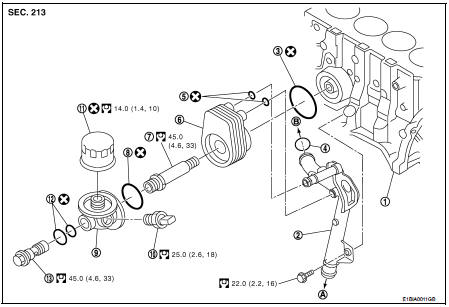
1. Cylinder block
2. Water pipe
3. O-ring
4. O-ring
5. O-ring
6. Oil cooler
7. Connecting stud
8. O-ring
9. Oil filter bracket
10. Oil pressure switch
11. Oil filter
12. O-ring
13. Connecting bolt
A. : To radiator lower hose B. : To water pump
 : N·m (kg-m, ft-lb)
 : Always replace after every
disassembly.
CAUTION:
• Be careful not to get burned when the engine and engine oil are hot.
• When removing, prepare a shop cloth to absorb any oil leakage or spillage.
• Completely wipe off any oil that abhere to the engine and the vehicle.
Removal and Installation
REMOVAL
1. Drain engine coolant. Refer to CO-62, "Draining".
CAUTION:
Perform when engine is cold.
2. Remove oil filter and oil filter bracket. Refer to LU-35, "Exploded View".
3. Remove alternator.
4. Remove oil cooler.
INSTALLATION
Installation is in reverse order of removal.
• Replace the O-ring (A) of the oil cooler, positioning the lip (B) of the seal behind the lug (C) of the oil cooler.
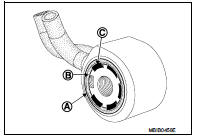
• Confirm that no foreign objects are adhering to the installation planes of the oil cooler and block.
Inspection
Oil Cooler
Check oil cooler for cracks and clogging by blowing through coolant inlet. If
necessary, replace oil cooler
assembly.
 Oil pump
Exploded View
1. Oil pump drive chain
2. Crankshaft sprocket
3. Oil pump assembly
Removal and Installation
REMOVAL
1. Disconnect the battery cable from the negative terminal.
2. Remove eng ...
 Service data and specifications
(SDS)
Service data and specifications
(SDS)
Standard and Limit
OIL PRESSURE
OIL CAPACITY (APPROXIMATE)
TIGHTENING TORQUE
...
Other materials:
Oil pan
Exploded View
1. Transaxle assembly
2. Oil pan gasket
3. Magnet
4. Oil pan
5. Overflow tube
6. Drain plug gasket
7. Drain plug
8. Oil pan fitting bolt
: Always replace after every
disassembly.
: N·m (kg-m, ft-lb)
: N·m (kg-m, it-lb)
Removal and Installation
REMOVAL
1. Remove ...
Rear door lock
Exploded View
1. Outside handle assembly
2. Rear door sealing screen
3. Door lock assembly
4. TORX bolt
5. Inside handle
: Clip
: Pawl
: Vehicle front
: Do not reuse
: N·m (kg-m, in-lb)
: Body grease
Door lock
DOOR LOCK : Removal and Installation
REMOVAL
1. Remove rear door glas ...
P2080 EGT sensor 1
DTC Logic
DTC DETECTION LOGIC
Diagnosis Procedure
1.CHECK GROUND CONNECTIONS
1. Turn ignition switch OFF.
2. Check ground connection E38. Refer to Ground inspection in GI-44, "Circuit
Inspection".
Is the inspection result normal?
YES >> GO TO 2.
NO >> Repair or ...
