
Nissan Leaf 2018-2025 (ZE1) Owner's Manual : High voltage precautions
High-voltage components
WARNING
- The advanced electric vehicle (EV) system in your Nissan Leaf operates using high-voltage electricity, reaching levels up to approximately 400 volts DC. Please be aware that these internal components can remain extremely hot during operation, immediately after starting, and even after the vehicle has been powered down. Exercise extreme caution around both the high-voltage electrical systems and high-temperature components to prevent accidental injury.
Always pay close attention to all safety warning labels permanently affixed to the vehicle, as they provide critical information regarding high-voltage hazards.
- Under no circumstances should you attempt to disassemble, remove, or replace any high-voltage components, cables, or their specific connectors. Unauthorized interference with these parts can result in catastrophic electrical shock or severe thermal burns, posing a significant risk of grave injury or fatality. For your safety, high-voltage cables are distinctly colored orange to alert you to their nature. The high-voltage infrastructure of the Nissan Leaf contains no user-serviceable parts; for any maintenance, inspection, or repairs, it is strictly recommended that you rely exclusively on a NISSAN certified LEAF dealer.
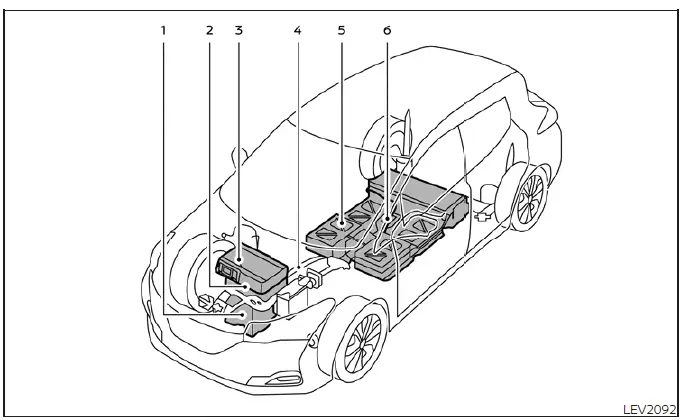
- Traction motor and reduction gear
- Traction motor inverter
- Power delivery module (PDM) (incorporating the onboard charger, DC/DC converter, and junction box)
- High-voltage wire harnesses (identifiable by their distinct orange insulation)
- Li-ion battery pack
- Service plug
 Li-ion battery warmer
For models equipped with a 40 kWh battery
CAUTION
The Li-ion battery warmer system is designed to maintain optimal battery health; however, it will not operate if the available battery charg ...
 Road accident precautions
WARNING
In the event of a vehicular collision, please follow these safety protocols:
If your Nissan Leaf remains drivable, maneuver the vehicle to a secure location away from activ ...
Other materials:
Thermo control amplifier
Component Function Check
1.CHECK A/C ON SIGNAL
With CONSULT-III
1. Turn ignition switch ON.
2. Select “AIR CONDITIONER� of “BCM� using CONSULT-III.
3. Select “THERMO AMP� in “DATA MONITOR� mode, and check status under the
following condition.
Is the inspection result normal ...
Precaution for Brake System
WARNING:
Clean any dust from the front brake and rear brake using a vacuum dust
collector. Never blow by compressed
air.
• Brake fluid use refer to MA-13, "Fluids and Lubricants".
• Never reuse drained brake fluid.
• Never spill or splash brake fluid on painted surfaces. Brake ...
Inside mirror
Exploded View
Manual anti-dazzling type
1. Windshield glass
2. Mirror base
3. Inside mirror assembly
: Do not reuse
Auto anti-dazzling type
1. Rain sensor bracket
2. Mirror base
3. Rain sensor
4. Inside mirror assembly
: Pawl
: Do not reuse
Removal and Installation
CAUTION:
Ne ...
