
Nissan Juke Service and Repair Manual : Front disc brake
Brake pad : Inspection and Adjustment
INSPECTION
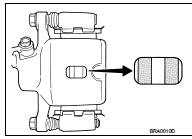
Check brake pad wear thickness from an inspection hole on cylinder body. Check using a scale if necessary.Wear thickness : Refer to BR-137, "Front Disc Brake".
ADJUSTMENT
Burnish contact surfaces between disc rotor and brake pads according to the following procedure after refinishing or replacing brake pads, or if a soft pedal occurs at very low mileage.
CAUTION:
• Be careful of vehicle speed because the brake does not operate firmly/securely
until pads and disc
rotor are securely fitted.
• Only perform this procedure under safe road and traffic conditions. Use extreme caution
.
1. Drive vehicle on straight, flat road.
2. Depress brake pedal with the power to stop vehicle within 3 to 5 seconds until the vehicle stops.
3. Drive without depressing brake for a few minutes to cool the brake.
4. Repeat steps 1 to 3 until pad and disc rotor are securely fitted.
Disc rotor : Inspection and Adjustment
INSPECTION
Appearance
Check surface of disc rotor for uneven wear, cracks, and serious damage. Replace
it if necessary.
• MR16DDT: Refer to FAX-11, "Removal and Installation".
• HR16DE: Refer to FAX-43, "Removal and Installation".
• K9K: Refer to FAX-68, "Removal and Installation".
Runout
1. Fix the disc rotor to the wheel hub and bearing assembly with
wheel nuts (2 points at least).
2. Check the wheel bearing axial end play before the inspection.
• MR16DDT: Refer to FAX-9, "Inspection".
• HR16DE: Refer to FAX-41, "Inspection".
• K9K: Refer to FAX-66, "Inspection".
3. Inspect the runout with a dial indicator to measure at 10 mm (0.39 in) inside the disc edge.
Runout (with it attached to the vehicle) : Refer to BR-137, "Front Disc Brake".
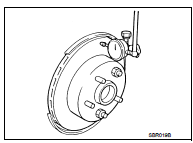
4. Find the installation position that has a minimum runout by shifting the disc rotor-to-wheel hub and bearing assembly installation position by one hole at a time if the runout exceeds the limit value.
• Refinish the disc rotor if the runout is outside the limit even after performing the above operation.
CAUTION
:
• Check in advance that the thickness of the disc rotor is wear thickness + 0.3
mm (0.012 in) or more.
• If the thickness is less than wear thickness + 0.3 mm (0.012 in), replace the disc rotor.
- MR16DDT: Refer to FAX-11, "Removal and Installation".
- HR16DE: Refer to FAX-43, "Removal and Installation".
- K9K: Refer to FAX-68, "Removal and Installation".
Wear thickness : Refer to BR-137, "Front Disc Brake".
Thickness
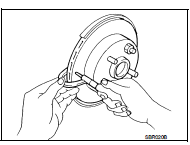
Check the thickness of the disc rotor using a micrometer. Replace
the disc rotor if the thickness is below the wear limit.
• MR16DDT: Refer to FAX-11, "Removal and Installation".
• HR16DE: Refer to FAX-43, "Removal and Installation".
• K9K: Refer to FAX-68, "Removal and Installation".
Wear thickness : Refer to BR-137, "Front Disc Brake".
ADJUSTMENT
Burnish contact surfaces between disc rotors and brake pads according to the following procedure after refinishing or replacing disc rotor, or if a soft pedal occurs at very low mileage.
CAUTION:
• Be careful of vehicle speed because the brake does not operate firmly/securely
until pad and disc
rotor are securely fitted.
• Only perform this procedure under safe road and traffic conditions. Use extreme caution.
1. Drive vehicle on straight, flat road.
2. Depress brake pedal with the power to stop vehicle within 3 to 5 seconds until the vehicle stops.
3. Drive without depressing brake for a few minutes to cool the brake.
4. Repeat steps 1 to 3 until pad and disc rotor are securely fitted.
 Brake booster
Inspection
OPERATION
Depress the brake pedal several times at 5-second intervals with the engine
stopped. Start the engine with the
brake pedal fully depressed. Check that the clearance between b ...
 Rear disc brake
Brake pad : Inspection and Adj
INSPECTION
Check brake pad wear thickness from an inspection hole on cylinder
body. Check using a scale if necessary.
Wear thickness : Refer to BR-137, "Rear Di ...
Other materials:
ECO Mode
The ECO mode is a specialized driving setting designed to optimize your energy consumption. By smoothing out throttle response—effectively reducing acceleration compared to the same accelerator pedal input in the standard D (Drive) position—this mode helps you extract the m ...
Front wheel hub and knuckle
Exploded View
1. Steering knuckle
2. Splash guard
3. Hub bolt
4. Wheel hub assembly (Bearing-integrated
type)
5. Disc rotor
6. Wheel hub lock nut
7. Adjusting cap
8. Cotter pin
A. Tightening must be done following the installation procedure. Refer to
FAX-43, "Removal and Insta ...
ANTI-HIJACK function does not operate
Diagnosis Procedure
1.CHECK “DOOR LOCK–UNLOCK SET� SETTING IN “WORK SUPPORT�
1. Select “DOOR LOCK� of “BCM� using CONSULT-III.
2. Select “DOOR LOCK-UNLOCK SET� in “WORK SUPPORT� mode.
3. Check “DOOR LOCK-UNLOCK SET� in “WORK SUPPORT�
Refer to DLK-371, "DOO ...
