
Nissan Juke Service and Repair Manual : Engine oil
Inspection
OIL LEVEL AND MUDDINESS
• Before starting the engine, check the oil level placing vehicle horizontally.
If the engine is already started, stop it and allow 10 minutes before checking.
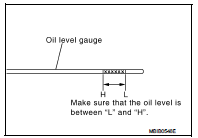
• Make sure the oil level is within the range shown in the figure.
• If it is out of range, adjust it.
ENGINE OIL APPEARANCE
• Check engine oil for white turbidity or heavy contamination.
• If engine oil becomes turbid and white, it is highly probable that it is contaminated with engine coolant.
Repair or replace damaged parts.
OIL LEAKAGE
Check for oil leakage around the following area.
• Oil pan
• Oil pan drain plug
• Oil pressure switch
• Oil filter bracket
• Vacuum pump
• Oil pump housing
• Mating surface between cylinder block and cylinder head
• Mating surface between cylinder head and rocker cover
• Oil cooler
• Crankshaft oil seals
OIL PRESSURE CHECK
WARNING:
• Be careful not to burn yourself, as the engine oil is hot.
• Oil pressure check should be done in Neutral “N� position.
1. Check the oil level. Refer to “OIL LEVEL MUDDINES“.
2. Remove engine undercover.
3. Disconnect harness connector at oil pressure switch (1), and remove oil pressure switch using a deep socket (commercial service tool).
2 : Oil pan : Vehicle front
CAUTION:
Never drop or shock oil pressure switch.
![4. Install oil pressure gauge [SST:KV113E0020 (Mot. 836-05)]](images/books/335/8/index.81.jpg)
4. Install oil pressure gauge [SST:KV113E0020 (Mot. 836-05)] 5. After warming up the engine, make sure oil pressure corresponding to the engine speed is produced.
Engine oil pressure : Refer to LU-39, "Standard and Limit".
6. After checking, install the oil pressure switch as follows.
a. Remove old liquid gasket adhering to the switch and engine.
b. Apply liquid gasket and tighten oil pressure switch to specification.
Use Genuine Liquid Gasket or equivalent.
Tightening torque : Refer to LU-35, "Exploded View".
7. Start engine and check for oil leakage.
Draining
WARNING:
• Be careful not to get burned, as engine oil may be hot.
• Prolonged and repeated contact with used engine oil may cause skin cancer. Try to avoid direct skin contact with used engine oil. If skin contact is made, wash thoroughly with soap or hand cleaner as soon as possible.
1. Warm up the engine, and check for engine oil leakage from engine components. Refer to LU-25, "Inspection".
2. Stop the engine and wait for 10 minutes.
3. Loosen oil filler cap.
4. Remove drain plug and then drain engine oil.
Refilling
1. Refill with new engine oil.
Engine oil specification and viscosity: Refer to MA-13, "Fluids and Lubricants".
Engine oil capacity : Refer to LU-39, "Standard and Limit".
CAUTION:
• The refill capacity depends on the engine oil temperature and drain time. Use
these specifications
for reference only.
• Always use oil level gauge to determine the proper amount of engine oil in the engine.
2. Warm up engine and check area around drain plug and oil filter for engine oil leakage.
3. Stop engine and wait for 10 minutes.
4. Check the engine oil level. Refer to LU-33, "Inspection".

 Oil filter
Exploded View
1. O-ring
2. Oil filter bracket
3. Oil pressure switch
4. Oil filter
5. O-ring
6. Connecting bolt
A. To oil cooler
: N·m (kg-m, ft-lb)
: Always replace after every
disa ...
Other materials:
P0651 sensor power supply
DTC Logic
DTC DETECTION LOGIC
Diagnosis Procedure
1.CHECK GROUND CONNECTION
1. Turn ignition switch OFF.
2. Check ground connection E38. Refer to Ground Inspection in GI-44, "Circuit
Inspection".
Is the inspection result normal?
YES >> GO TO 2.
NO >> Repair or r ...
Floor trim
Exploded View
LHD models
1. Floor carpet
2. Carpet hook
3. Trim clip
4. Column hole cover
5. Harness clip
6. Front floor spacer RH
7. Front floor spacer LH
8. Rear floor spacer LH
9. Rear floor spacer RH
: Clip
: Pawl
Removal and Installation
REMOVAL
CAUTION:
• When removi ...
Front door
Exploded View
1. Front door panel
2. Grommet
3. Door hinge (upper)
4. Door hinge (lower)
5. Door check link
6. Bumper rubber
7. Door pad
8. Door striker
9. TORX bolt
10. Grommet
: Do not reuse
: N·m (kg-m, in-lb)
: N·m (kg-m, ft-lb)
: Body grease
Door assembly
DOOR ASSEMBLY ...
