
Nissan Leaf 2018-2025 (ZE1) Owner's Manual : Changing wheels and tires
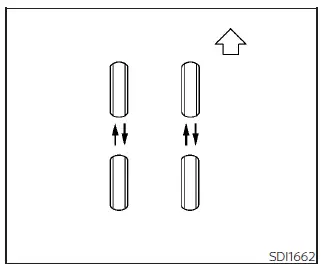
Tire rotation
To ensure even tread wear and extend the lifespan of your tires, NISSAN strongly recommends rotating the tires on your Nissan Leaf every 7,500 miles (12,000 km).
As soon as possible after any wheel removal, tighten the wheel nuts to the factory-specified torque using a calibrated torque wrench.
Wheel nut tightening torque: 90 ft-lb (122 N-m)
The wheel nuts must be maintained at this specified torque at all times. It is best practice to have the wheel nuts checked and tightened to these specifications during every scheduled tire rotation interval.
WARNING
- Immediately following any tire rotation, you must check and adjust the tire pressure to the recommended levels.
- Wheel nuts should be re-torqued after the vehicle has been driven for 600 miles (1,000 km) following any service, including after addressing a flat tire.
- For more extensive details regarding tire maintenance, please refer to the "Important Tire Safety Information" (US) or "Tire Safety Information" (Canada) section found in your Warranty Information Booklet.
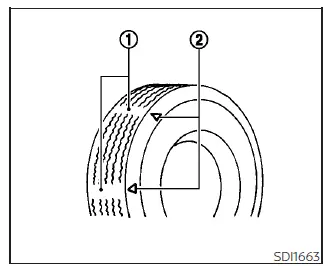
Tire wear and damage
- Wear indicator
- Wear indicator location mark
WARNING
- Periodically inspect your tires for signs of uneven wear, surface cracking, bulges, or embedded objects. If you detect excessive wear, cracks, sidewall bulging, or deep tread cuts, the tire(s) must be replaced immediately.
- Original equipment tires are manufactured with built-in tread wear indicators. When these indicators become flush with the tread surface, the tire has reached its service limit and must be replaced.
- Tires naturally degrade over time, even with minimal usage. Tires older than 6 years should be professionally inspected by a qualified technician, as structural damage may not be visible to the naked eye. Replace older tires as necessary to prevent sudden tire failure and ensure your safety.
- For further guidance on tire health, refer to the "Important Tire Safety Information" (US) or "Tire Safety Information" (Canada) provided in your Warranty Information Booklet.
Replacing wheels and tires
When selecting replacement tires for your Nissan Leaf, you must use the same size, tread design, speed rating, and load-carrying capacity as the tires originally installed at the factory. Please see the "Wheels and tires" section for detailed information on recommended tire and wheel specifications.
WARNING
- The use of non-recommended tires, or mixing different brands, construction types (e.g., mixing bias-belted and radial), or incompatible tread patterns can severely compromise your Nissan Leaf. This may adversely affect vehicle stability, braking, handling, the Vehicle Dynamic Control (VDC) system, ground clearance, tire-to-body clearance, tire chain compatibility, speedometer accuracy, headlight alignment, and bumper height, significantly increasing the risk of an accident.
- If you are only replacing two tires, install the new tires on the rear axle. Placing new tires on the front axle can lead to a loss of vehicle control in certain driving conditions.
- If you replace wheels for any reason, they must match the original off-set dimension of your Nissan Leaf.
Using wheels with a different off-set can cause accelerated tire wear, degrade handling, interfere with the VDC system, and create dangerous contact with the brake discs.
Such mechanical interference can lead to reduced braking performance and premature wear of brake components. Always consult the "Wheels and tires" section for correct off-set dimensions.
- When using a wheel without a TPMS sensor (e.g., a temporary spare), the TPMS will not function. The low tire pressure warning light will flash for approximately 1 minute and then remain illuminated. It is recommended to visit a NISSAN certified LEAF dealer to address this.
- Replacing tires with specifications not originally set by NISSAN can cause the TPMS to malfunction.
- TPMS sensors are delicate and can be damaged by improper handling; exercise extreme caution during tire service.
- When replacing a TPMS sensor, a new ID registration is often required.
We recommend visiting a NISSAN certified LEAF dealer for professional ID registration.
- Only use NISSAN-specified valve stem caps, as others may seize and become stuck.
- Ensure valve stem caps are always securely fitted to prevent dirt and debris from clogging the valve, which can lead to malfunctions or air pressure loss.
- Never install a wheel or tire that shows signs of structural damage or deformation, even if it appears to have been repaired.
- The use of retreaded tires is not recommended for your Nissan Leaf.
- For more information, refer to "Important Tire Safety Information" (US) or "Tire Safety Information" (Canada) in your Warranty Information Booklet.
Wheel balance
Improperly balanced wheels can negatively affect vehicle handling and significantly reduce tire longevity. Because wheels can fall out of balance through normal daily operation, they should be professionally balanced whenever a vibration is detected or tires are serviced.
Wheel balance service must be performed with the wheels removed from the Nissan Leaf.
Spin-balancing wheels while they are still mounted on the vehicle can cause significant mechanical damage to the drivetrain.
For additional information regarding tires, refer to "Important Tire Safety Information" (US) or "Tire Safety Information" (Canada) in the Warranty Information Booklet.
Emergency tire puncture repair kit
Your Nissan Leaf is supplied with an emergency tire puncture repair kit (Emergency Tire Sealant) instead of a traditional spare tire. This kit is designed to provide a temporary, emergency repair for minor punctures.
If possible, have the vehicle professionally towed to a service facility to have the tire permanently repaired or replaced. Be advised that using the emergency tire sealant can sometimes cause a malfunction of the tire pressure sensor, which may result in the low tire pressure warning light remaining illuminated.
 Types of tires
WARNING
When selecting replacement tires for your Nissan Leaf, it is mandatory to ensure all four tires are of the identical type (e.g., Summer, All-Season, or Snow) and construction. A ...

Other materials:
P range interlock door lock/unlock function does not operate
Diagnosis Procedure
1.CHECK “AUTOMATIC LOCK/UNLOCK SELECT� SETTING IN “WORK SUPPORT�
1. Select “DOOR LOCK� of “BCM� using CONSULT-III.
2. Select “AUTOMATIC LOCK/UNLOCK SELECT� in “WORK SUPPORT� mode.
3. Check “AUTOMATIC LOCK/UNLOCK SELECT� setting in “WORK SUPPORT†...
Vehicle-to-vehicle distance control mode limitations
WARNING
Below are the critical operational limitations for the Intelligent Cruise Control (ICC) system in your Nissan Leaf. Operating the vehicle without strict adherence to these guidelines could result in a loss of control, leading to serious injury or death.
The ICC system is ...
How to select piston and bearing
Description
• The identification grade stamped on each part is the grade for the
dimension measured in new condition. This grade cannot apply to reused parts.
• For reused or repaired parts, measure the dimension accurately. Determine the
grade by comparing the
measurement with the valu ...
